Linden Lab Announces Major Changes in Sansar Staffing and Direction: Is This a Platform Pivot Similar to High Fidelity’s?

This was me on Friday…
(Photo by twinsfisch on Unsplash)

Yesterday I was off sick from work, and I landed up spending most of the day resting in bed, popping extra strength Tylenol and nursing a sore shoulder and just generally feeling depressed, tired, and cranky.

I slept most of the day, so I missed the unexpected Product Meetup held on Friday in Sansar (after a previous announcement that there would be no Product Meetup this week, instead of on Thursday when they are usually held). Even worse, Inara Pey missed the last-minute meeting as well; I usually rely on her excellent, detailed reports myself, as I tend not to go to Product Meetups that often.

At Friday’s Product Meetup, several major changes in Sansar staffing and direction were announced. I did watch the livestream video that is posted to Twitch here (warning: the audio is still a bit low for my tastes, so you might need to use headphones or earphones to hear it) and here is what I learned:

  • The big news is that Sansar will now be focused primarily on live events. Galileo said Linden Lab will be bringing in some new event partners, as well as encouraging Sansarians to create more live events. They also announced a second focus, on in-world socialization and communication tools, but there were no technical details given.
  • It would appear that avatar body deformation, which according to a message I received from Landon McDowell back in September, Linden Lab was “working to get body morph in before the end of the year“, has been taken off the Sansar development roadmap. It would appear that any further avatar customization features have been pushed back indefinitely or even halted. Landon McDowell is (was?) the Chief Product Officer at Linden Lab. I say was, because it is clear (both from announcements at the Friday meeting and gossip I am hearing today) that there has been a major staff shake-up on the Sansar project.
  • While Galileo said that Linden Lab couldn’t comment on specific staff changes, a few were announced or mentioned in passing at the meeting. Lacie Linden said she is now responsible for responding to support tickets in addition to her other duties. Galileo said that Harley Linden has been reassigned to Second Life. Other staff changes announced at the Friday meeting: CowboyNinja Linden (someone new to me) is apparently the new General Manager for Sansar; Sheri Bryant, previously Vice President of Marketing, is now also a General Manager of Sansar (two General Managers? I’m confused); Hari Raghavan, previously the Senior Manager, Marketing Communication at Linden Lab, is the new Director of Marketing.

Coho Linden, the Release Manager for Sansar, reported on what will be in the next release of Sansar (hopefully next week):

  • Desktop user aiming improvements
  • Support for the pre-morph skeletons (not sure what this means)
  • Improved freecam edit mode in the Lookbook editor mode
  • Scripting of avatar spawn points
  • Scripting of camera view
  • Snap-to-grid for movement and rotation of objects
  • Import JPEG files and remove the limitations on texture dimensions
  • Establish an avatar texture budget which would allow for more avatars to be in a scene, and improve Sansar performance for users on lower-end computers
  • Allow users to abandon in-progress quests

Binah Linden announced a few changes to the in-client shopping experience:

  • The Sansar Store is now a movable, resizable window
  • New searching filters: male, female, Marvelous Designer, static mesh
  • Can now copy and share store links in chat
  • New script to add an interaction to an object that will open your store

Boden Linden announced a major change to events: events will be linked to a currently published world, instead of a template. Also, notifications that an event is starting will be sent out in-world to those users who indicated that they were interested in the event.

Skyler Linden, the Engineering Manager at Linden Lab, announced that persistent storage is coming. New scripting abilities will allow you to save data and keep track of persistent data. Data can also be shared using tables.

More information on these new features will be published in the documentation that always comes out with each new Sansar release.


So, what do I think about all this? Glad you asked, because, as always, I have opinions. People have been messaging me all day with gossip surrounding what appears to be a major shake-up of staff working on Sansar. One person told me:

Hello Ryan are you aware that there was “restructuration” that went on at Sansar? Apparently Landon is gone, Harley has been sent to SL, Nyx is gone, and I don’t know other names. People are saying 30 are gone, but I don’t know if that number is just speculation. People are checking the staff’s profiles on Discord to see if they are gone, but it’s not up to date yet. Harley is gone altogether from the server. Others show up in white: no roles.

But I am going to wait until I can get some confirmation before I report on any other staff changes. Here I have reported on the four staff changes that were talked about at Friday’s Product Meetup.

It is clear that there has been a major change in Sansar product development, similar in tone (if not in size) to the recent pivot announced this spring over at High Fidelity. Only in this instance, the pivot is not away from consumers to enterprise users; the pivot appears to be a new, primary focus on Sansar as a live event platform, at the expense of previous development priorities such as further avatar customization options, including the long-awaited body deformation Landon had promised me.

And, as you can tell, it’s not even clear yet who exactly has been taken off the Sansar project, and who is no longer with Linden Lab at all. It sounds as though most staff affected have been reshuffled to other jobs rather than let go, but nobody external to the company knows for sure. Again, comparing this pivot to High Fidelity’s recent pivot, at least Philip Rosedale made an official announcement of staff layoffs. I doubt that we will get a similar formal announcement from Ebbe Altberg; Linden Lab has tended not to announce staff changes, such as layoffs, in the past and I do not expect this to change.

Is this set of major changes in staffing and product direction a response to the relative lack of interest in Sansar, compared to the higher levels of concurrent users on other platforms such as VRChat and Rec Room? Is this is response to the lambasting Sansar is getting in user reviews on Steam? There has been a steady stream of thumbs-down reviews on Steam lately, to the point where Ebbe Altberg has recently asked users on the official Sansar Discord to post a review if they haven’t yet. I take this as a sign that Linden Lab is obviously worried about all the negative reviews on Steam. Is this a battening down of the hatches? Has Linden Lab decided to do what some external critics have suggested, and transfer some workers from Sansar to Second Life?

But the thing that bothers me the most about all this, is that we are now stuck halfway through what was supposed to be a major avatar update! What happened to all the big plans for Avatar 2.0? We were supposed to be getting body deformation in addition to the extensive face deformation options previously released! It sounds as though all work in this area has been halted. In response to a question from Bagnaria, we are not even getting custom skins for avatars. To me, this is a major disappointment, and a major setback to the project.

Feel free to leave a comment below, or, as always, you are welcome to join the freewheeling conversations, arguments, and debates about social VR and virtual worlds taking place on the RyanSchultz.com Discord server, the first cross-worlds discussion forum! We’d love to see you there. (And we do have a Sansar channel there, just for Sansar-related discussions.)

Editorial: Do What Makes You Happy (And Why Second Life Makes Me Happy)

I do find it bemusing, looking back at the various twists and turns of this blogging journey which I started in July of 2017.

This is a blog that I originally created in order to cover Sansar, only to eventually branch out to write about many other social VR platforms and virtual worlds. I’ve even gained a following, and a bit of a reputation as an expert on the rapidly evolving world of social VR.

But it’s ironic that I once swore I would never become a Second Life blogger, when 80% of my most recent blogpost have been about SL! What can I say? I have been particularly inspired by the new creative possibilities offered by Bakes on Mesh, as well as the various Halloween hunts and events (probably the busiest time of year in Second Life).

Somebody posted a picture to the official Second Life community forums that I wanted to share with you:

And, quite simply, spending time in Second Life makes me happy. I have tried to analyze exactly why it makes me so happy. I do have a few possible reasons.

First, I’ll admit it; I’m a packrat. Although I tend to rein in my packrat tendencies in real life, I still tend to hold on to stuff longer that I should. My main Second Life avatar, Vanity Fair, has an inventory of over 240,000 items, and I like to think that SL lets me indulge in a bit of sheer reckless abandonment when it comes to shopping and buying (mostly freebies and bargains) without any real-life negative side effects, like having to find extra closet storage.

Second: I still get, after 13 years in SL, a great deal of personal satisfaction from creating and styling a complete avatar look, from head to toe. Second Life gives me an unparalleled creative outlet. Some people paint; some design websites. I like to create avatars! And right now, no other social VR platform or virtual world can match SL’s virtually limitless avatar customization options: hundreds of thousands of items of clothing, hair and accessories, tens of thousands of skins and eyes, endless customized avatar products to turn you into whoever or whatever you want to be, etc.

Third, I just love to go exploring! And, being a mature, fully-evolved virtual world, Second Life has no shortage of places to explore—24,457 sims at last count! No other virtual world or social VR platform can compare, except perhaps VRChat, which boasts 50,000 user-created worlds.

My favourite way to explore is to type in random search terms under Places in Search, and just seeing what pops up in the search results. For example, this past week I found a wonderful sci-fi themed, simwide artspace called Vegetal Planet, quite by accident! I also have a set of transferable random teleporter backpacks, and I have fun just randomly jumping from spot to spot on the grid. I almost always find somewhere interesting to wander around in and investigate, admiring the amazingly creative landscaping and building work of other avatars.

So, what about you? What brings you happiness in Second Life? Feel free to leave a comment below, or, as always, you are welcome to join the freewheeling conversations, arguments, and debates about social VR and virtual worlds taking place on the RyanSchultz.com Discord server, the first cross-worlds discussion forum! We’d love to see you there.

Editorial: Why Unoptimized Mesh Bodies and Content Are a Problem in Second Life—And Why Most SL Users Don’t Care

Have you joined the RyanSchultz.com Discord yet? You’re invited to be a part of the first ever cross-worlds discussion group, with over 300 people participating from every social VR platform and virtual world! More details here. 


Image of a well-optimized mesh avatar body with a lower triangle count
(from New World Notes)

I am going to broach an unpopular topic in Second Life. (Some have even warned me that I might get hate mail from some readers.)

Wagner James Au has been writing his blog about Second Life since the very beginning of the platform, and he has seen a lot come and go in his time. One of his regular rants lately has been about just how horribly unoptimized and inefficient many of the modern mesh avatar bodies are in Second Life. (Frankly, it’s not just mesh bodies; there is quite a bit of other poorly-constructed content in SL—houses, furniture, decorations, etc.—with sky-high rendering costs. Part of the problem is that Linden Lab doesn’t want to break any old content if they can help it.)

Why is this so important? Well, the more complex your avatar is, the more effort it takes for the graphics card in your computer to calculate and display what you see correctly on your screen. And it’s not just your mesh avatar; it’s everybody else’s mesh avatar who is on the same sim as you, plus all the scenery around you, too! Every Second Life user has experienced irritating delays in rendering scenery when they first spawn on a new sim, and significant lag at busy events where there a large number of avatars to render. These problems have been going on for years and years now.

The problem is that Wagner is pretty much beating a dead horse with his critiques. Most Second Life users care only about how good their avatar looks, and they don’t know (or don’t care) about how much unoptimized mesh content negatively impacts SL and other users, particularly those on older, slower computers. I myself have an absolute beast of a gaming computer, built especially to support my Oculus Rift VR headset and to run VR games and apps at the requisite 90 frames per second (to avoid VR-induced nausea). I routinely run my Firestorm viewer for SL at the maximum, Ultra quality settings, and usually my computer handles everything just fine.

Linden Lab well knows that this can be a problem, and some years ago they introduced something called the Avatar Rendering Cost (ARC for short). Here’s a summary of how ARC is calculated. Basically, it is a figure calculated for each avatar on a sim, based on whether they have a classic or mesh avatar, what they are wearing (clothes, hair, shoes, accessories), etc. Showing the ARC on yourself and other avatars is easy to turn on in Firestorm: just press Ctrl-P to bring up the Preferences panel, click on the General tab on the top left-hand side, and check the box next to “Show avatar complexity”:

Many SL viewers will allow you to automatically derender avatars whose ARC is above a certain limit (which means offenders will appear as the so-called “jelly dolls”). This feature can improve Second Life performance significantly for some users. (Like I said, I have my settings adjusted to properly view everybody around me on a sim, regardless of how high their ARC is. I want to see what everybody is wearing, dammit! I often find new stores to visit and new things to buy by doing a right click/inspect on avatars around me. I can’t do that if they are derendered! But obviously, there is a significant rendering cost on my computer, especially at busy events.)

But today’s discussion of this topic on the #second-life channel on the RyanSchultz.com Discord server really brought home to me just how serious the problem of unoptimized, inefficient mesh can be in SL. Recently, a Second Life vlogger named Cassie Middles created a chart showing how many triangles make up each of the popular mesh bodies. (Here’s a direct link to the Google spreadsheet she created. The higher the number of triangles, the more complex the object, and the harder your computer graphics card has to work in order to render it properly. As well as everybody else’s computer.)

One of the mind-blowing facts I learned today is that the brand new Legacy mesh body (just the naked body with hands and feet, without any clothes, shoes, jewelry, a mesh head, hair, etc.) comes out to a whopping 794,368 triangles!

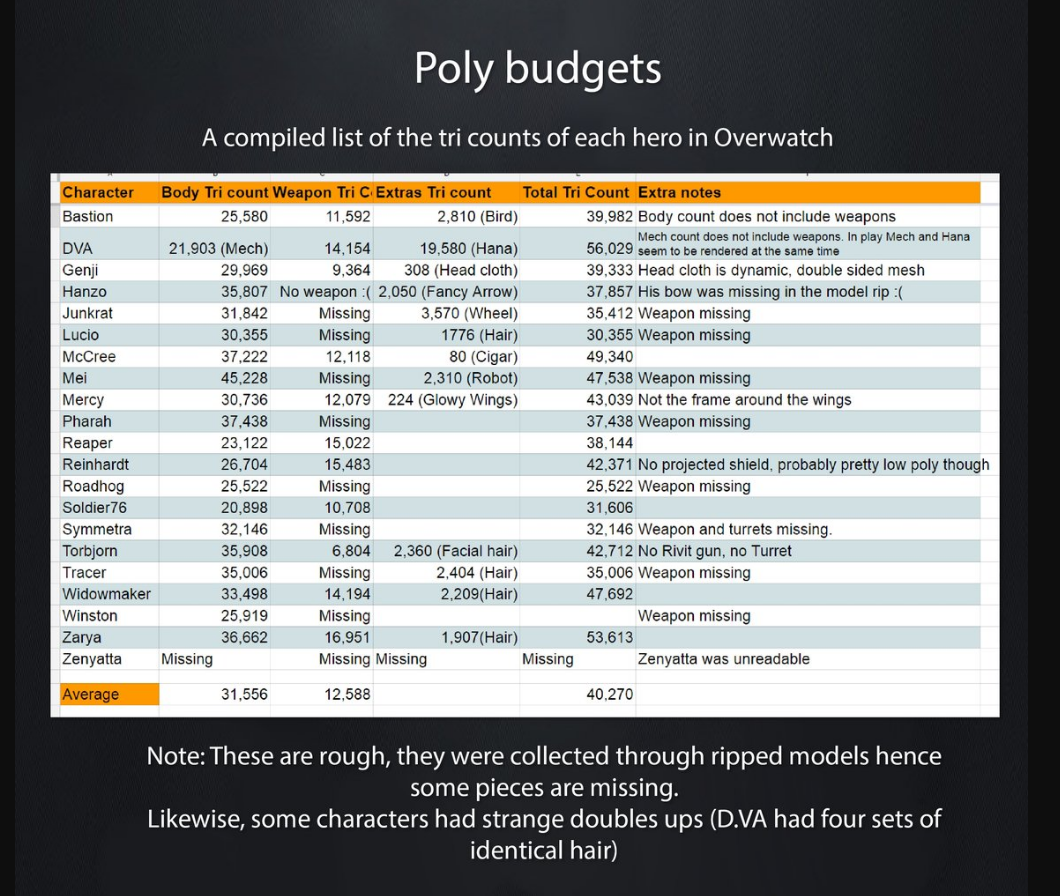
To put that astronomical figure into some perspective, someone said that that number is significantly higher than the rendering cost of an entire match of Overwatch players (two teams of six avatars each, at an average triangle count of 40,270 triangles per character, for a total of 483,240 triangles). That is truly insane! And the feet alone on the new Legacy mesh body come to 380,368 triangles! Mind you, most games are deliberately designed to be as optimized as possible, but nobody needs that level of complexity! It is complete overkill.

But, as I said, writing about this is kind of like closing the barn door after the horse has bolted. There is really no incentive for mesh body makers (and other mesh content makers) to create and sell better-optimized mesh in Second Life, and no penalty if they don’t. Linden Lab does not ban or restrict avatars for having very high rendering costs. For example, here is one outfit I put together for my main avatar, Vanity Fair, which has a total Avatar Rendering Cost of 702,597! This means that, when I wear this lovely outfit to a place like Frank’s Jazz Club, I am pretty much seen as a jelly doll (i.e. derendered) by everybody around me. In other words, I am only dressing to be seen by me.

If I take off the three sets of shimmery flexiprims that are part of the skirt of this beautiful gown, the ARC drops to 108,365. If I remove the jewelry, the ARC goes down to a quite reasonable 59,575 (some older jewelry in particular can be quite badly optimized):

Even making these simple changes to an outfit can make a big difference to performance (for you and others), especially at crowded events.

So, even though it might be a losing battle, I might just decide to add my voice to Wagner’s about the proper optimization of mesh content in Second Life. I still think it’s a losing battle, though. Most SL consumers could care less.

I think that the best that we can do at this stage is two things:

  1. Promote awareness of the problems of unoptimized, inefficent content among Second Life consumers (for example, including triangle counts or some other complexity measurement in SL Marketplace listings of products);
  2. Educate SL content creators to make more efficient mesh by using proper decimation and other techniques in tools such as Maya, 3ds Max, and Blender.

Yes, it’s an uphill battle, but it’s worth fighting for a better-performing Second Life for everybody, don’t you agree?

Editorial: Facebook, Free Speech, and Disinformation

Well, as many of you already know, I left Facebook at the end of last year as my New Year’s resolution. But you might not know that I have now resurrected my account on the Facebook social network.

In my first post to my Facebook timeline (and perhaps the only one I am willing to make for quite some time), I write the following:

Yes, after leaving Facebook at the end of last year as my New Year’s resolution, and asking Facebook to delete over 13 years’ worth of data it had collected about me, I have decided to set up an account again.

Why? Well, as a social VR/virtual worlds blogger, I want to be able to cover Facebook’s new social VR platform, Facebook Horizon, and that apparently will require an account on the Facebook social network to use (it launches in closed beta in early 2020).

So, I am back, but don’t expect me to post a lot, or use this account very much. After the Cambridge Analytica/Trump/Brexit scandal (covered so well by the Netflix documentary The Great Hack), I am very, VERY wary to share a lot of data here for Facebook to strip-mine for profit!

Which leads me (in a roundabout way) to the point of this blogpost. There is an exceptionally well-written, well-reasoned article by Siva Vaidhyanathan on The Guardian newspaper website, titled Mark Zuckerberg doesn’t understand free speech in the 21st century. Dr. Vaidhyanathan is a professor of media studies at the University of Virginia and the author of the book Antisocial Media: How Facebook Disconnects Us and Undermines Democracy. He addresses a recent speech Facebook CEO Mark Zuckerberg gave to students at Georgetown University, which has been criticized by many commentators, including Martin Luther King’s daughter Bernice:

I strongly urge you to read Dr. Vaidhyanathan’s article yourself, but I did want to quote a few sections that I thought made insightful arguments:

Facebook has three defining attributes that make Facebook Facebook. Its scale of 2.4 billion people uploading content in more than 150 languages make it too big to filter. Its algorithmic design that amplifies content judged to attract attention and interaction (clicks, shares, likes, comments) favors extremism and powerful emotions over rational and measured expression. And the cheap and effective advertising system is monumentally profitable and thus starves other sources of good information of needed revenue.

In his speech Thursday Zuckerberg boasted that the Black Lives Matter movement started on Facebook. It did. But it also almost died there. It jumped to Twitter and thrived. As the internet scholar Zeynep Tufekci has explained, Facebook’s algorithmic system squelched #BlackLivesMatter and other activist movements as it was promoting vapid images like the Ice Bucket Challenge. On Twitter, with much lighter algorithmic amplification, #BlackLivesMatter could hold attention.

Zuckerberg also neglected the fact that the largest Black Lives Matter group on Facebook was hosted by a white man from Australia and was otherwise completely fake.

Zuckerberg wants us to believe that one must be for or against free speech with no nuance, complexity or cultural specificity, despite running a company that’s drowning in complexity. He wants our discussions to be as abstract and idealistic as possible. He wants us not to look too closely at Facebook itself.

…

The problem of the 21st century is cacophony. Too many people are yelling at the same time. Attentions fracture. Passions erupt. Facts crumble. It’s increasingly hard to deliberate deeply about complex crucial issues with an informed public. We have access to more knowledge yet we can’t think and talk like adults about serious things.

By invoking all the progressive social movements that have found Facebook useful, Zuckerberg tries to hitch his company to their results. But ignoring the Nazis and misogynists who also use Facebook to organize and recruit, he hopes we equate motivation with free speech and democracy.

The thing is, a thriving democracy needs more than motivation, the ability to find and organize like-minded people. Democracies also need deliberation. We have let the institutions that foster discussion among well informed, differently-minded people crumble. Soon all we will have left is Facebook. Look at Myanmar to see how well that works.

This is a perfect encapsulation of what I think is wrong with Facebook. Put simply, Facebook has too much power, and it wields that power in a demonstrably inconsistent fashion when it comes to free speech.

So, informed by past experience, I will severely limit how much information I choose to share on Facebook, and who I choose to befriend. I will restrict when and how often I check Facebook (for example, I will not install the app on my iPhone, and I will only access the Facebook website via a Chrome browser with the highly-recommended F.B. Purity extension added).

And I do not want to live in a world where Facebook has the loudest megaphone. I will continue to pursue and peruse my news from authoritative sources outside Facebook, such as The Guardian. And I will actively promote campaigns such as BreakTheFake, which provide helpful tips for consumers to determine fact from fiction on the Internet.

Social media such as Facebook has been weaponized, and is being used against us. The situation demands that we all become smarter consumers of information. The future absolutely depends on it.