UPDATED JAN. 20th, 2026 WITH EXTRA COMMENTARY: Metaverse Bombshell: NETFLIX Acquires Ready Player Me—What Does This Mean for Metaverse Platforms Using Ready Player Me Avatars?

I somehow missed a major piece of news that dropped last Friday, which will definitely impact a lot of existing metaverse platforms (including big names like VRChat). On Dec. 19th, 2025, Sarah Perez wrote, in an article on the tech news website TechCrunch:

After shifting its gaming strategy to focus more on games played on the TV, Netflix announced it’s acquiring Ready Player Me, an avatar-creation platform based in Estonia. The streamer said Friday it plans to use the startup’s development tools and infrastructure to build avatars that will allow Netflix subscribers to carry their personas and fandom across different games.

Terms of the deal were not disclosed. Ready Player Me had raised $72 million in venture backing from investors, including a16z, Endeavor, Konvoy Ventures, Plural, and various angels, including the co-founders of companies like Roblox, Twitch, and King Games.

Netflix told TechCrunch the startup’s team of around 20 people will be joining the company. Of the four founders Rainer Selvet, Haver Järveoja, Kaspar Tiri, and Timmu Tõke, only CTO Rainer Selvet is moving to Netflix. It doesn’t have an estimate of how long it will be until avatars launch. Nor does it detail which games or types of games will be first to get avatars.

Following the acquisition, Ready Player Me will be winding down its services on January 31, 2026, including its online avatar creation tool, PlayerZero.

Scott Hayden, in an article written for The Road to VR website, adds:

“Our vision has always been to enable avatars and identities to travel across many games and virtual worlds,” Ready Player Me CEO Timmu Tõke said. “We’ve been on an independent path to make that vision a reality for a long time. I’m now very excited for the Ready Player Me team to join Netflix to scale our tech and expertise to a global audience and contribute to the exciting vision Netflix has for gaming.”

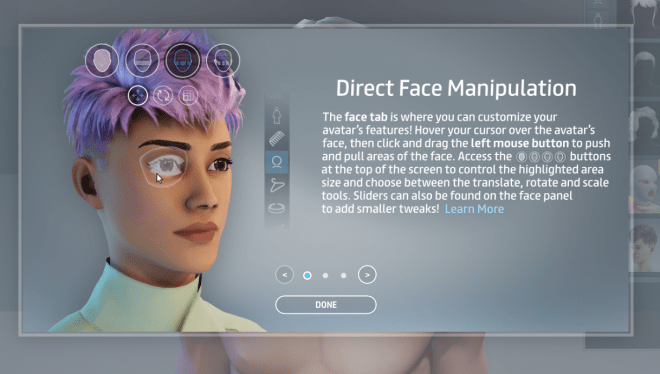
Avatar creation using Ready Player Me in the metaverse platform Spatial

Additionally, Ready Player Me announced its taking avatar creation services offline starting January 31st, 2026.

And, indeed, when I head over to the Ready Player Me website, the banner across the top of my screen declares:

Thank you for the chance to build together with you. Our services will become unavailable starting January 31, 2026. Please reach out to devs@readyplayer.me for any questions.

I pity the poor person on the receiving end of all those emails, because there are countless metaverse platforms which have relied on Ready Player Me as their avatar creation component, rather than try to build their own avatar design system in-house. All of these platforms now have a little over a month to come up with a replacement for the services provided up until now by Ready Player Me, which is shutting down on January 31st, 2026!

Ready Player Me’s avatar creation tools, which have been used by many virtual worlds and social VR platforms, will be shutting down on January 30th, 2026.
Among the tools affected by the NETFLIX acquisition of Ready Player Me are the Avatar Creator SDK, and the newer PlayerZero SDK, which allowed for users to create and sell avatar modifications and updates.

Ready Player Me has been the go-to solution for both gaming and metaverse companies for outsourcing much of its avatar creation process. Among those companies is VRChat. Scott Hayden opines:

Netflix hasn’t intimated it’s getting into XR gaming yet, so it’s pretty safe to say the Ready Player Me acquisition and subsequent shutdown is more or less a blow to one specific group of people: namely, VRChat users.

VRChat beginners looking to make their own avatars over the years were almost always pointed to Ready Player Me, with the platform even allowing users to upload a personal photo and generate a cartoony persona that was easy to mix-and-match with a variety of parts.

And while they weren’t always the most original avatars out there, it’s difficult to argue with the platform’s ease of use, as the web-based tool basically got you a (mostly) unique avatar that was not only cross-platform, but also already rigged for VRChat.

I’m not too worried on the impact to VRChat; as Scott goes on to write in his article, there are alternatives, albeit ones requiring a bit more technical know-how on the part of the user. VRChat also has a thriving third-party avatar creation and sale ecosystem, including a very popular series of Virtual Market avatar shopping events). VRChat will be fine. But it’s the smaller metaverse platforms like Spatial.io, which wholly rely on Ready Player Me’s services, that are now going to have to scramble to find and implement a replacement in very little time.

NETFLIX’s acquisition of Ready Player Me reminds me, at first glance, of when the fledgling metaverse platform Cloud Party (which I have written about on my blog before) was acquired by Yahoo! back in early 2014, over a decade ago. The entire small company (only 3-4 people) was “acquihired” by Yahoo!, and they shut down the Cloud party platform (with a truly memorable sendoff, as they shut down the servers, that made me emotional; this link is from a former Blogger.com blog I used to write about Cloud Party, which is still up!). The staff were absorbed into Yahoo! to work on Yahoo! projects, and God only knows what happened to them, or the projects they were hired to work on. (And, of course, Yahoo! is a shadow of its former self; does anybody still use it?)

It is very clear from this news that NETFLIX has big plans for its gaming service, and they “acquihired” the staff (and assets) of Ready Player Me, in order to use them for some future project. Their gain (for whatever project they are working on) is the loss of the hundreds of virtual worlds, games, and social VR/AR platforms which relied on Ready Player Me.

The fallout from all this is going to be fascinating to watch.

UPDATE Dec. 23rd, 2025: Another thing that came to mind after I posted this blogpost is this: metaverse-building companies who choose to outsource aspects of their services to other companies like Ready Player Me, have to be prepared for the possibility that that other company could be bought out, change the terms of their service, or even shut down. While it might be more time and money consuming to build something like an avatar system in-house, at least it’s under your control, and you don’t run the risk of having the rug pulled from under you.


Thank you to my metaverse friend Carlos Austin for the heads-up on this news.

UPDATE Jan. 20th, 2026: Today I came across an article on LinkedIn by Terry Proto for the group with the lengthy title, Reality Innovators Network for Spatial Computing, Metaverse, AI & XR – Virtual, Augmented Reality (whew, that’s a mouthful!):

8,000 developers. 6 weeks. One lesson. Netflix bought Ready Player Me, and January 31st is the deadline to replace avatar infrastructure for a lot of companies.

This isn’t the first time we’ve seen this. Altspace. 8th Wall. The pattern repeats.

The lesson? Interoperable ≠ open.

RPM worked everywhere. But it was still owned by one company. One acquisition later, and thousands of production systems are scrambling.

That’s the difference between building on convenience vs. building on ownership.

I just wrote a new article on why the spatial internet can’t be built on rented land. Have a look here: https://lnkd.in/etu3xpiF

(Note: I don’t know if you actually have to have a LinkedIn account to read this article.)

In the linked article from the above quote, Terry goes to give a very good summary of why relying on a third-party solution (even one that is interoperable), is still not as good as having open standards.

He writes:

Netflix acquired Ready Player Me on Dec 19 and 8,000 developers have until January 31st to rip out and replace their avatar infrastructure.

That’s six weeks.

Six weeks to rebuild identity systems that many teams integrated as foundational layers, not optional features. For some developers, RPM wasn’t just powering avatars. It was powering user accounts, social presence, cross-platform persistence, and the entire notion that their users could carry an identity across virtual worlds.

As Jose Antonio Tejedor Garcia of Virtway put it: “Trust built over years is breaking in weeks.”

As I write this, that six-week window has narrowed to (checks calendar) just twelve days. And, as Terry has stated, many of the 6,000 developers who used Ready Player Me, used it for a lot more than just avatar appearance. He goes on to add what I was trying to get at in my original blogpost, but does it much more concisely:

ack in June 2023, I wrote about “life after Altspace”, exploring which platforms could fill the void when Microsoft shut down one of the oldest social VR spaces. Altspace launched in 2015, got acquired by Microsoft in 2017 and closed in March 2023. The community scrambled to find new homes.

Sound familiar?

But back then, I was asking the wrong question. Finding alternative platforms doesn’t solve the underlying problem. It just kicks the can down the road until the next acquisition, the next pivot, the next “strategic realignment.”

The real question is: why do we keep building critical infrastructure on top of proprietary platforms?

I am not going to quote it all, but I do strongly recommend you read the entire article here (even if I very strongly disagree with any potential solution which requires blockchain, cryptocurrencies or NFTs, all of which by now are tainted beyond redemption by numerous scandals, scams, and rugpulls). And I will watch with keen interest as the deadline of January 31st, 2026 comes and goes.

Ignite 2021: Microsoft Is Adding Avatars to Microsoft Teams

Have you joined the RyanSchultz.com Discord yet? You’re invited to be a part of the first ever cross-worlds discussion group, with over 600 people participating from every social VR platform and virtual world! We discuss, debate and argue about the ever-evolving metaverse, its avatars, and all the companies building it. Come join us! More details here.


Hard on the heels of Facebook (now Meta) and their Connect 2021 event comes today’s Microsoft Ignite 2021, where Microsoft shows off some of the technology they’re working on. And, of course, give their own spin on the metaverse!

Microsoft CEO Satya Nadella presents the company’s metaverse solutions

Here’s a seven-minute clip from Ignite of Microsoft CEO Satya Nadella talking about his vision for the metaverse:

Tom Warren of tech news website The Verge reports:

Microsoft is entering the race to build a metaverse inside Teams, just days after Facebook rebranded to Meta in a push to build virtual spaces for both consumers and businesses. Microsoft is bringing Mesh, a collaborative platform for virtual experiences, directly into Microsoft Teams next year. It’s part of a big effort to combine the company’s mixed reality and HoloLens work with meetings and video calls that anyone can participate in thanks to animated avatars.

With today’s announcement, Microsoft and Meta seem to be on a collision course to compete heavily in the metaverse, particularly for the future of work.

An example of a 3D avatar within Microsoft Teams (image source: Microsoft, from TheVerge)

And—if you’re having a bad hair day—hey, no worries!

Microsoft Teams will get new 3D avatars in a push toward a metaverse environment, and you won’t need to put a VR headset on to use them. These avatars can literally represent you both in 2D and 3D meetings, so you can choose to have an animated version of yourself if you’re not feeling like turning your webcam on.

Bloomberg reports that this new feature will be released next year:

If you’re worried the metaverse will be all fun and games, fear not: Microsoft Corp. is taking its own stab at the idea, and it will have PowerPoint and Excel.

The company is adapting its signature software products to create a more corporate version of the metaverse — a concept promoted by Facebook co-founder Mark Zuckerberg that promises to let users live, work and play within interconnected virtual worlds.

The first offering, a version of Microsoft’s Teams chat and conferencing program that features digital avatars, is in testing now and will be available in the first half of 2022. Customers will be able to share Office files and features, like PowerPoint decks, in the virtual world.

It would appear Microsoft’s avatars (like those in Meta’s Horizon Worlds and Horizon Workrooms) will lack legs (image source: Microsoft, via Bloomberg)

Of course, most people already know that Microsoft acquired the social VR platform AltspaceVR in 2017 (which, by the way, is still absolutely killing it with live events programming!). Altspace is being used for a variety of purposes, including higher education (for example, teaching a psychology course at Mount Royal University).

AltspaceVR (image source: VRFocus)

It looks like we will see more integration between established business software such as Microsoft Teams with concepts from the metaverse, including avatars, over the next twelve months. The era of avatarism appears to be in full swing!


Thanks to Rainwolf for the heads up!

Alter Ego, A New Fox/CTV Singing Competition Television Show Where the Contestants are Avatars: Further Proof that the Era of Avatarism is Upon Us

Have you joined the RyanSchultz.com Discord yet? You’re invited to be a part of the first ever cross-worlds discussion group, with over 550 people participating from every social VR platform and virtual world! We discuss, debate and argue about the ever-evolving metaverse, its avatars, and all the companies building it. Come join us! More details here.


I don’t usually watch singing competition TV shows, but a new one has definitely got my attention! It’s called Alter Ego, and the Fox show (which will appear on CTV here in Canada) has a twist: instead of appearing on stage as themselves, they will be represented by their avatar, which they will drive while wearing a full motion-capture suit from backstage during their performances!

Yes, these are the same motion-capture suits which were used by the members of ABBA to create “ABBAtars”, presenting themselves as they were in 1979 in a future series of concerts to be held in London, England. In that blogpost, I argued that the era of avatarism (i.e. the freedom to choose the form in which you are seen by others) had truly arrived. And the Alter Ego TV show is further proof that the age of avatarism is indeed upon us!

The Fox 5 TV station in Altanta interviewed one of the contestants appearing in the first episode of Alter Ego:

Rolling Stone reporter Samantha Hissong wrote:

I was skeptical, a few weeks ago, as I approached the doors to a taping of Alter Ego, Fox’s new singing competition with a high-tech twist, but it felt the same as entering any old sound stage — at least for the first minute or so. On Alter Ego, which premieres this Wednesday night (September 22nd), the contestants don’t perform on stage, but rather behind a curtain whilst donning motion-capturing suits that control their own highly fantastical, augmented-reality avatars.

In typical music-TV fashion, the winner will get a cash prize ($100,000), as well as mentorship opportunities from celebrity judges: willi.i.am, Grimes, Alanis Morissette, and Nick Lachey. But the judges, along with host Rocsi Diaz and in-person audiences, watch the performances on eye-level monitors placed strategically around the room — so as to appear as if they’re looking centerstage. Moreover, the judges won’t learn the true identity of the winner until they’ve already won.

To film, Alter Ego relies on 14 cameras, eight of which use advanced camera-tracking technologies. “It’s not something that’s done in post,” creative producer Michael Zinman — who previously partnered with Fox on The Masked Singer — tells Rolling Stone on the still-empty studio floor. Above our heads, thousands of Infrared Reflective (IR) markers — one-inch-by-one-inch silver squares that, essentially, create a map for these cameras — twinkle like a mini galaxy.

The smart cameras then communicate with Unreal Engine, a video-game design software, to render the avatars in real time. (A company called Silver Spoon, which was responsible for creating virtual crowds for Major League Baseball in 2020, designed the 3D models in advance with creative input from the contestants. An augmented reality company called Lulu helped with the stage-plotting.)

Avatar data — things like eye color, height, and special effects — motion-capture data, lighting data, and camera data all meet in a hub of servers next to the mini stage behind the actual stage. “Then, if it all goes right, it spits it out and you see the composite,” Zinman explains. As the host, Diaz is the only one who really has to act, as she’s tasked with standing “next to” the avatars when they’re critiqued at the end of their performances: “You have to go back to your five-year-old self, play pretend, and talk with your imaginary friend,” she says. “It’s actually a lot of fun.”

Alter Ego contestant Dasharra Bridges and her avatar, Queen Dynamite (source: Rolling Stone)

The first episode of the show dropped yesterday, so you might want to check it out on your streaming service or cable TV! I know I’ll be watching every episode 🙂

Editorial: With ABBAtars, the Era of Avatarism Has Truly Arrived

Have you joined the RyanSchultz.com Discord yet? You’re invited to be a part of the first ever cross-worlds discussion group, with over 550 people participating from every social VR platform and virtual world! We discuss, debate and argue about the ever-evolving metaverse and the companies building it. Come join us! More details here.


Not too long ago, there was an interesting and wide-ranging discussion on the RyanSchultz.com Discord server, about a March 3rd, 2021 article on Medium, written by Greg Fodor, titled The Rise of Avatarism. In it, Greg wrote:

Avatarism is a movement to recognize and protect the fundamental human right of freedom of form. Like freedom of speech, freedom of form is a claim on an endowed right to free expression. And like the right to bear arms, it is a right which will suddenly gain relevancy after specific technological breakthroughs.

Specifically, freedom of form is the right to choose the form in which you are seen by others...

Soon our physical form will become subservient to one or more virtualized ones. Fully controlling how we are seen by others will become more accessible, frequent, common, and culturally accepted, and be less like a radical, life-altering event, and much closer to how we think of changing our clothes today.

He mentions that some people choose plastic surgery or body modification to permanently change their real-life physical appearance, something to which I can attest. My dirty little secret is that I am obsessed with the dumpster-fire-train-wreck of the Botched Surgeries subReddit community, where I am routinely appalled by the horrible, botched plastic surgeries that people put themselves through in real life—butt implants that stick out like shelves, facial filler that gives unnaturally sharp cheekbones and chins, eyebrow lifts that make people look like they should speak Vulcan, and breast implants that look like overinflated balloons that are about to pop at any second. (WARNING: If you visit, you might need eye bleach afterwards! Consider yourself warned! I constantly come away from that Reddit community feeling much better about myself and my own body, though.)

Greg argues, though, that with the advent of consumer XR technology (virtual reality, augmented reality, and mixed reality headsets, and eventually, glasses), we are at the cusp of an era where we can change how people see us, but in a less permanent way:

Soon our physical form will become subservient to one or more virtualized ones. Fully controlling how we are seen by others will become more accessible, frequent, common, and culturally accepted, and be less like a radical, life-altering event, and much closer to how we think of changing our clothes today…

Today, many are benefiting from virtualized avatars or by completely overriding their physical forms. Avatar chat apps and online games have allowed millions to embody avatars…

Meanwhile, phone-based augmented reality is taking off, letting people experiment with fully overriding how they appear to others. Snapchat filters, AR-generated clothing, and celebrity deepfakes are getting more and more sophisticated and accessible to your average person…

All of these point to a wider trend of virtualized, avatar-based representations becoming widely accepted and embraced.

(By the way, speaking of phone-based AR, you can check out my adventures with feeding Second Life avatar selfies into the WOMBO and Reface apps here.)

I’m not going to directly quote a lot of Greg Fodor’s thought-provoking article; you can go over and read it yourself. It’s a 15-minute read, and well worth it, as he raises some interesting philosophical and theoretical questions about the topic. For example, will we reach a point where someone actually goes to court to assert their right to freedom of form, i.e. how other people are required to see them? (For example, a Dutchman recently lost a bid to legally lower his age by 20 years.)


I was pondering all this when yesterday, news dropped that the Swedish supergroup ABBA (one of the best-selling music artists of all time, with an estimated 150 million records sold worldwide) had reunited after 40 years, and were releasing a new album in November.

The four members of the group spent five weeks being recorded in motion-capture suits for an upcoming series of London concerts produced by George Lucas’ Industrial Light and Magic studio, which will feature Agnetha Fältskog, Björn Ulvaeus, Benny Andersson, and Anni-Frid Lyngstad as holographic avatars, pictured as they would have appeared at the height of their fame in 1979. Yahoo! News reports:

The 10-track album, ABBA Voyage, will be released on Nov. 5, and the new songs will also be performed during a virtual concert residency that will open at a custom-built arena in East London on May 27, 2022. The “revolutionary” show, also titled “ABBA Voyage,” will run six nights a week and will feature ABBA holograms — cleverly known as “ABBAtars” — and a 10-piece live band playing 22 of the Swedish superstars’ greatest hits. 

The ABBAtars were designed by Industrial Light and Magic (the visual effects company founded by George Lucas), and more than 850 people employed motion-capture technology to recreate band members Agnetha Fältskog, Björn Ulvaeus, Benny Andersson, and Anni-Frid Lyngstad’s “every mannerism and every motion” from when they were “in their prime.”

ABBA in their motion capture suits

You can see a bit of these avatars at the tail end of this new music video:

I still vividly remember the live Lindsey Stirling concert I attended in Wave as a highlight of my social VR experiences in 2019, where the electronic violinist wore a full-body 3D motion capture suit and special VR gloves, which allowed her to completely animate her avatar in Wave, from her head down to her feet (including each individual finger on her hands), as she played and danced! Unlike Lindsey, who played a live concert and steered her avatar directly, the upcoming ABBA concerts will consist of prerecorded avatar hologram playback to the music (performed by a 10-piece live band).

Truly, when the members of a band can appear on a physical stage as they were 40 years ago at a concert series, we have entered the age of avatarism! We may yet witness things which we never would have ever dreamed possible in the past. As Greg Fodor says in the conclusion of his article:

Avatarism is about the sudden arrival of transformative, new answers to a universal question: how should others see you?

If you think the answer is a simple one, one day you might just look back and yourself, and smile at your naïveté.