InZOI: A Two-Part Look at the New Life Simulation Game, Focusing on Avatar Customization

You might remember that I said I had had a hard drive crash on my Windows desktop PC in May of 2025, which (among other things) put my Valve Index PCVR headset out of commission until recently. Well, another casualty of that hard drive crash was some software which I had installed a week or so earlier, a life simulation game called InZOI, by a South Korean video game company called KRAFTON. Think of the Sims, but with some truly breathtaking graphics and avatar customization tools (as you’ll see).

I wanted to share my experience with you, even though I would not classify InZOI as a metaverse platform, because I think I can see a vision where some of the features of this life simulation game could potentially lend themselves towards a next-generation metaverse.

So, I had started writing a blogpost about my initial experiences with InZOI in April 2025, but it wasn’t until yesterday (Sunday, August 30th, 2026) that I finally got around to reinstalling the client software on my hard drive.

First, I’m going to share with you the original text I wrote in April 2025 (plus screen captures), then I’m going to finally finish the post I had started 16 months ago, showing you the avatar customization features (which is what had intrigued me enough to purchase and install the software in the first place). Finally, I’m going to wrap this up by explaining why I don’t like InZOI, and why I’m probably not going to be playing it (or talking about it on my blog) very much.

Still with me? Okay, let’s dive in.


Part One (Originally Written April 2025)

As a librarian, it’s hard not to like a game with an opening sequence set in a library!
The graphics in inZOI are pretty impressive! Here, my avatar wanders around the beach in Bliss Bay.
My ZOI avatar catches some virtual rays on the beach in Bliss Bay, The lighting is among the best I have seen in any virtual world, but you will need a good graphics card to see it in the best way!

I first heard about InZOI last year, via some excited chatter among the Second Life user community who were creating some amazingly lifelike avatars using a time-limited test period of the new game’s much-vaunted character creator module. Here’s a half-hour YouTube video giving you a rundown of how it worked as of late 2024:

Well, after a second demo period earlier this year, InZOI finally became available for purchase via the Early Release program on Steam two weeks ago, and since my Windows desktop computer met all the recommended hardware requirements, I decided to buy it now. The game is still in beta, with a limited feature set, and it’s buggy in places, but I was especially curious to put the character creator software to the test, to see what kind of avatars I could create, and I also wanted to wander around and explore the worlds which were already available.


Now, before we get started, I want to make it clear that I am not really into life simulation games per se. You might not know this, but there is already a vibrant subculture within Second Life, where avatars purchase, use, and follow life simulation systems sold under various brand names (e.g. MyStory), which mean that your avatar feels thirsty, hungry, dirty, tired, the need to go to the bathroom, etc. And, of course, the entire line of Sims life simulation games have been quite popular since their first release back in 2000 (predating Second Life by three years).

I want to point out that there is a key difference between a metaverse platform like Second Life or Sansar (we’ll get back to Sansar in a minute) and a life simulation game like the Sims or InZOI. In a metaverse, you usually can join for free and then pay as you go, shopping for avatar customization items like skins, hair, and clothing. In a life simulation game, you pay up-front for the game, which includes a broad range of built-in avatar customization options to get you started. (Of course, both types of virtual world usually offer an in-world marketplace, where players buy and sell user-created content with each other.)

Avatars in InZOI are called ZOIs, and you can create not only yourself, but also a entire family of characters that you can interact with.


Part Two (Written August 2026)

Okay, today I want to focus on the avatar customization features in InZOI, which I found to be rather impressive. I will assume that, in the intervening 16 months, that a few bug fixes and updates have added a bit more polish to these avatar (erm, ZOI) customization features.

You create and customize your ZOI using the Character Studio, which allows you to start by selecting a preset (the round buttons on the right hand side of the screen), and other characteristics such as age (on the left side of the screen):

You have your choice of six different ages to choose from.

You can also pan, zoom, and rotate your ZOI to get a better look at him:

I noticed some interesting parallels between 2025/2026-era InZOI and 2017/2018-era Sansar (a social VR platform which you can still visit today). To my mind, at least, Sansar walked so InZOI could run. Here’s what the facial customization features in Sansar look like:
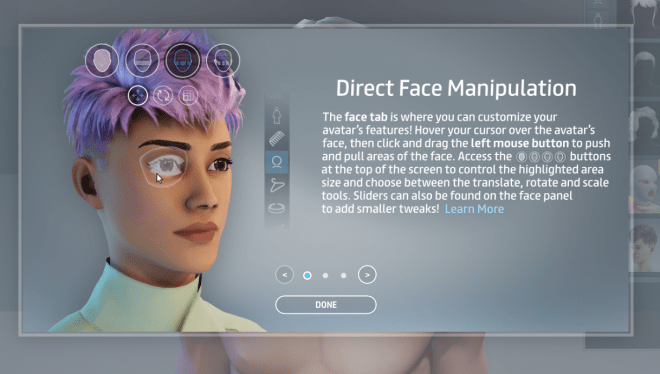
THIS IS SANSAR, NOT INZOI! Sansar screen shot: direct face manipulation

Sansar allows you to select the entire head, or just specific sections of the head/face, and then use the mouse to push and pull (translate, rotate, and scale) areas to completely customize the head of your avatar. Here’s a short video of what the face/head customization features look like (and, as I said, if you’re interested, you can download and install Sansar yourself and play around with it; you can run the client software without a VR headset, on your Windows desktop PC).

THIS IS SANSAR, NOT INZOI! Sansar’s head/face customization tools in action.

Now, compare Sansar’s tools with how InZOI has approached the problem: instead of giving you the translate, rotate, and scale options, you simply click on the white dots and drag on parts of the head and face to adjust them. (Also note the much higher level of detail in the avatar, erm, ZOI. We’ve come a long way from 2017, baby!!)

Head and facial adjustments in InZOI’s Character Studio

And, there are a similar set of drag-and-drop features and some sliders to customize your ZOI’s body shape (Sadly, the plug was essentially pulled on Sansar before the next planned step, a similar sort of body modification, could be coded.)

A look at the body customization options in InZOI’s Character Studio

Now, imagine a metaverse platform with InZOI’s level of avatar customization. Can you see the vision? (C’mon, work with me, people!! 😉)


To wrap up, I am going to talk a bit about why I am not a fan of life simulation games like the Sims and InZOI. A key difference between a life simulation game such as InZOI, and a metaverse platform like Sansar or Second Life, is that in the former, everybody else you encounter is an NPC; there are no other real players steering ZOIs in your game! InZOI is a solitary pursuit, whereas true metaverse platforms like Second Life can be a highly social experience if you wish it to be.

Another thing I dislike about life simulation games like InZOI is that they are, by definition, games, with all the built-in limitations that games possess. Yes, you can design and build your dream house and furnish it—but only in carefully-controlled and corralled, predefined cities (you have three to choose from in InZOI at present, although I expect they will expand this over time). You do not have the blank, three-dimensional creative canvas which a true metaverse platform offers you, to be wild and crazy and build whatever you can dream of.

Many years ago, I played the Sims for something like a week, quickly got bored, and quit. I much prefer using Second Life for my creative expression, and as a temporary escape from nasty, painful, chaotic real life. The very last thing I wanted in any game was to constantly be checking various on-screen meters and gauges to see if my avatar needed cheering up, to go sleep in a virtual bed, or to run to a virtual toilet!

Yesterday, I took my new avatar (erm, ZOI) out of her house. As she was walking down the street, while I was still getting comfortable with the WASD navigation controls, she kept bumping into NPCs who were also walking by her on the sidewalk. And, of course, as programmed NPCs, some would stop and glare at her. The whole excursion landed up making me so anxious that my ZOI scurried back to the safety of her home! And frankly, it also depressed me to think that, here I was, avoiding some real-life responsibilities while basically watching my ZOI pretty much run through her day on auto-pilot. (And yes, the irony that I also essentially do this in Second Life and VRChat and other metaverse platforms is not lost on me, at all.)

I spent less than an hour in my resintalled copy of InZOI before I decided to quit. I’m in no hurry to go back. Truly, the only things I found interesting about InZOI were the avatar customization features (maybe because they reminded me of Sansar’s).

So, yeah, despite InZOI’s many shiny new features, I’m still not a fan of life simulation games. I still want the freedom of that blank creative 3D canvas which a true metaverse platform offers me, and I also want the inherently social aspect of virtual worlds and social VR/AR—to know that most of the other avatars I encounter have real-life people behind them! (And yes, I am aware that there can be bots and NPCs in spaces like Second Life and Sansar, too. That does not negate my argument that metaverse platforms are inherently designed to be social spaces.)

UPDATED JAN. 20th, 2026 WITH EXTRA COMMENTARY: Metaverse Bombshell: NETFLIX Acquires Ready Player Me—What Does This Mean for Metaverse Platforms Using Ready Player Me Avatars?

I somehow missed a major piece of news that dropped last Friday, which will definitely impact a lot of existing metaverse platforms (including big names like VRChat). On Dec. 19th, 2025, Sarah Perez wrote, in an article on the tech news website TechCrunch:

After shifting its gaming strategy to focus more on games played on the TV, Netflix announced it’s acquiring Ready Player Me, an avatar-creation platform based in Estonia. The streamer said Friday it plans to use the startup’s development tools and infrastructure to build avatars that will allow Netflix subscribers to carry their personas and fandom across different games.

Terms of the deal were not disclosed. Ready Player Me had raised $72 million in venture backing from investors, including a16z, Endeavor, Konvoy Ventures, Plural, and various angels, including the co-founders of companies like Roblox, Twitch, and King Games.

Netflix told TechCrunch the startup’s team of around 20 people will be joining the company. Of the four founders Rainer Selvet, Haver Järveoja, Kaspar Tiri, and Timmu Tõke, only CTO Rainer Selvet is moving to Netflix. It doesn’t have an estimate of how long it will be until avatars launch. Nor does it detail which games or types of games will be first to get avatars.

Following the acquisition, Ready Player Me will be winding down its services on January 31, 2026, including its online avatar creation tool, PlayerZero.

Scott Hayden, in an article written for The Road to VR website, adds:

“Our vision has always been to enable avatars and identities to travel across many games and virtual worlds,” Ready Player Me CEO Timmu Tõke said. “We’ve been on an independent path to make that vision a reality for a long time. I’m now very excited for the Ready Player Me team to join Netflix to scale our tech and expertise to a global audience and contribute to the exciting vision Netflix has for gaming.”

Avatar creation using Ready Player Me in the metaverse platform Spatial

Additionally, Ready Player Me announced its taking avatar creation services offline starting January 31st, 2026.

And, indeed, when I head over to the Ready Player Me website, the banner across the top of my screen declares:

Thank you for the chance to build together with you. Our services will become unavailable starting January 31, 2026. Please reach out to devs@readyplayer.me for any questions.

I pity the poor person on the receiving end of all those emails, because there are countless metaverse platforms which have relied on Ready Player Me as their avatar creation component, rather than try to build their own avatar design system in-house. All of these platforms now have a little over a month to come up with a replacement for the services provided up until now by Ready Player Me, which is shutting down on January 31st, 2026!

Ready Player Me’s avatar creation tools, which have been used by many virtual worlds and social VR platforms, will be shutting down on January 30th, 2026.
Among the tools affected by the NETFLIX acquisition of Ready Player Me are the Avatar Creator SDK, and the newer PlayerZero SDK, which allowed for users to create and sell avatar modifications and updates.

Ready Player Me has been the go-to solution for both gaming and metaverse companies for outsourcing much of its avatar creation process. Among those companies is VRChat. Scott Hayden opines:

Netflix hasn’t intimated it’s getting into XR gaming yet, so it’s pretty safe to say the Ready Player Me acquisition and subsequent shutdown is more or less a blow to one specific group of people: namely, VRChat users.

VRChat beginners looking to make their own avatars over the years were almost always pointed to Ready Player Me, with the platform even allowing users to upload a personal photo and generate a cartoony persona that was easy to mix-and-match with a variety of parts.

And while they weren’t always the most original avatars out there, it’s difficult to argue with the platform’s ease of use, as the web-based tool basically got you a (mostly) unique avatar that was not only cross-platform, but also already rigged for VRChat.

I’m not too worried on the impact to VRChat; as Scott goes on to write in his article, there are alternatives, albeit ones requiring a bit more technical know-how on the part of the user. VRChat also has a thriving third-party avatar creation and sale ecosystem, including a very popular series of Virtual Market avatar shopping events). VRChat will be fine. But it’s the smaller metaverse platforms like Spatial.io, which wholly rely on Ready Player Me’s services, that are now going to have to scramble to find and implement a replacement in very little time.

NETFLIX’s acquisition of Ready Player Me reminds me, at first glance, of when the fledgling metaverse platform Cloud Party (which I have written about on my blog before) was acquired by Yahoo! back in early 2014, over a decade ago. The entire small company (only 3-4 people) was “acquihired” by Yahoo!, and they shut down the Cloud party platform (with a truly memorable sendoff, as they shut down the servers, that made me emotional; this link is from a former Blogger.com blog I used to write about Cloud Party, which is still up!). The staff were absorbed into Yahoo! to work on Yahoo! projects, and God only knows what happened to them, or the projects they were hired to work on. (And, of course, Yahoo! is a shadow of its former self; does anybody still use it?)

It is very clear from this news that NETFLIX has big plans for its gaming service, and they “acquihired” the staff (and assets) of Ready Player Me, in order to use them for some future project. Their gain (for whatever project they are working on) is the loss of the hundreds of virtual worlds, games, and social VR/AR platforms which relied on Ready Player Me.

The fallout from all this is going to be fascinating to watch.

UPDATE Dec. 23rd, 2025: Another thing that came to mind after I posted this blogpost is this: metaverse-building companies who choose to outsource aspects of their services to other companies like Ready Player Me, have to be prepared for the possibility that that other company could be bought out, change the terms of their service, or even shut down. While it might be more time and money consuming to build something like an avatar system in-house, at least it’s under your control, and you don’t run the risk of having the rug pulled from under you.


Thank you to my metaverse friend Carlos Austin for the heads-up on this news.

UPDATE Jan. 20th, 2026: Today I came across an article on LinkedIn by Terry Proto for the group with the lengthy title, Reality Innovators Network for Spatial Computing, Metaverse, AI & XR – Virtual, Augmented Reality (whew, that’s a mouthful!):

8,000 developers. 6 weeks. One lesson. Netflix bought Ready Player Me, and January 31st is the deadline to replace avatar infrastructure for a lot of companies.

This isn’t the first time we’ve seen this. Altspace. 8th Wall. The pattern repeats.

The lesson? Interoperable ≠ open.

RPM worked everywhere. But it was still owned by one company. One acquisition later, and thousands of production systems are scrambling.

That’s the difference between building on convenience vs. building on ownership.

I just wrote a new article on why the spatial internet can’t be built on rented land. Have a look here: https://lnkd.in/etu3xpiF

(Note: I don’t know if you actually have to have a LinkedIn account to read this article.)

In the linked article from the above quote, Terry goes to give a very good summary of why relying on a third-party solution (even one that is interoperable), is still not as good as having open standards.

He writes:

Netflix acquired Ready Player Me on Dec 19 and 8,000 developers have until January 31st to rip out and replace their avatar infrastructure.

That’s six weeks.

Six weeks to rebuild identity systems that many teams integrated as foundational layers, not optional features. For some developers, RPM wasn’t just powering avatars. It was powering user accounts, social presence, cross-platform persistence, and the entire notion that their users could carry an identity across virtual worlds.

As Jose Antonio Tejedor Garcia of Virtway put it: “Trust built over years is breaking in weeks.”

As I write this, that six-week window has narrowed to (checks calendar) just twelve days. And, as Terry has stated, many of the 6,000 developers who used Ready Player Me, used it for a lot more than just avatar appearance. He goes on to add what I was trying to get at in my original blogpost, but does it much more concisely:

ack in June 2023, I wrote about “life after Altspace”, exploring which platforms could fill the void when Microsoft shut down one of the oldest social VR spaces. Altspace launched in 2015, got acquired by Microsoft in 2017 and closed in March 2023. The community scrambled to find new homes.

Sound familiar?

But back then, I was asking the wrong question. Finding alternative platforms doesn’t solve the underlying problem. It just kicks the can down the road until the next acquisition, the next pivot, the next “strategic realignment.”

The real question is: why do we keep building critical infrastructure on top of proprietary platforms?

I am not going to quote it all, but I do strongly recommend you read the entire article here (even if I very strongly disagree with any potential solution which requires blockchain, cryptocurrencies or NFTs, all of which by now are tainted beyond redemption by numerous scandals, scams, and rugpulls). And I will watch with keen interest as the deadline of January 31st, 2026 comes and goes.

UPDATED! Decentraland Avatar Creation: How to Get a Custom Avatar Name for Free

Early this morning, I received an invitation in my email inbox to create my own custom avatar to use in the blockchain-based virtual world Decentraland when it launches. Today marked the official launch of the avatar creation program.

Note that Decentraland (DCL for short) was originally supposed to launch in open beta at the end of June, but that has been pushed back. Instead, DCL is going to invite groups of users in successive waves over the next month in a closed beta test, before opening the doors to the general public. Creating your avatar is the first step to setting foot in-world (once you are invited into the closed beta).

Here’s a brief new promotional video from Decentraland, showing off the different ways you can style and animate your avatars:

You can start the avatar creation process at this page. The avatar creation module is pretty straight-forward, and in no time at all you can customize an avatar to your desire. You have a choice of a male or a female avatar (sorry, no non-human avatars yet):

But there’s a catch. You can style your avatar as you like, but if you want to pick a name for your avatar (other than “Guest”), well, that’s going to cost you:

The fee is 100 MANA, which is the name of Decentraland’s in-world cryptocurrency. According to this cryptocurrency exchange calculator, that works out to US$5.10 at the moment. Not to mention the hassle of actually having to set up a cryptocurrency wallet and buying MANA, which I really don’t want to deal with right now.

However, according to the official blogpost of the announcement:

It usually costs 100 MANA to claim a name, but for the first 1,000 people claiming a name with cryptocurrency wallet, Trust Wallet, it’s completely free. What’s more, Trust Wallet and exchange partner Binance will stump up the gas fee.

Hey, free works for me! So, I downloaded the free Trust Wallet app onto my iPhone and set it up. Only to get hopelessly lost about how to actually connect the mobile-based Trust Wallet to use with the Decentraland avatar creation website on my desktop computer. It turns out that’s not possible (D’oh!).

Finally, I tried using the built-in web browser in the Trust Wallet app on my iPhone, but I only got as far as being able to select a name. The CLAIM NAME button at the bottom of my screen was still greyed out and unresponsive:

So, for a while confusion reigned on the official Decentraland Discord server as various people tried to troubleshoot my problem (thank you to everyone who offered suggestions!). Nobody seemed to know exactly how this promotion with the Trust Wallet works. Shouldn’t DCL have all this figured out before making the official announcement? Just sayin’.

Eventually, however, I was connected with someone from Decentraland who walked me through the process, step-by-step, through claiming my 100 MANA (a step they neglected to tell anyone about!), and then claiming my custom avatar name, all done using the web browser built in to the Trust Wallet app on my iPhone.

And finally, I got an email confirmation:

And checking my account, I now see:

Yay! Success! But it should not be this complicated. If a geek like me is having trouble with something as simple as setting up a username, you can imagine how confused the average Joe consumer is going to be. Hopefully, the team at Decentraland are rewriting their communications on the Trust Wallet offer, and providing STEP-BY-STEP instructions for other clueless cryptocurrency newbies.

Frankly, I think charging cryptocurrency for a custom avatar name is a significant stumbling block for many potential Decentraland users. I can understand needing to charge for land and goods and services, but something like a user name should be free to set up. DCL is setting itself apart from most of the competition in charging for a custom avatar name. I can only think of a few virtual worlds (IMVU, Twinity) that use this model. None of the major social VR platforms and virtual worlds charge you a fee to choose an avatar name. Decentraland might want to carefully re-think this policy.

UPDATE 2:50 p.m.: The following message was posted to the official Decentraland Discord server by toonpunk:

Anybody having issues with Trust wallet not being free please visit this link and it will work – https://claim.decentraland.org/ thanks.

You will need to visit this website in the built-in browser in the Trust Wallet app on your mobile device, then visit the avatar creation page.

UPDATE July 9th, 2019: Wow, that was fast! Toonpunk announced this morning on the official Decentraland Discord server that all 1,000 offers to create a custom avatar name for free are now completely used up. So it will now cost you 100 MANA to create a DCL username. Here’s a list of markets where you can buy MANA.

UPDATED: Notes from Today’s Avatar Customization Product Meetup in Sansar

I decided to come in-world to report on this week’s important Sansar Product Meetup, which was entirely focused on Linden Lab’s plans for future avatar customization. This is an opportunity for Sansar users to hear LL’s plans and provide feedback on what features they would like to see. Nearly 60 avatars were present at the meeting, an over-capacity crowd which lead to people landing up in separate instances of the experience (something that Linden Lab really needs to address going forward).

People who could not attend today’s meeting can follow one of three livestreams. Two attendees are livestreaming today’s Product Meetup: Daisy Gator at https://www.youtube.com/watch?v=auVnsfdJ5jw and Ryzo-Rin at https://www.twitch.tv/ryzorin. The official Sansar Twitch stream can be found at https://www.twitch.tv/sansarofficial.

Cara reported that there will be more avatar sliders, first for the face and then the body. The new default human avatars will have maps on the body itself, and you will be able to use your mouse to click and drag to adjust your features. This would be a different way to adjust your face and body than using simple sliders, and it sounds exciting!

Linden Lab is considering adding an avatar height slider, and they are also looking at uniform scaling to make larger and smaller but still proportional avatars (e,g, giants and pixies).

Linden Lab also wants to push for more custom avatars on the marketplace. They are also looking at the ability to dress custom avatars using clothing created in Marvelous Designer within the next couple of releases of the client software, according to Cara. The AABB bounding box on the avatar will be expanded to allow for such things as larger wings, for example.


Cara and Lacie Address Questions from the Audience

They also want to add more avatar attachment points, and they also want to look at improving the accessories so you can adjust the item while wearing it.

High heels: not one of Linden Lab’s priorities at the moment. Many users want to have this ability though, sooner rather than later.

Custom skins: Linden Lab does want to open up the ability to upload and sell custom skins on the market.

The current humanoid skin type will be tintable (as hair and nails are now), but the next-generation avatar will have a skin type which will use subsurface scattering and shaders to look better, and will require a different way to tint it.

Animated attachments: not a current priority.

Hotswapping avatars (between saved looks in the Lookbook) is a feature that Linden Lab would like to set up for us to be able to use (i.e. not having to go into Lookbook to change an outfit but doing it instantly).

It was a very good meeting, short of actual delivery dates, but still giving us a glimpse of where avatar customization is going within Sansar. I think many of the people who attended the meeting were very pleased with the announcements that were made by Cara and Lacie.

UPDATE Feb. 15th: Inara Pey, who does a much better job of summarizing these weekly Product Meetups than I do, corrects a mistake I made:

“Hotswapping avatars (between saved looks in the Lookbook) is a feature that Linden Lab would like to set up for us to be able to use”

As a point of clarification, Cara actually said this is something the Lab is *unable* to support at the moment – and no indication was given that this is being looked at. What she did mention was that the idea of some kind of “personal inventory” of objects “carried” by an avatar is still under discussion at the Lab.

Thanks for the clarification, Inara! You can find her detailed report on the meeting here, including audio excerpts.