NEWLY UPDATED WITH VIDEO! Your Metaverse Is Too Small: My Keynote Presentation to the 2026 Virtual Worlds Best Practices in Education (VWBPE) Conference

Marie Vans (left) introduces me (right) as a keynote speaker at the 19th annual Virtual Worlds Best Practices in Education conference, held in the pioneering virtual world of Second Life (screen capture from the video at the end of this blog post)

As some of you might know, a while back I was asked by my librarian colleague (and fellow Second Life aficianado) Marie Vans if I would be willing to be one of the three keynote speakers during the 2026 Virtual Worlds Best Practices in Education (VWBPE) Conference, which is held every year in the pioneering virtual world of Second Life. I said yes (of course!). I never turn down an opportunity to give a presentation in my beloved Second Life. (I was asked to speak at the 2021 Virtual Ability Mental Health Symposium, giving a presentation on the topic of this blogpost on acedia during the pandemic, and in 2024, I gave a presentation on virtual world building in Second Life, in Second Life, to a graduate class in virtual world building and design, which was team-taught by a computer science professor and an interior design professor.) So, as you can see, this was not my first rodeo. 😉

The title of my presentation, which I gave as the keynote speech of the conference on its second day, Friday, March 20th, was Your Metaverse Is Too Small: How the Biases and Preconceptions of Virtual Worlds Hinder Their Use in Education. I was inspired by a keynote address at last November’s IMMERSIVE X conference by Andy Fidel, who titled her talk, held on the ENGAGE social VR platform: The State of the Metaverse in 2026. My talk therefore consisted of three parts as follows:

  • Quotes from Andy Fidel’s talk which I found inspiring and wanted to share (7 slides);
  • My initial, general observations about the metaverse (4 slides); and finally
  • A section titled Your Metaverse Is Too Small, where I discuss various ways our biases and preconceptions about virtual worlds and social VR/AR actually hinder their effective use in educational settings (with reference to Andy’s comments; 14 slides).

Yes, it’s a lot to cover in 45 minutes, but I did it! I’m just going to share my slides as-is, without any Creative Commons-type license this time around, since a lot of it is referring back to Andy Fidel’s ideas, which I found so inspirational in the first place. And yes, while the topics of these 14 slides in part 3 all sprang out of one particularly fevered brain dump of my ideas one evening, rather than relying on GenAI, I do freely admit that I fed my entire blog into a Google NotebookLM and asked it questions in order to create the content based on thirteen (yes, 13!) different ways that, quote: “your metaverse is too small!”

Your metaverse is too small because…

  • it has too steep a learning curve for new users
  • your platform has a poor fit-to-purpose
  • it lacks accessibility features (e.g. speech-to-text for the Deaf/HoH community)
  • it is poorly designed and/or Quality Assurance tested, and it causes VR sickness/nausea (more common among women than men)
  • it is soulless/designed by committee (hello Meta Horizon Worlds and Workrooms! Proof positive that you cannot will metaverse platforms into existence by executive fiat and the spending of billions of dollars.)
  • it requires a VR/AR/XR headset (I used two slides to discuss this controversial take; see below for more detail)
  • it relies on cryptocurrencies, NFTs, or some other form of blockchain (do I really have to explain this at this point?)
  • it has poor (or non-existent) safety and trust features and policies
  • it focuses on the product rather than the community
  • it has user data privacy issues/is based on surveillance capitalism (once again, hello Meta Horizon Worlds and Workrooms!)
  • you fail to market it properly (or, in many cases, fail to market it at all)
  • it is unfriendly to different cultures and subcultures (e.g. trans people, furries, etc.)
  • (another controversial one, explained further below) it refuses adult content

Now, before all you social VR adherents rise up with torches and pitchforks and tar and feather me for even daring to say “your metaverse is too small because it requires users to have a VR/AR/XR headset,” here are the two slides, plus speaker notes:

Your metaverse is too small because it requires you to use a virtual reality headset.

It is not a surprise that many of the most popular social VR platforms (e.g. Rec Room, VRChat) also allow for non-VR users to participate. The VR headset market still has not taken off. Even the best-selling Meta Quest line of wireless virtual reality headsets (which make up an estimated 70% of the global VR headset market) has sold only approximately 30 million units around the world, and many of those devices land up collecting dust after the initial novelty of the product wears off. Apple’s Vision Pro, launched to enormous fanfare, does not publish sales figures, but industry reporters said that the company shipped approximately 390,000 units in 2024 and approximately 90,000 units in 2025. VR hardware remains bulky, heavy, and uncomfortable for extended wear. Nausea continues to affect a significant proportion of users. A VR headset isolates the wearer from their physical surroundings and from the facial expressions of the people around them—an anti-social device, in practice, even when its purpose is socialization via social VR.

The PC-tethered VR headset market—the high-end, high-fidelity segment that many early social VR platforms had built toward—proved especially stagnant. The dream of millions of consumers owning gaming-grade PCs with tethered Oculus Rift or HTC Vive headsets never materialized. Even the shift to standalone headsets like the Meta Quest series failed to generate the consumer mass-market that had been anticipated. Sansar is perhaps the most instructive case study in the danger of building a platform around assumed headset adoption. Developed by Linden Lab—the company behind Second Life—Sansar was announced in 2014 and launched in beta in 2017, timed almost precisely to coincide with what seemed like the dawning of the VR era following Facebook’s acquisition of Oculus. But the bet on tethered PCVR headsets never paid off. In March 2020, Linden Lab sold Sansar to a little-known startup called Wookey and pivoted to focus on live music events and virtual concerts, attempting to find a more sustainable niche. That hasn’t worked, either. Sansar still exists, but it is only being kept alive by volunteers at this point.

Research on technology adoption consistently shows that devices requiring behavioral change—for example, for VR, wearing something on your face, isolating yourself from physical surroundings—face much higher adoption friction than technologies that integrate into existing habits. The iPhone and Android phones succeeded partly because they fit into already-established phone-carrying behavior. VR headsets require building a new behavior from scratch.

The failure of the last metaverse hype cycle does not mean that immersive technology has no future. What failed was the specific prediction that millions of people would soon be spending significant time in virtual worlds accessed primarily through VR headsets; that this would create platform-scale opportunities comparable to social media or mobile devices.

Don’t hate me for speaking facts. No VR/AR headset (even the Meta Quest line of headsets) has taken off in the way that iPhones/Android phones and tablets and smartwatches have. In particular, the developers of those platforms who bet the farm on widespread adoption of high-end tethered PCVR headsets (hello, Sansar and High Fidelity!) lost that bet badly; Sansar is essentially moribund, and High Fidelity is now closed (although it does live on in its successor social VR platforms Vircadia and Overte, which were based on HiFi’s open-source codebase, but are also not heavily used). This failure is one of the reasons why Second Life is still going strong (or strong enough) to endure and still be profitable for Linden Lab, for over 22 years now.

And speaking of SL…

I want to make one thing very clear: in some educational applications of the metaverse (especially those intended for children and teenagers, i.e. K-12 education), a ban on adult content is absolutely necessary.

However. As my speaker notes for this last slide in my presentation state:

However, in any institution of higher learning (e.g. a university). you will find faculty, staff, and students teaching about, learning about, and doing research on topics which may include controversial or adult topics. I have argued that one of the most significant strategic errors a metaverse platform can make is the outright refusal to host adult content (or do some other sort of heavy-handed sanitization of adult content, like imposing baked-on underwear on the base male and female adult avatars).

In my blog, I’ve pointed out that for some successful virtual worlds, adult communities are not just a niche—they are the economic and social engine that keeps the lights on. I have frequently cited Second Life as the prime example of a platform that understands the value of adult content. On my blog, I’ve noted that the adult-rated regions of Second Life generate a good portion of the platform’s revenue through land tier fees and the sale of virtual goods (clothing, skins, animations). In contrast, I wrote about Sansar’s early decision to strictly moderate content and its struggle to establish a clear policy on adult material. I argued that by trying to keep the platform “brand-safe” for corporate partners, they essentially “cut off their nose to spite their face,” alienating a potential demographic of creators and consumers who were ready to spend money on higher-fidelity adult experiences. And the corporate clients never came anyway!!

I believe that the ability to explore one’s identity—including its sexual or adult aspects—is fundamental to the metaverse experience. For example, both Second Life and VRChat tend to attract the trans community, giving them a way to experiment with how they represent themselves in a way that might be difficult or impossible to do in real life (particularly at a time when trans people are increasingly under attack in certain jurisdictions). Platforms that ban adult content often end up banning people by extension. If a platform’s moderation is too aggressive, it can lead to the marginalization of subcultures (like the furry community or the trans community) who use virtual worlds as a safe space for exploration. This aligns with Andy’s focus on “presence” and “feeling seen”. Andy argues that gathering spaces should be “smaller, weirder,” and more human. I have argued that by refusing to host adult content, platforms are choosing “corporate safety” over “human authenticity.” They are creating “noise” for brands rather than “spaces that matter” to real people.

One of my core arguments is that you cannot impose a culture on a virtual world; the users bring the culture with them. I’ve pointed out that in almost every successful social VR platform (like VRChat), “NSFW” content and communities exist regardless of official policies. Trying to ban these things is like trying to stop the tide with a broom. Platforms that fight their own communities on this issue usually lose the “heart and soul” that Andy Fidel says is required for a space to be successful. Andy speaks about “architecting belonging” and building spaces like cities. A real-life city has red-light districts, gay bathhouses, private clubs, and adult stores. By refusing to allow these “niche micro-communities” to exist, platform owners are failing to be the architects of a real society and are instead acting as corporate landlords of a sanitized shopping mall.

Okay, enough ranting. Here’s my slide presentation, which you can download to read the rest of my slides and my speaking notes:


Please note: while Philip Rosedale’s keynote speech on the first day of the Virtual Worlds Best Practices in Education conference on Thursday, March 19th has already been uploaded to the VWBPE YouTube channel, mine has not yet been uploaded to view. When it is, I will update this blogpost with a link to the video of my talk.

UPDATE March 30th, 2026: The video of my presentation in Second Life has now been uploaded to the VWBPE YouTube channel! Here it is (and I haven’t even watched it myself yet):

A Report from the IMMERSIVE X Conference, Nov. 12th and 13th, 2025

Because of my workload, I was only able to attend one session of the IMMERSIVE X metaverse conference on Wednesday, November 12th:

  • Conversational AI in Healthcare (held in Foretell Reality, which was a new-to-me platform).

However, I more than made up for it on Thursday, November 13th, attending the following five conference sessions:

  • Private, Present & Fully Heard: How Virtual Reality is Reclaiming the Power of Anonymous Peer Support (held in Foretell Reality)
  • Healing Beyond Walls: VR Social Support For Patients At SickKids (held in Foretell Reality)
  • Immersive Learning Beyond the Classroom (held in ENGAGE)
  • AI, WebXR and the Future of the Immersive Web (held in Hubs)
  • Will AR Be The Big Immersive Breakthrough? (held in VRChat)

So I will briefly report on each of these six sessions, one by one.

I accessed the three sessions held in Foretell Reality using the Meta Quest 3 wireless headset at my workplace, and I entered the sessions in ENGAGE and VRChat using my PCVR setup at work, a Vive Pro 2 VR headset tethered to a Windows desktop PC with a fairly decent NVidia gaphics card.

The final session, held in Hubs (formerly Mozilla Hubs), I could have entered via virtual reality, but instead I opted to pay a visit via the flatscreen monitor on my trusty MacBook Pro! By the end of the day, my neck and shoulders were aching, but I did make it through.

Conversational AI in Healthcare

This was not the first time that I had seen artificial intelligence combined with social VR (the first time was a memorable conversation I had with an AI-enhanced toaster in the now-shuttered platform called Tivoli Cloud VR, back in January of 2021), this one had a more practical purpose: to use generative AI to power a diabetes counselor (played by an NPC avatar) who could hold a conversation with a real-life person who has questions after being newly-diagnosed with type II diabetes.

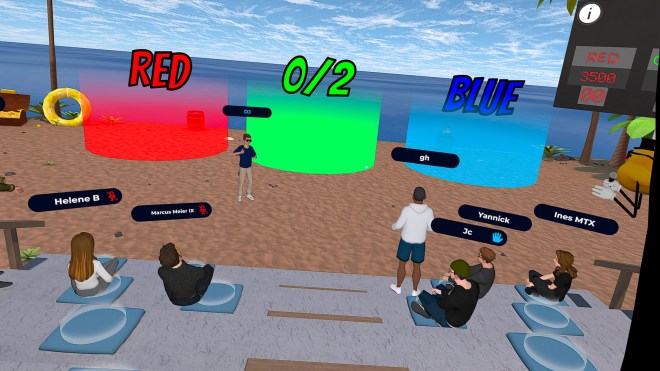
An initial discussion held in an open-air auditorium was followed by a group teleport to a lecture theatre where the embodied AI chatbot (a woman dressed in light blue, centre) held a conversation with a demonstrator (the woman named Ines MTX):

When I asked what generative AI system was being used to drive this demo, I was informed that Foretell Reality actually can use any of Google’s Gemini, OpenAI’s ChatGPT, or Anthropic’s Claude AI to generate responses. As somebody who was actually diagnosed with Type II diabetes during the recent pandemic, and who never had an opportunity to meet with a real-life diabetic coach, I would really have appreciated having something like this available!

Unfortunately, the conference session description was frustratingly short on concrete details: who the speakers were, what company (or companies) they represented (other than Foretell Reality), and who the actual client was. It was also not clear to me if this just a tech demo or an actual system used by real people. And, because I was in my Meta Quest 3 headset, I could not take any written notes as people were speaking. There was a company called MTX involved, as far as I can remember. This is an example of where an inadequate session description hampers my ability to report on the event itself, as impressive as the technology demo was.

Private, Present & Fully Heard: How Virtual Reality is Reclaiming the Power of Anonymous Peer Support

We started off in this open-air amphitheatre at dusk (I think they said it was based on Red Rocks in Colorado)

Unlike the previous day’s session, both sessions I attended in Foretell Reality were sterling examples of how social VR could be used as an effective solution to address real-world problems and issues, and provide tangible benefits.

First up, here’s the conference blurb about the NorthStar project:

In traditional Alcohol & Substance Use Disorder treatment spaces, anonymity is often promised but rarely provided. NorthStar’s groundbreaking VR platform redefines what true
anonymity can look like—and how it unlocks unparalleled honesty, vulnerability, and connection. This session explores how immersive, avatar-based peer support transforms treatment outcomes by allowing patients to show up fully without being seen, while feeling surrounded by a community. We’ll discuss how VR group therapy makes treatment more accessible, more private, and more powerful—meeting people where they are – literally – while protecting who they are.

Unfortunately, the representative from NorthStar was unable to be present at this session, but DJ from Foretell Reality still had plenty to show us, taking us on a sort of field trip through the various settings built by the company to facilitate NorthSatr’s virtual group meetings (based on Alcoholics Anonymous principles), such as an urban park where you could toss a stick and have one of several virtual dogs fetch it back to you:

Foretell Reality’s dog park, where virtual AA meetings are sometimes held

Other locations included a chilly space station, where you could see your breath in front of you in the frosty air, and gravity could be turned off and on at will:

Foretell Reality’s space station

And finally, a newer addition, a competitive shooting game where you were part of team trying to shoot down rubber ducks of various colours! (I’m not sure if this last one was actually used by NorthStar clients, though).

Duck hunting in Foretell Reality

Overall, and especially when combined with the following conference session I describe below, I came away with a very favourable impression of Foretell Reality. You can check out their website here.

Healing Beyond Walls: VR Social Support For Patients At SickKids

Shaindy the avatar presents a video of the real-life Shaindy, explaining the SickKids project

Another Foretell Reality client is Toronto, Ontario’s famous SickKids Hospital,where the conference blurb states:

Join us for a special fireside chat with Shaindy, Clinical Manager [of the] Child Life Program at SickKids Hospital in Canada and DJ Smith, Co-Founder and Chief Creative Officer of Foretell Reality. Together, they will share how virtual reality is transforming the way children facing serious illnesses connect, play, and support one another. Shaindy will discuss her groundbreaking program that allows kids to log in once a week to a virtual world for group sessions. DJ will highlight how Foretell Reality’s platform has powered successful clinical pilots and is now scaling to reach even more children. This conversation will explore the impact on patients and families, the power of hospital collaboration, and the future of immersive technology in pediatric care.  

By “kids,” Shaindy explained that these were actually teenagers (aged 13 to 19) who were in hospital or a hospice, fighting various health-threatening conditions such as cancer. Because of their illnesses, these teenagers often found it difficult to socialize, which is where social VR afforded them an opportunity to interact and have fun virtually. Shaindy explained that they would get groups of six or so patients together, and they would keep it open and freeform so the “kids” could join or leave as they felt able to do so.

Among the many stories told were the delight by one patient who discovered a rubber ducky hiding in one of the virtual environment, which led to a quest to hide ducks (and pigs!) in as many environments as possible, for others to find. DJ helpfully rezzed one such duck for show-and-tell (also a pig, but I didn’t take a picture of that!). I apologize for the lopsided aspect of some of these screenshots; determining the right balance of your head in a VR headset when taking screenshots is a bit of a black art, at which I usually fail miserably!!

Behold, a rubber duck! (Apologies for the awkward angle of this shot.)

The presentation ended with a group teleport to a meditation centre, where Saindy led us through a box breathing exercise, helped along by the in-world painting tools installed by Foretell Reality!

We ended with a box breathing exercise in a meditation temple, assisted by a little art therapy. (Again, apologies for the sideways tilt!)

This was one of the most heartwarming conference sessions I have ever attended, and I wish this project every success as they hope to expand this service to more hospitals in future!

Immersive Learning Beyond the Classroom

This session had a capacity crowd of avatars present, and was held in ENGAGE (in fact, there were so many avatars that my experience began to degrade to the point where I eventually had to bail out of my Vive Pro 2 VR headset or risk nausea!). Because of that, I missed about the final third of the talk. Here’s the blurb:

How can immersive environments transform teaching, learning, and cross-cultural connection? This panel brings together diverse perspectives from the fields of education and innovation.
Chris Madsen empowers organizations worldwide through the ENGAGE XR platform. Wolf Arne Storm and his team at the Goethe-Institut created GoetheVRsum, which explores new formats in culture, language, and creativity. Marlene May researches and teaches in 3D virtual spaces at Karlshochschule International University and Birgit Giering is pioneering the large-scale adoption of XR in schools of North Rhine-Westphalia. Moderated by Prof. Dr. Dr. Björn Bohnenkamp, this session will explore the future of learning beyond traditional classrooms.

However, this time I was able to take some chicken scratch handwritten notes! So here goes…Wolf-Arne spoke about the Goethe Institut, Marlene spoke about the Karlshochschule International University (in fact, the space where we met in ENGAGE was one of their creations), and Birgit spoke her work in the schools of North Rhine-Westphalia.

The Goethe Institut is Germany’s premier cultural institute, with locations around the world teaching German language and culture. The organization chose ENGAGE as their metaverse platform, creating a virtual space called the Goethevrsum. The Goethevrsum uses the works of various Bauhaus artists as inspiration for its design.

It was a shame that technical glitches kinda marred the overall experience for me, but I am glad that I was able to be able to make it in, and make it through most of it!

AI, WebXR and the Future of the Immersive Web

This session was held in (formerly Mozilla) Hubs, and much like all Hubs experiences I have ever had, it tended towards the spontaneous, the off-the-cuff and the chaotic! Like the ENGAGE session, it was unfortunately plagued by technical issues and problems. The presenter, Adam Filandr, talked about how he used open-source WebXR code and generative AI tools to create something called NeoFables, which delivered personalized worlds, characters, and storytelling (currently limited to 2D images, although he hopes to be able to expand it over time to create 3D content).

Screenshot

He discussed the advantages and disadvantages of using WebXR to create VR content, and gave a couple of examples of bigger-name projects which were based on WebXR (Wol, made by Google to provide information about the U.S. national parks system, and Raw Emotion Unites Us, about Paralympian athletes). It was interesting to hear a developer’s perspective of using WebXR to create content, mixed in with generative AI tools, however.

Will AR Be The Big Immersive Breakthrough (Heather Dunaway Smith and Lien Tran)

My final session on Thursday, Nov. 13th was not what I expected. It was a panel discussion with two musicians and artists, Lien and Heather, who have worked extensively with augmented reality and mixed reality. They shared samples of their work, and the panel (moderated by Christopher Morrison) held a wide-ranging discussion on how AR/MR/XR (or, as Chris said it, “XR-poly”) is impacting and transforming creative expression. I’m not sure if there will be a livestream of this talk (I did not see Carlos and his video camera while I was there), so I will leave it at that, since (again), I did not take written notes.

UPDATED! A Report from the IMMERSIVE X Conference, Nov. 11th, 2025

If anything, I urge everyone in our industry to build our digital spaces the way we design cities: with flow, gathering spots, heart and soul. Places that invite people to linger, not just scroll. It’s not just about what people see—it’s about where they feel seen.

—Andy Fidel, State of the Metaverse in 2026 keynote presentation, IMMERSIVE X Conference, November 11th, 2025 (in ENGAGE).

Julian Reyes delivering his talk titled Preserving the Legacy of Digital Culture: The Virtual Worlds Museum Living Archive, which took place yesterday evening my time in a virtual world in Spatial (I’m the blonde in the green T-shirt, sitting in the front row, near the centre bottom of this screen capture).

Yesterday, November 11th, 2025, I had the opportunity to attend three sessions of the IMMERSIVE X conference, held on three different platforms:

  • IMMERSIVE X 2025 Warm-Up: Curator’s Remarks (held in VRChat)
  • Andy Fidel’s keynote, The State of the Metaverse in 2026 (held in ENGAGE)
  • Julian Reyes’ presentation, Preserving the Legacy of Digital Culture: The Virtual Worlds Museum™ Living Archive (held in Spatial)

Warm-Up: Curator’s Remarks (Thomas Zorbach)

Set in a custom-built theatre surrounded by lush rainforest. Thomas Zorbach set the tone and agenda for the conference sessions to follow over the hree days of the conference. My friend Carlos Austin was the videographer for the event (as he no doubt will be for many of the conference sessions!), and he produced the following video of Thomas’ speech, which was posted to the IMMERSIVE X YouTube streams channel (I also took some photos using VRChat’s built-in camera, but I first have to figure out how to transfer them from VRChat to my blog!).

UPDATE Nov. 13th, 2025: I was finally able to add some photos I shot while in VRChat to this section of my blog post (please see the pictures above).

The State of the Metaverse in 2026 (Andy Fidel)

Andy’s keynote was prefaced by a half-hour red carpet awards session where various people were introduced, and several awards were given out (I arrived late for this part, but here’s the 35-minute video from IMMERSIVE X’s YouTube channel). Here’s the blurb from the conference program:

What an entrance! Dress your avatar to impress and flash your most dazzling smile for the photo. Once again, the path to the Opening Keynote leads across the legendary red carpet of the Polys Theater, home of the annual Polys Awards. Thanks to Ben Erwin and his incredible Polys team, this festive event marks the official start of IMMERSIVE X 2025. Don’t miss this prestigious social event in the Metaverse — you might just be in for a surprise or two.

After the red carpet, we all moved over to the main stage where Andy Fidel, the founder and creative lead at Spatial Networks, shared her insights on where the metaverse stands today and where it might be heading.

Andy Fidel on the virtual stage, giving her keynote address in ENGAGE (it was giving TED Talk!)
I took a selfie of my avatar in ENGAGE at the red carpet event prior to Andy’s keynote!

Because I attended the event in my Vive Pro 2 VR headset, I did not take written notes of her talk, but it was excellent! Also, Andy has asked that her talk not be streamed to YouTube, a decision which I can totally understand and respect. However, Andy was happy to share her speech notes with me, so I did not have to rely on my notoriously faulty 61-year-old memory to share a few quotes which especially resonated with me!

Andy started her presentation off with a sigh, stating:

I’m tired of the [metaverse] hype cycle. I don’t know what we’re all waiting for. Because I’ve seen us create real, human digital experiences—moments of presence—every day for the past ten years. This isn’t a sci-fi episode. The metaverse is already here. It’s in your browser tab. It’s not just a concept, a game, or a place. It’s how we’re choosing to show up online.

And my favourite [metaverse] misconception? We’re not escaping reality—we’re extending it.

There were more of Andy’s quotes which I really appreciated. In talking about the shift away from massive metaverse platforms to micro-communities, she said:

We’ve got to find new ways of measuring success when we talk about connection. Every social metric measures visibility, impressions, clicks, followers…that’s activity, not authenticity. And I don’t know about you—but I’m done chasing mass engagement and empty distribution. Because connection isn’t content. It’s presence.

And she talked about how, perhaps, we are a little too narrowly focused on what the “metaverse” is:

Let’s be honest—the metaverse didn’t start with VR. We’ve been building shared digital worlds for decades: Second Life, World of Warcraft, Minecraft…The only difference now? The new emerging tech finally lets us feel presence. VR, AR, digital—these are just new layers on something deeply human. “Metaverse” is just a new name for something we’ve always done: to gather. And to gather, we need space to do so. What’s different now? We have the technology to do it remotely, and feel like we’re right there. With embodiment, body language, haptics, even phantom touch—we’re tapping into all the little things that make our digital space feel more immersive and real.

And:

Virtual presence has become its own form of togetherness. We show up not just in person, but in-world. Because let’s be honest—why show up at all? Because you can feel it.

The metaverse isn’t here to replace the real world. It’s here to layer it with new forms of meaning. It’s not just a playground, [and] not just a marketplace. It’s a new layer of human communication.

And look—if you say, “the metaverse isn’t for me,” that a bit like saying “the internet isn’t for me” in the 1990s. You don’t have to love every corner of it. You just have to find the part that resonates. Because this isn’t about tech for tech’s sake. It’s about connecting—more intimately, across space, time and medium.

UPDATE Nov. 13th, 2025: I was finally able to add some photos I shot while in ENGAGE to this section of my blog post (please see above).

I want to thank Thomas Zorbach for shoehorning me into this avatar-packed session, after I personally begged him to let me in, even though the event was fully booked and no longer accepting signups. I did not want to miss Andy’s speech, and I was not disappointed!

Preserving the Legacy of Digital Culture: The Virtual Worlds Museum™ Living Archive (Julian Reyes)

I was not sure if I was going to be able to attend this session (I was having all kinds of trouble getting Spatial to work for me, and I eventually threw my hands up, gave up on attending in virtual reality, and instead visited via my flatscreen monitor on my Windows home computer instead). However, I am so, so glad that I did! A video stream of the 45-minute presentation has already been posted to the IMMERSIVE X YouTube channel, but I will also add some of my own remarks (since I was on desktop, I took written notes).

This blogpost will be updated as I add pictures and more of my impressions, so check back later today for those updates! I enjoyed all three sessions, and I am very much looking forward to the sessions I will be attending today and tomorrow!


With the deepest thanks to Andy Fidel for sharing her speaking notes with me. Thanks, Andy!

The IMMERSIVE X Metaverse Conference, November 11-13, 2025

I’m laid up with severe neck and shoulder pain, off sick from work today again, lying on the sofa and blogging via iPad, my neck propped up on a good pillow. In addition to visits to my family doctor and my physiotherapist (who also does acupuncture), I’ve started seeing a massage therapist. I had a one-hour massage session Friday morning, and felt wonderful afterward—only to have rebound neck and shoulder aches and pains which scuppered my Friday night plans and put me in a foul, cranky mood all weekend.

This is all coming at a time when I need to be well enough to attend a metaverse conference coming up this week! It’s the IMMERSIVE X Conference, organized and run from Berlin, Germany, but with events taking place in various social VR platforms and flatscreen virtual worlds. Instead of getting on a plane to go to a physical conference in meatspace, I just put on a VR headset and attend in cyberspace!

However, my physical pain today does not bode well for my metaverse excursions on Tuesday (Remembrance Day here in Canada, if not in Germany), Wednesday, and Thursday. Wish me well! I’m probably going to have to take breaks between sessions to pop painkillers, apply cold and heat packs, and do my prescribed physiotherapy exercises to get through this. But come hell or high water, I am going!!

I started preparing for the conference last week, revisiting some social VR platforms that I had not visited in many months, and making sure that I could still remember how to log in and move around in my Vive Pro 2 PCVR setup in my office (sadly neglected since I began my well-documented love affair with my Apple Vision Pro).

I must admit that I was surprised when I signed into my VRChat account on their website, to discover that I first joined VRChat 8 years ago! (You can find all my blogposts about VRChat here.)

And likewise, I had first joined ENGAGE in July of 2018, which means I have been using the metaverse platform for over seven years at this point! (You can find all my blogposts about ENGAGE here.) I am especially excited that the organizers were able to squeeze me into Andy Fidel’s keynote State of the Metaverse presentation in ENGAGE (a big thank you Thomas Zorbach and his team!).

In addition to VRChat and ENGAGE, I signed up for sessions being held on three other metaverse platforms: Spatial, Foretell Reality, and Hubs. I’ve been in Spatial and (formerly Mozilla) Hubs before, but Foretell Reality is new to me.

So I hope to be able to post my session notes to the blog, starting tomorrow. And, in the meantime, I will rest, take painkillers, do my physiotherapy exercises, and pray my body holds up. Stay tuned!