A Report from the IMMERSIVE X Conference, Nov. 12th and 13th, 2025

Because of my workload, I was only able to attend one session of the IMMERSIVE X metaverse conference on Wednesday, November 12th:

  • Conversational AI in Healthcare (held in Foretell Reality, which was a new-to-me platform).

However, I more than made up for it on Thursday, November 13th, attending the following five conference sessions:

  • Private, Present & Fully Heard: How Virtual Reality is Reclaiming the Power of Anonymous Peer Support (held in Foretell Reality)
  • Healing Beyond Walls: VR Social Support For Patients At SickKids (held in Foretell Reality)
  • Immersive Learning Beyond the Classroom (held in ENGAGE)
  • AI, WebXR and the Future of the Immersive Web (held in Hubs)
  • Will AR Be The Big Immersive Breakthrough? (held in VRChat)

So I will briefly report on each of these six sessions, one by one.

I accessed the three sessions held in Foretell Reality using the Meta Quest 3 wireless headset at my workplace, and I entered the sessions in ENGAGE and VRChat using my PCVR setup at work, a Vive Pro 2 VR headset tethered to a Windows desktop PC with a fairly decent NVidia gaphics card.

The final session, held in Hubs (formerly Mozilla Hubs), I could have entered via virtual reality, but instead I opted to pay a visit via the flatscreen monitor on my trusty MacBook Pro! By the end of the day, my neck and shoulders were aching, but I did make it through.

Conversational AI in Healthcare

This was not the first time that I had seen artificial intelligence combined with social VR (the first time was a memorable conversation I had with an AI-enhanced toaster in the now-shuttered platform called Tivoli Cloud VR, back in January of 2021), this one had a more practical purpose: to use generative AI to power a diabetes counselor (played by an NPC avatar) who could hold a conversation with a real-life person who has questions after being newly-diagnosed with type II diabetes.

An initial discussion held in an open-air auditorium was followed by a group teleport to a lecture theatre where the embodied AI chatbot (a woman dressed in light blue, centre) held a conversation with a demonstrator (the woman named Ines MTX):

When I asked what generative AI system was being used to drive this demo, I was informed that Foretell Reality actually can use any of Google’s Gemini, OpenAI’s ChatGPT, or Anthropic’s Claude AI to generate responses. As somebody who was actually diagnosed with Type II diabetes during the recent pandemic, and who never had an opportunity to meet with a real-life diabetic coach, I would really have appreciated having something like this available!

Unfortunately, the conference session description was frustratingly short on concrete details: who the speakers were, what company (or companies) they represented (other than Foretell Reality), and who the actual client was. It was also not clear to me if this just a tech demo or an actual system used by real people. And, because I was in my Meta Quest 3 headset, I could not take any written notes as people were speaking. There was a company called MTX involved, as far as I can remember. This is an example of where an inadequate session description hampers my ability to report on the event itself, as impressive as the technology demo was.

Private, Present & Fully Heard: How Virtual Reality is Reclaiming the Power of Anonymous Peer Support

We started off in this open-air amphitheatre at dusk (I think they said it was based on Red Rocks in Colorado)

Unlike the previous day’s session, both sessions I attended in Foretell Reality were sterling examples of how social VR could be used as an effective solution to address real-world problems and issues, and provide tangible benefits.

First up, here’s the conference blurb about the NorthStar project:

In traditional Alcohol & Substance Use Disorder treatment spaces, anonymity is often promised but rarely provided. NorthStar’s groundbreaking VR platform redefines what true
anonymity can look like—and how it unlocks unparalleled honesty, vulnerability, and connection. This session explores how immersive, avatar-based peer support transforms treatment outcomes by allowing patients to show up fully without being seen, while feeling surrounded by a community. We’ll discuss how VR group therapy makes treatment more accessible, more private, and more powerful—meeting people where they are – literally – while protecting who they are.

Unfortunately, the representative from NorthStar was unable to be present at this session, but DJ from Foretell Reality still had plenty to show us, taking us on a sort of field trip through the various settings built by the company to facilitate NorthSatr’s virtual group meetings (based on Alcoholics Anonymous principles), such as an urban park where you could toss a stick and have one of several virtual dogs fetch it back to you:

Foretell Reality’s dog park, where virtual AA meetings are sometimes held

Other locations included a chilly space station, where you could see your breath in front of you in the frosty air, and gravity could be turned off and on at will:

Foretell Reality’s space station

And finally, a newer addition, a competitive shooting game where you were part of team trying to shoot down rubber ducks of various colours! (I’m not sure if this last one was actually used by NorthStar clients, though).
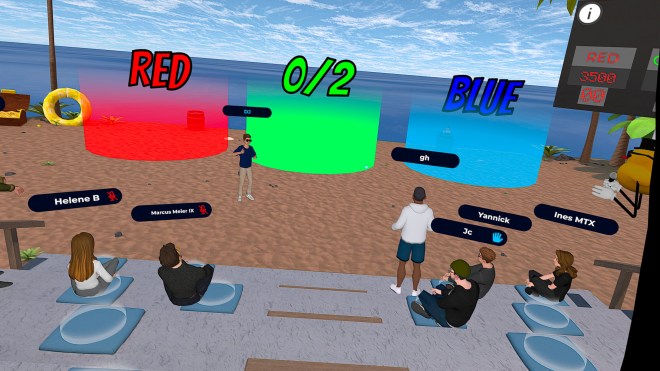
Duck hunting in Foretell Reality

Overall, and especially when combined with the following conference session I describe below, I came away with a very favourable impression of Foretell Reality. You can check out their website here.

Healing Beyond Walls: VR Social Support For Patients At SickKids

Shaindy the avatar presents a video of the real-life Shaindy, explaining the SickKids project

Another Foretell Reality client is Toronto, Ontario’s famous SickKids Hospital,where the conference blurb states:

Join us for a special fireside chat with Shaindy, Clinical Manager [of the] Child Life Program at SickKids Hospital in Canada and DJ Smith, Co-Founder and Chief Creative Officer of Foretell Reality. Together, they will share how virtual reality is transforming the way children facing serious illnesses connect, play, and support one another. Shaindy will discuss her groundbreaking program that allows kids to log in once a week to a virtual world for group sessions. DJ will highlight how Foretell Reality’s platform has powered successful clinical pilots and is now scaling to reach even more children. This conversation will explore the impact on patients and families, the power of hospital collaboration, and the future of immersive technology in pediatric care.  

By “kids,” Shaindy explained that these were actually teenagers (aged 13 to 19) who were in hospital or a hospice, fighting various health-threatening conditions such as cancer. Because of their illnesses, these teenagers often found it difficult to socialize, which is where social VR afforded them an opportunity to interact and have fun virtually. Shaindy explained that they would get groups of six or so patients together, and they would keep it open and freeform so the “kids” could join or leave as they felt able to do so.

Among the many stories told were the delight by one patient who discovered a rubber ducky hiding in one of the virtual environment, which led to a quest to hide ducks (and pigs!) in as many environments as possible, for others to find. DJ helpfully rezzed one such duck for show-and-tell (also a pig, but I didn’t take a picture of that!). I apologize for the lopsided aspect of some of these screenshots; determining the right balance of your head in a VR headset when taking screenshots is a bit of a black art, at which I usually fail miserably!!

Behold, a rubber duck! (Apologies for the awkward angle of this shot.)

The presentation ended with a group teleport to a meditation centre, where Saindy led us through a box breathing exercise, helped along by the in-world painting tools installed by Foretell Reality!

We ended with a box breathing exercise in a meditation temple, assisted by a little art therapy. (Again, apologies for the sideways tilt!)

This was one of the most heartwarming conference sessions I have ever attended, and I wish this project every success as they hope to expand this service to more hospitals in future!

Immersive Learning Beyond the Classroom

This session had a capacity crowd of avatars present, and was held in ENGAGE (in fact, there were so many avatars that my experience began to degrade to the point where I eventually had to bail out of my Vive Pro 2 VR headset or risk nausea!). Because of that, I missed about the final third of the talk. Here’s the blurb:

How can immersive environments transform teaching, learning, and cross-cultural connection? This panel brings together diverse perspectives from the fields of education and innovation.
Chris Madsen empowers organizations worldwide through the ENGAGE XR platform. Wolf Arne Storm and his team at the Goethe-Institut created GoetheVRsum, which explores new formats in culture, language, and creativity. Marlene May researches and teaches in 3D virtual spaces at Karlshochschule International University and Birgit Giering is pioneering the large-scale adoption of XR in schools of North Rhine-Westphalia. Moderated by Prof. Dr. Dr. Björn Bohnenkamp, this session will explore the future of learning beyond traditional classrooms.

However, this time I was able to take some chicken scratch handwritten notes! So here goes…Wolf-Arne spoke about the Goethe Institut, Marlene spoke about the Karlshochschule International University (in fact, the space where we met in ENGAGE was one of their creations), and Birgit spoke her work in the schools of North Rhine-Westphalia.

The Goethe Institut is Germany’s premier cultural institute, with locations around the world teaching German language and culture. The organization chose ENGAGE as their metaverse platform, creating a virtual space called the Goethevrsum. The Goethevrsum uses the works of various Bauhaus artists as inspiration for its design.

It was a shame that technical glitches kinda marred the overall experience for me, but I am glad that I was able to be able to make it in, and make it through most of it!

AI, WebXR and the Future of the Immersive Web

This session was held in (formerly Mozilla) Hubs, and much like all Hubs experiences I have ever had, it tended towards the spontaneous, the off-the-cuff and the chaotic! Like the ENGAGE session, it was unfortunately plagued by technical issues and problems. The presenter, Adam Filandr, talked about how he used open-source WebXR code and generative AI tools to create something called NeoFables, which delivered personalized worlds, characters, and storytelling (currently limited to 2D images, although he hopes to be able to expand it over time to create 3D content).

Screenshot

He discussed the advantages and disadvantages of using WebXR to create VR content, and gave a couple of examples of bigger-name projects which were based on WebXR (Wol, made by Google to provide information about the U.S. national parks system, and Raw Emotion Unites Us, about Paralympian athletes). It was interesting to hear a developer’s perspective of using WebXR to create content, mixed in with generative AI tools, however.

Will AR Be The Big Immersive Breakthrough (Heather Dunaway Smith and Lien Tran)

My final session on Thursday, Nov. 13th was not what I expected. It was a panel discussion with two musicians and artists, Lien and Heather, who have worked extensively with augmented reality and mixed reality. They shared samples of their work, and the panel (moderated by Christopher Morrison) held a wide-ranging discussion on how AR/MR/XR (or, as Chris said it, “XR-poly”) is impacting and transforming creative expression. I’m not sure if there will be a livestream of this talk (I did not see Carlos and his video camera while I was there), so I will leave it at that, since (again), I did not take written notes.

The IMMERSIVE X Metaverse Conference, November 11-13, 2025

I’m laid up with severe neck and shoulder pain, off sick from work today again, lying on the sofa and blogging via iPad, my neck propped up on a good pillow. In addition to visits to my family doctor and my physiotherapist (who also does acupuncture), I’ve started seeing a massage therapist. I had a one-hour massage session Friday morning, and felt wonderful afterward—only to have rebound neck and shoulder aches and pains which scuppered my Friday night plans and put me in a foul, cranky mood all weekend.

This is all coming at a time when I need to be well enough to attend a metaverse conference coming up this week! It’s the IMMERSIVE X Conference, organized and run from Berlin, Germany, but with events taking place in various social VR platforms and flatscreen virtual worlds. Instead of getting on a plane to go to a physical conference in meatspace, I just put on a VR headset and attend in cyberspace!

However, my physical pain today does not bode well for my metaverse excursions on Tuesday (Remembrance Day here in Canada, if not in Germany), Wednesday, and Thursday. Wish me well! I’m probably going to have to take breaks between sessions to pop painkillers, apply cold and heat packs, and do my prescribed physiotherapy exercises to get through this. But come hell or high water, I am going!!

I started preparing for the conference last week, revisiting some social VR platforms that I had not visited in many months, and making sure that I could still remember how to log in and move around in my Vive Pro 2 PCVR setup in my office (sadly neglected since I began my well-documented love affair with my Apple Vision Pro).

I must admit that I was surprised when I signed into my VRChat account on their website, to discover that I first joined VRChat 8 years ago! (You can find all my blogposts about VRChat here.)

And likewise, I had first joined ENGAGE in July of 2018, which means I have been using the metaverse platform for over seven years at this point! (You can find all my blogposts about ENGAGE here.) I am especially excited that the organizers were able to squeeze me into Andy Fidel’s keynote State of the Metaverse presentation in ENGAGE (a big thank you Thomas Zorbach and his team!).

In addition to VRChat and ENGAGE, I signed up for sessions being held on three other metaverse platforms: Spatial, Foretell Reality, and Hubs. I’ve been in Spatial and (formerly Mozilla) Hubs before, but Foretell Reality is new to me.

So I hope to be able to post my session notes to the blog, starting tomorrow. And, in the meantime, I will rest, take painkillers, do my physiotherapy exercises, and pray my body holds up. Stay tuned!

UPDATED: Mozilla Ceases Support for Mozilla Hubs (but the Open-Source Hubs Community Edition Continues)


HOUSEKEEPING NOTICE: Today is the first of twelve successive Mondays which I am taking as research days from my full-time paying job as an academic librarian at the University of Manitoba. During this time, I am finally tackling two long-delayed tasks:

  1. Updating and reorganizing my list of social VR, virtual worlds, and metaverse platforms (to which I add new platforms as I write about them on my blog; and
  2. Updating and reorganizing the more detailed spreadsheet, a comparison chart of social VR platforms (here’s a direct link to a read-only copy of that spreadsheet).

Of these two, I have decided to immediately start on the second project, which I have not worked on since 2019 (but I would like to thank Dr. Fran Babcock, who made some updates to this spreadsheet in 2021).

This task is long overdue, and there are many entries of metaverse platforms which have shut down since the first version of this spreadsheet, among them:


But, to me, the saddest of the shutdowns arrived this month, when Mozilla announced in a blogpost on February 15th, 2024:

On February 13, 2024, Mozilla announced an organization-wide restructuring impacting a number of products housed within the Mozilla Corporation. Unfortunately, Hubs is one of the products impacted and it will be shut down later this year. This will be a multi-month process with three members of the Hubs team overseeing the transition.

We look forward to having more time to reflect on the full history of the Hubs project, where we succeeded, where we came up short, our feelings about it ending, and Hubs’ overall legacy. However, right now our only goal is to support you as you have so lovingly supported us after learning this sad news and over the last six years...

While we hope that Hubs can have a vibrant life outside of Mozilla, there are a number of pieces of Hubs that will end as part of the shutdown. These include the Hubs Demo Server (hubs.mozilla.com) and the Managed Subscription, the two services actively maintained by Mozilla that most of our users rely on.

Last October, Mozilla announced that it had decided to discontinue the Hubs Cloud hosting service, which ran on AWS (Amazon Web Services). In its place, the company announced the Hubs Cloud Community Edition:

Community Edition is designed to help developers deploy the full Hubs stack on any Linux-based infrastructure, including AWS, Google Cloud, and even your own computer. In the same way that Hubs Cloud mimicked how the Hubs team ran the server managed by Mozilla, Community Edition mimics the infrastructure our team uses for the managed subscription service. Community Edition simplifies and automates most of the complex deployment process using Kubernetes, which is a containerized software orchestration system.

The obvious benefit of a solution like Community Edition is that it gives developers more choices for hosting Hubs. The less obvious benefit is that it offers greater flexibility when dealing with significant updates to a hosting platform. In the past, if there was a major update to the AWS platform, Hubs Cloud developers had to wait for our team to release a new version of AWS launch configuration. Community Edition eliminates this limitation.

Unlike Hubs Cloud, Community Edition is designed for developers who are well-versed with the full Hubs stack and comfortable navigating cloud hosting platforms. While we will be providing examples and guidance on how to host Community Edition, we will not designate a primary hosting platform, as we did with AWS for Hubs Cloud. Community Edition users will be responsible for researching, evaluating, and staying informed about the hosting options available to them.

Setting up Community Edition will require more effort than many of our current Hubs Cloud customers may be accustomed to. However, we believe that this direction best empowers our developer community. Many of you have already chosen to bootstrap and self-host the codebase on your own instead of using Hubs Cloud, and we hope that Community Edition will offer a more straight-forward approach for achieving your goals.

In the Feb. 15th announcement, Mozilla stated that the sunset plan and timeline for Hubs Cloud has not been changed. The company has already ceased support for Hubs Cloud on AWS as of January 1st, 2024, however existing Hubs Cloud instances will not be automatically shut off, as the FAQs section of the October 2023 announcement explains:

We will be ceasing to support Hubs Cloud on AWS starting on January 1, 2024. Existing Hubs Cloud instances will not be automatically shut off on January 1. On that date, we will de-list Hubs Cloud from the AWS marketplace to disable new sign-ups. Existing customers will then have a minimum of 90 days to migrate to another Hubs service before their subscriptions to Hubs Cloud come to an end. The earliest date for these subscriptions to cease will be March 30th…

Developers may continue to use their subscription and manually maintain their instances until we fully remove Hubs Cloud from the AWS marketplace (March 30th, 2024 at the earliest). After January 1, it is difficult to predict which AWS platform updates released will impact current Hubs Cloud customers, given the variability in current Hubs Cloud instances. Many customers, whose instances were created years ago, may not have kept their code current with the updates that have been released. However, if you have experience with AWS development, there’s no reason you cannot manually troubleshoot these issues yourself to continue using your existing instance…

We are currently working on tools to automate the data migration process from existing Hubs Cloud instances to Community Edition and Managed Subscription instances. These tools may vary from platform to platform, however expect to see them released in the lead-up to January 1st. Join our Discord server and check out the #community-edition channel to stay tuned!

Here’s the shutdown timeline, provided by Mozilla in its Feb. 2024 blogpost:

  • March 1st, 2024: The creation of new subscriptions will be disabled. Existing subscriptions will be able to continue using their instances until the full shutdown is complete. The demo server will continue to function as normal.
  • April 1st, 2024: A tool to download your data will be released. Demo users and subscribers will be able to begin downloading their data.
  • May 31, 2024: Existing subscription instances and the demo server will be turned off. All Mozilla-run community resources and platforms will also be turned off.

From this timeline, it sounds as though the official Mozilla Hubs Discord server will also be shutting down on May 31st (I have just posted a question in that Discord to confirm that assumption, though, and I will report back). I am also somewhat concerned that all the links to join the Mozilla Hubs Discord server in the Feb. 15th blogpost give me errors, but I have generated a new invite link here (and reported the problem in their Discord):

The invite links in the announcement blogpost all give errors! Here’s a new one.

So, all of this means that Hubs users have some difficult decisions to make over the next few months, as the sunset timeline marches ahead. However, the future looks promising for Hubs to continue as an open-source, community-run initiative. As Mozilla states in their sunset blogpost:

Hubs’ code is open source, which means that it can have a life outside of Mozilla. Since [the February 15th] announcement, many former Hubs team members have returned to the Discord server to remind the community that Hubs was built with life outside of Mozilla in mind. The project’s commitment to open source and focus on self-hosted versions of Hubs mean that no one entity can determine Hubs’ future; only this community can do that.

And (as we have seen with Tivoli Cloud VR, Vircadia, and Overte springing from High Fidelity), there is already precedent in having a metaverse platform move from company-run to community-run (albeit with varying degrees of success!). I wish the team at Mozilla, and the Hubs community, nothing but the best during this transition, and I look forward to participating in Hubs Community Edition.

Mozilla Hubs will be missed!

UPDATE Feb. 27th, 2024: Michael Morran, of the Mozilla Hubs team, has responded to my questions about the Hubs Discord server and the invite link:

Hey Ryan, thanks for the write-up. The broken link is not intentional, so I’ll update that now. As far as what happens to the discord after May 31, we are currently unsure what Mozilla can transfer over to the community, but we hope to get clarity on this soon.

Thanks, Michael! Here’s the updated invite link for the Mozilla Hubs Discord server.

Mozilla Hubs and Sketchfab Announce a Design Challenge: Create Your Own Clubhouse!

Mozilla Hubs 30 Oct 2018.png

Sketchfab and Mozilla Hubs are teaming up for a contest: design your own clubhouse! (Apparently, this is a trend in virtual world contests…)

Welcome to our new community contest! Once again we’ve joined up with the Mozilla crew to build virtual worlds. This time we’re exploring their new Hubs platform and populating it with new spaces and props.

The theme is ‘Clubhouse’ – this can be anything from a treehouse to a speakeasy, a space station to a super-secret gathering space at the bottom of the ocean. You’ll be challenged to design both the space as well as props for it so that other people can use them on Mozilla Hubs.

About Mozilla Hubs

Hubs is Mozilla’s new social 3D platform. It lets you meet friends, ‘voice talk’ to them, and decorate the space with any kind of content, including YouTube videos, images and, of course, Sketchfab models – just by visiting a link.

Give it a try now! Visit this room on Hubs, open a second window with downloadable Sketchfab models and just copy and paste the page URL for in any downloadable Sketchfab model to add it to your space.

The prizes are pretty sweet, too:

1st Place

  • $1,000 Amazon Gift Card
  • Oculus Go – If Amazon supports shipping in country ($200 gift card if not)
  • 1 year of Sketchfab PRO

2nd Place

  • $750 Amazon Gift Card
  • Oculus Go – If Amazon supports shipping in country ($200 gift card if not)
  • 6 months of Sketchfab PRO

3rd Place

  • $350 Amazon Gift Card
  • Oculus Go – If Amazon supports shipping in country ($200 gift card if not)
  • 3 months of Sketchfab PRO

10 Honorable Mentions

  • $50 Amazon Gift Card
  • 1 month of Sketchfab PRO

The contest deadline is Tuesday, November 27th, 2018. The complete list of contest details and rules can be found here.