InZOI: A Two-Part Look at the New Life Simulation Game, Focusing on Avatar Customization

You might remember that I said I had had a hard drive crash on my Windows desktop PC in May of 2025, which (among other things) put my Valve Index PCVR headset out of commission until recently. Well, another casualty of that hard drive crash was some software which I had installed a week or so earlier, a life simulation game called InZOI, by a South Korean video game company called KRAFTON. Think of the Sims, but with some truly breathtaking graphics and avatar customization tools (as you’ll see).

I wanted to share my experience with you, even though I would not classify InZOI as a metaverse platform, because I think I can see a vision where some of the features of this life simulation game could potentially lend themselves towards a next-generation metaverse.

So, I had started writing a blogpost about my initial experiences with InZOI in April 2025, but it wasn’t until yesterday (Sunday, August 30th, 2026) that I finally got around to reinstalling the client software on my hard drive.

First, I’m going to share with you the original text I wrote in April 2025 (plus screen captures), then I’m going to finally finish the post I had started 16 months ago, showing you the avatar customization features (which is what had intrigued me enough to purchase and install the software in the first place). Finally, I’m going to wrap this up by explaining why I don’t like InZOI, and why I’m probably not going to be playing it (or talking about it on my blog) very much.

Still with me? Okay, let’s dive in.


Part One (Originally Written April 2025)

As a librarian, it’s hard not to like a game with an opening sequence set in a library!
The graphics in inZOI are pretty impressive! Here, my avatar wanders around the beach in Bliss Bay.
My ZOI avatar catches some virtual rays on the beach in Bliss Bay, The lighting is among the best I have seen in any virtual world, but you will need a good graphics card to see it in the best way!

I first heard about InZOI last year, via some excited chatter among the Second Life user community who were creating some amazingly lifelike avatars using a time-limited test period of the new game’s much-vaunted character creator module. Here’s a half-hour YouTube video giving you a rundown of how it worked as of late 2024:

Well, after a second demo period earlier this year, InZOI finally became available for purchase via the Early Release program on Steam two weeks ago, and since my Windows desktop computer met all the recommended hardware requirements, I decided to buy it now. The game is still in beta, with a limited feature set, and it’s buggy in places, but I was especially curious to put the character creator software to the test, to see what kind of avatars I could create, and I also wanted to wander around and explore the worlds which were already available.


Now, before we get started, I want to make it clear that I am not really into life simulation games per se. You might not know this, but there is already a vibrant subculture within Second Life, where avatars purchase, use, and follow life simulation systems sold under various brand names (e.g. MyStory), which mean that your avatar feels thirsty, hungry, dirty, tired, the need to go to the bathroom, etc. And, of course, the entire line of Sims life simulation games have been quite popular since their first release back in 2000 (predating Second Life by three years).

I want to point out that there is a key difference between a metaverse platform like Second Life or Sansar (we’ll get back to Sansar in a minute) and a life simulation game like the Sims or InZOI. In a metaverse, you usually can join for free and then pay as you go, shopping for avatar customization items like skins, hair, and clothing. In a life simulation game, you pay up-front for the game, which includes a broad range of built-in avatar customization options to get you started. (Of course, both types of virtual world usually offer an in-world marketplace, where players buy and sell user-created content with each other.)

Avatars in InZOI are called ZOIs, and you can create not only yourself, but also a entire family of characters that you can interact with.


Part Two (Written August 2026)

Okay, today I want to focus on the avatar customization features in InZOI, which I found to be rather impressive. I will assume that, in the intervening 16 months, that a few bug fixes and updates have added a bit more polish to these avatar (erm, ZOI) customization features.

You create and customize your ZOI using the Character Studio, which allows you to start by selecting a preset (the round buttons on the right hand side of the screen), and other characteristics such as age (on the left side of the screen):

You have your choice of six different ages to choose from.

You can also pan, zoom, and rotate your ZOI to get a better look at him:

I noticed some interesting parallels between 2025/2026-era InZOI and 2017/2018-era Sansar (a social VR platform which you can still visit today). To my mind, at least, Sansar walked so InZOI could run. Here’s what the facial customization features in Sansar look like:
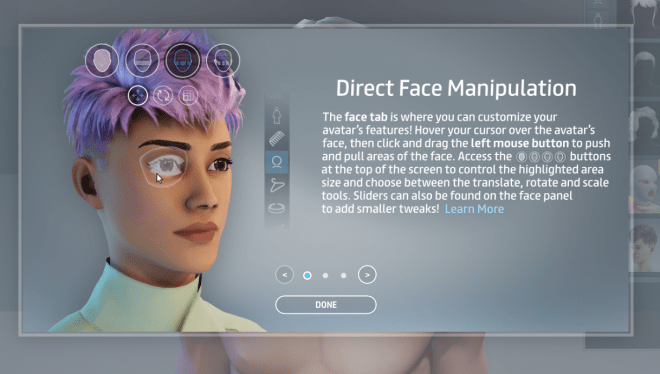
THIS IS SANSAR, NOT INZOI! Sansar screen shot: direct face manipulation

Sansar allows you to select the entire head, or just specific sections of the head/face, and then use the mouse to push and pull (translate, rotate, and scale) areas to completely customize the head of your avatar. Here’s a short video of what the face/head customization features look like (and, as I said, if you’re interested, you can download and install Sansar yourself and play around with it; you can run the client software without a VR headset, on your Windows desktop PC).

THIS IS SANSAR, NOT INZOI! Sansar’s head/face customization tools in action.

Now, compare Sansar’s tools with how InZOI has approached the problem: instead of giving you the translate, rotate, and scale options, you simply click on the white dots and drag on parts of the head and face to adjust them. (Also note the much higher level of detail in the avatar, erm, ZOI. We’ve come a long way from 2017, baby!!)

Head and facial adjustments in InZOI’s Character Studio

And, there are a similar set of drag-and-drop features and some sliders to customize your ZOI’s body shape (Sadly, the plug was essentially pulled on Sansar before the next planned step, a similar sort of body modification, could be coded.)

A look at the body customization options in InZOI’s Character Studio

Now, imagine a metaverse platform with InZOI’s level of avatar customization. Can you see the vision? (C’mon, work with me, people!! 😉)


To wrap up, I am going to talk a bit about why I am not a fan of life simulation games like the Sims and InZOI. A key difference between a life simulation game such as InZOI, and a metaverse platform like Sansar or Second Life, is that in the former, everybody else you encounter is an NPC; there are no other real players steering ZOIs in your game! InZOI is a solitary pursuit, whereas true metaverse platforms like Second Life can be a highly social experience if you wish it to be.

Another thing I dislike about life simulation games like InZOI is that they are, by definition, games, with all the built-in limitations that games possess. Yes, you can design and build your dream house and furnish it—but only in carefully-controlled and corralled, predefined cities (you have three to choose from in InZOI at present, although I expect they will expand this over time). You do not have the blank, three-dimensional creative canvas which a true metaverse platform offers you, to be wild and crazy and build whatever you can dream of.

Many years ago, I played the Sims for something like a week, quickly got bored, and quit. I much prefer using Second Life for my creative expression, and as a temporary escape from nasty, painful, chaotic real life. The very last thing I wanted in any game was to constantly be checking various on-screen meters and gauges to see if my avatar needed cheering up, to go sleep in a virtual bed, or to run to a virtual toilet!

Yesterday, I took my new avatar (erm, ZOI) out of her house. As she was walking down the street, while I was still getting comfortable with the WASD navigation controls, she kept bumping into NPCs who were also walking by her on the sidewalk. And, of course, as programmed NPCs, some would stop and glare at her. The whole excursion landed up making me so anxious that my ZOI scurried back to the safety of her home! And frankly, it also depressed me to think that, here I was, avoiding some real-life responsibilities while basically watching my ZOI pretty much run through her day on auto-pilot. (And yes, the irony that I also essentially do this in Second Life and VRChat and other metaverse platforms is not lost on me, at all.)

I spent less than an hour in my resintalled copy of InZOI before I decided to quit. I’m in no hurry to go back. Truly, the only things I found interesting about InZOI were the avatar customization features (maybe because they reminded me of Sansar’s).

So, yeah, despite InZOI’s many shiny new features, I’m still not a fan of life simulation games. I still want the freedom of that blank creative 3D canvas which a true metaverse platform offers me, and I also want the inherently social aspect of virtual worlds and social VR/AR—to know that most of the other avatars I encounter have real-life people behind them! (And yes, I am aware that there can be bots and NPCs in spaces like Second Life and Sansar, too. That does not negate my argument that metaverse platforms are inherently designed to be social spaces.)

NEWLY UPDATED WITH VIDEO! Your Metaverse Is Too Small: My Keynote Presentation to the 2026 Virtual Worlds Best Practices in Education (VWBPE) Conference

Marie Vans (left) introduces me (right) as a keynote speaker at the 19th annual Virtual Worlds Best Practices in Education conference, held in the pioneering virtual world of Second Life (screen capture from the video at the end of this blog post)

As some of you might know, a while back I was asked by my librarian colleague (and fellow Second Life aficianado) Marie Vans if I would be willing to be one of the three keynote speakers during the 2026 Virtual Worlds Best Practices in Education (VWBPE) Conference, which is held every year in the pioneering virtual world of Second Life. I said yes (of course!). I never turn down an opportunity to give a presentation in my beloved Second Life. (I was asked to speak at the 2021 Virtual Ability Mental Health Symposium, giving a presentation on the topic of this blogpost on acedia during the pandemic, and in 2024, I gave a presentation on virtual world building in Second Life, in Second Life, to a graduate class in virtual world building and design, which was team-taught by a computer science professor and an interior design professor.) So, as you can see, this was not my first rodeo. 😉

The title of my presentation, which I gave as the keynote speech of the conference on its second day, Friday, March 20th, was Your Metaverse Is Too Small: How the Biases and Preconceptions of Virtual Worlds Hinder Their Use in Education. I was inspired by a keynote address at last November’s IMMERSIVE X conference by Andy Fidel, who titled her talk, held on the ENGAGE social VR platform: The State of the Metaverse in 2026. My talk therefore consisted of three parts as follows:

  • Quotes from Andy Fidel’s talk which I found inspiring and wanted to share (7 slides);
  • My initial, general observations about the metaverse (4 slides); and finally
  • A section titled Your Metaverse Is Too Small, where I discuss various ways our biases and preconceptions about virtual worlds and social VR/AR actually hinder their effective use in educational settings (with reference to Andy’s comments; 14 slides).

Yes, it’s a lot to cover in 45 minutes, but I did it! I’m just going to share my slides as-is, without any Creative Commons-type license this time around, since a lot of it is referring back to Andy Fidel’s ideas, which I found so inspirational in the first place. And yes, while the topics of these 14 slides in part 3 all sprang out of one particularly fevered brain dump of my ideas one evening, rather than relying on GenAI, I do freely admit that I fed my entire blog into a Google NotebookLM and asked it questions in order to create the content based on thirteen (yes, 13!) different ways that, quote: “your metaverse is too small!

Your metaverse is too small because…

  • it has too steep a learning curve for new users
  • your platform has a poor fit-to-purpose
  • it lacks accessibility features (e.g. speech-to-text for the Deaf/HoH community)
  • it is poorly designed and/or Quality Assurance tested, and it causes VR sickness/nausea (more common among women than men)
  • it is soulless/designed by committee (hello Meta Horizon Worlds and Workrooms! Proof positive that you cannot will metaverse platforms into existence by executive fiat and the spending of billions of dollars.)
  • it requires a VR/AR/XR headset (I used two slides to discuss this controversial take; see below for more detail)
  • it relies on cryptocurrencies, NFTs, or some other form of blockchain (do I really have to explain this at this point?)
  • it has poor (or non-existent) safety and trust features and policies
  • it focuses on the product rather than the community
  • it has user data privacy issues/is based on surveillance capitalism (once again, hello Meta Horizon Worlds and Workrooms!)
  • you fail to market it properly (or, in many cases, fail to market it at all)
  • it is unfriendly to different cultures and subcultures (e.g. trans people, furries, etc.)
  • (another controversial one, explained further below) it refuses adult content

Now, before all you social VR adherents rise up with torches and pitchforks and tar and feather me for even daring to say “your metaverse is too small because it requires users to have a VR/AR/XR headset,” here are the two slides, plus speaker notes:

Your metaverse is too small because it requires you to use a virtual reality headset.

It is not a surprise that many of the most popular social VR platforms (e.g. Rec Room, VRChat) also allow for non-VR users to participate. The VR headset market still has not taken off. Even the best-selling Meta Quest line of wireless virtual reality headsets (which make up an estimated 70% of the global VR headset market) has sold only approximately 30 million units around the world, and many of those devices land up collecting dust after the initial novelty of the product wears off. Apple’s Vision Pro, launched to enormous fanfare, does not publish sales figures, but industry reporters said that the company shipped approximately 390,000 units in 2024 and approximately 90,000 units in 2025. VR hardware remains bulky, heavy, and uncomfortable for extended wear. Nausea continues to affect a significant proportion of users. A VR headset isolates the wearer from their physical surroundings and from the facial expressions of the people around them—an anti-social device, in practice, even when its purpose is socialization via social VR.

The PC-tethered VR headset market—the high-end, high-fidelity segment that many early social VR platforms had built toward—proved especially stagnant. The dream of millions of consumers owning gaming-grade PCs with tethered Oculus Rift or HTC Vive headsets never materialized. Even the shift to standalone headsets like the Meta Quest series failed to generate the consumer mass-market that had been anticipated. Sansar is perhaps the most instructive case study in the danger of building a platform around assumed headset adoption. Developed by Linden Lab—the company behind Second Life—Sansar was announced in 2014 and launched in beta in 2017, timed almost precisely to coincide with what seemed like the dawning of the VR era following Facebook’s acquisition of Oculus. But the bet on tethered PCVR headsets never paid off. In March 2020, Linden Lab sold Sansar to a little-known startup called Wookey and pivoted to focus on live music events and virtual concerts, attempting to find a more sustainable niche. That hasn’t worked, either. Sansar still exists, but it is only being kept alive by volunteers at this point.

Research on technology adoption consistently shows that devices requiring behavioral change—for example, for VR, wearing something on your face, isolating yourself from physical surroundings—face much higher adoption friction than technologies that integrate into existing habits. The iPhone and Android phones succeeded partly because they fit into already-established phone-carrying behavior. VR headsets require building a new behavior from scratch.

The failure of the last metaverse hype cycle does not mean that immersive technology has no future. What failed was the specific prediction that millions of people would soon be spending significant time in virtual worlds accessed primarily through VR headsets; that this would create platform-scale opportunities comparable to social media or mobile devices.

Don’t hate me for speaking facts. No VR/AR headset (even the Meta Quest line of headsets) has taken off in the way that iPhones/Android phones and tablets and smartwatches have. In particular, the developers of those platforms who bet the farm on widespread adoption of high-end tethered PCVR headsets (hello, Sansar and High Fidelity!) lost that bet badly; Sansar is essentially moribund, and High Fidelity is now closed (although it does live on in its successor social VR platforms Vircadia and Overte, which were based on HiFi’s open-source codebase, but are also not heavily used). This failure is one of the reasons why Second Life is still going strong (or strong enough) to endure and still be profitable for Linden Lab, for over 22 years now.

And speaking of SL…

I want to make one thing very clear: in some educational applications of the metaverse (especially those intended for children and teenagers, i.e. K-12 education), a ban on adult content is absolutely necessary.

However. As my speaker notes for this last slide in my presentation state:

However, in any institution of higher learning (e.g. a university). you will find faculty, staff, and students teaching about, learning about, and doing research on topics which may include controversial or adult topics. I have argued that one of the most significant strategic errors a metaverse platform can make is the outright refusal to host adult content (or do some other sort of heavy-handed sanitization of adult content, like imposing baked-on underwear on the base male and female adult avatars).

In my blog, I’ve pointed out that for some successful virtual worlds, adult communities are not just a niche—they are the economic and social engine that keeps the lights on. I have frequently cited Second Life as the prime example of a platform that understands the value of adult content. On my blog, I’ve noted that the adult-rated regions of Second Life generate a good portion of the platform’s revenue through land tier fees and the sale of virtual goods (clothing, skins, animations). In contrast, I wrote about Sansar’s early decision to strictly moderate content and its struggle to establish a clear policy on adult material. I argued that by trying to keep the platform “brand-safe” for corporate partners, they essentially “cut off their nose to spite their face,” alienating a potential demographic of creators and consumers who were ready to spend money on higher-fidelity adult experiences. And the corporate clients never came anyway!!

I believe that the ability to explore one’s identity—including its sexual or adult aspects—is fundamental to the metaverse experience. For example, both Second Life and VRChat tend to attract the trans community, giving them a way to experiment with how they represent themselves in a way that might be difficult or impossible to do in real life (particularly at a time when trans people are increasingly under attack in certain jurisdictions). Platforms that ban adult content often end up banning people by extension. If a platform’s moderation is too aggressive, it can lead to the marginalization of subcultures (like the furry community or the trans community) who use virtual worlds as a safe space for exploration. This aligns with Andy’s focus on “presence” and “feeling seen”. Andy argues that gathering spaces should be “smaller, weirder,” and more human. I have argued that by refusing to host adult content, platforms are choosing “corporate safety” over “human authenticity.” They are creating “noise” for brands rather than “spaces that matter” to real people.

One of my core arguments is that you cannot impose a culture on a virtual world; the users bring the culture with them. I’ve pointed out that in almost every successful social VR platform (like VRChat), “NSFW” content and communities exist regardless of official policies. Trying to ban these things is like trying to stop the tide with a broom. Platforms that fight their own communities on this issue usually lose the “heart and soul” that Andy Fidel says is required for a space to be successful. Andy speaks about “architecting belonging” and building spaces like cities. A real-life city has red-light districts, gay bathhouses, private clubs, and adult stores. By refusing to allow these “niche micro-communities” to exist, platform owners are failing to be the architects of a real society and are instead acting as corporate landlords of a sanitized shopping mall.

Okay, enough ranting. Here’s my slide presentation, which you can download to read the rest of my slides and my speaking notes:


Please note: while Philip Rosedale’s keynote speech on the first day of the Virtual Worlds Best Practices in Education conference on Thursday, March 19th has already been uploaded to the VWBPE YouTube channel, mine has not yet been uploaded to view. When it is, I will update this blogpost with a link to the video of my talk.

UPDATE March 30th, 2026: The video of my presentation in Second Life has now been uploaded to the VWBPE YouTube channel! Here it is (and I haven’t even watched it myself yet):

Terje Jansen, 1963-2023: Grieving a Loss in the Sansar Community

Today is a sad day.

Terje Jansen was a vital part of the small but dedicated Sansar community, known for his welcoming friendliness, his story-telling, and his Norwegian accent. He loved Sansar so much that he became a member of the new Sansar team, and his presence will be sorely missed by many.

Terje passed away on Feb. 13th, 2023, but it was not until yesterday afternoon that word of his death reached the Sansar Discord server, where it was met with shock and sadness.

There will be a number of events taking place in Sansar this week, an open mic chat on Monday, March 13th for those who knew Terje, plus a couple of memorials taking place on Saturday, March 18th. Please check the Sansar events listing for details on the times and locations of these and many other events.

If you wish to pay your respects, the Ebbe and Terje virtual in-world memorial is located here. Terje’s virtual tombstone sits on a small hill under an oak tree, right next to that of Ebbe Altberg, who was the CEO of Linden Lab, the company who originally created Sansar (he passed away in 2021).

Throughout the afternoon (my time), avatars would come and pay their respects, using text chat to share reminiscences and offer each other support.

There’s also a memorial webpage (it’s in Norwegian; please use your in-browser translator to read the tributes in English).

UPDATED: Sansar Launches a New Homepage (and an Age 18+ Rating)

If you visit the Sansar homepage (and you’re not already signed in with your Sansar account), you will see a brand new, revamped homepage for the five-year-old social VR project:

One noticeable change is the “18+” logo prominently displayed, something which I do not remember seeing before. Wasn’t the age limit formerly 13+? I can’t recall, but I was pretty sure that teenagers were allowed onto Sansar, back in the days when naked base humanoid avatars were forbidden (you had to have baked-on underwear, or your avatar would be removed from the Sansar store).

So, it would appear that the new owners of Sansar are going to allow adult content. This would probably give them an advantage, in that few other social VR platforms currently allow adult content. Let me disgress by explaining how Second Life (Sansar’s predecessor in many ways) handles adult content.


BACKGROUNDER: In Second Life, they have a system where a sim (the basic parcel of virtual land) has one of three ratings:

  • General: “A region designated General is not allowed to advertise or make available content or activity that is sexually explicit, violent, or depicts nudity. Sexually-oriented objects such as “sex beds” or poseballs may not be located or sold in General regions.”
  • Moderate: “Second Life’s Moderate designation accommodates most of the non-adult activities common in Second Life. Dance clubs, bars, stores and malls, galleries, music venues, beaches, parks, and other spaces for socializing, creating, and learning all support a Moderate designation so long as they do not host publicly promoted adult activities or content and do not use adult search tags.”
  • Adult: “The Adult designation applies to Second Life regions that host, conduct, or display content that is sexually explicit, intensely violent, or depicts illicit drug use.”

While generally, Second Life is meant for people age 18 and up, in special cases, those age 13-17 can get in. Those 16 and 17 years old are restricted to sims rated General, while those age 13-15 “can access Second Life through an affiliated organization and will be restricted to the private estate of that organization.” Also, for those 13-15, older SL users won’t be able to access these private estates, except for pre-approved adults affiliated with the organization (e.g. teachers). This is intended to create a safe space for young teens, separate from adult areas.


So, it will be interesting to see whether Sansar will hold to a firm 18+ age rating, as I suspect, or if (like Second Life) they will set up some sort of system to gate-keep adult content, thereby allowing those users under the age of 18 some limited access.

Back in 2019, I wrote an entire editorial about adult content and social VR, which you can read here. Much of what I wrote then still applies today, particularly that adult content can be a double-edged sword! However, if managed properly, it can add life ( and longevity) to a metaverse platform. Whether you like it or not, sex sells!

What do you think? Please sound off in the comments, or join us in the RyanSchultz.com Discord, where over 700 people representing various social VR platforms (and flatscreen virtual worlds, too!) meet to discuss, debate, and argue about the ever-evolving metaverse and the companies building it. More information here.

UPDATE Oct. 5th, 2022: I have been informed by a Sansar staff member:

Just a small clarification, we are adult only but without NSFW content, so it’s still safe for [a] professional or academic setting.

So it would appear that I was wrong in assuming that Sansar will permit adult content. I stand corrected! The staff member, EvoAv, goes on to tell me:

A lot of other things fall under [the] 18+ category, and mixing adult users with teenagers/kids has potential issues of its own. Our users have been predominantly adults throughout Sansar’s history, so we do not see this as a limitation, but more of a safeguard that will allow us to introduce content geared towards adults, just not NSFW, or at least give us the option to change our minds later if we want to allow NSFW content with some moderation in the future.

screen capture from the new Sansar homepage