

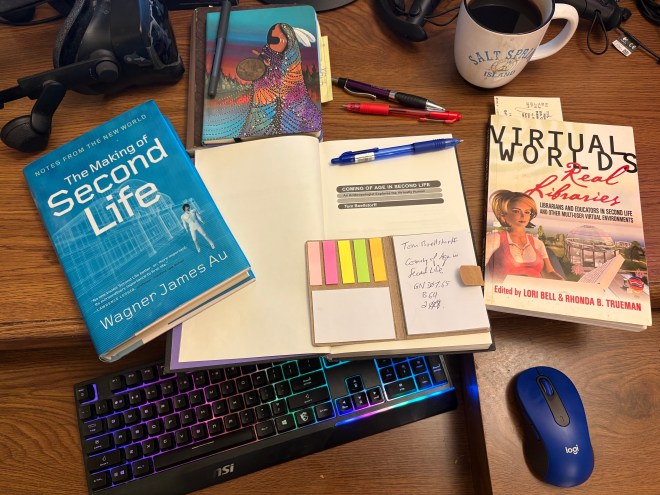
I am still working away—slowly—on the first two chapters of my OER textbook about the metaverse. Today, in an effort to motivate this librarian to do some (gasp!) actual dead-tree book reading as part of my research for chapter 2, which is all about Second Life, I have decided to make it more fun by simultaneously writing a blogpost review of three books while I (re)read them. I get to kill two birds with one stone: I move forward in my research while taking notes for my own book, and you, my faithful blog readers, get some content. (Also I also get to rest my sore neck and shoulder joints and muscles by NOT sitting in front of a desktop computer all day.)
The three books, all published in the same year, 2008, are:
- Au, W. (2008). The making Of Second Life: notes from the New World. HarperCollins.
- Bell, L., & Trueman, R. B. (2008). Virtual worlds, real libraries : librarians and educators in Second Life and other multi-user virtual environments (1st ed.). Information Today.
- Boellstorff, T. (2008). Coming of age in second life : an anthropologist explores the virtually human. Princeton University Press. (PLEASE SEE NOTE AT END)
Virtual Worlds, Real Libraries: Librarians and Educators in Second Life and Other Multi-User Virtual Environments

Lori Bell (a librarian with the Alliance Library System in Illinois) and Rhonda B. Trueman (an acquisitions and access services librarian at Northwest Florida State College) were both highly active in the collective work of setting up and running libraries in Second Life, circa 2007-2009 (my first years in Second Life). They are the co-editors of this 21-chapter book, with contributions from 26 authors.
Note: the website cited in this book appears to have shut down, but the Community Virtual Library project still has a website, which is regularly updated (for example, from it I learned that one of the editors of this book, Lori Bell, passed away earlier this year; I actually found several different dates for her death, but I am going to assume that the February 10th, 2026 date in this heartfelt tribute is the correct one).
This book referred to virtual worlds as MUVEs (Multi-User Virtual Environments), perhaps to carry on the tradition of using MU* acronyms to refer to previous, text-based virtual worlds (MUDs, MUSHes, etc.). MUVE proved to be a unpopular term, and as far as I am aware, it did not catch on.
A passage from the introduction (by Bell & Trueman) struck me:
Libraries need to look at places on the web, including virtual worlds, where potential library users are active and assess how library services might be integrated into these environments. Many individuals now involved in virtual worlds may not be traditional library users. By putting ourselves where these users are, librarians have a remarkable opportunity to increase use of the brick-and-mortar library, promote library services and materials, and support education initiatives in SL and other virtual worlds.
Some see libraries in virtual worlds as representing a “third type” of library presence, in addition to traditional brick-and-mortar institutions and virtual interactions conducted via chat or email. Virtual worlds are the new frontier; they offer librarians the exciting opportunity to serve as leaders in shaping these environments and influencing their use in education, business, and day-to-day life. Believe it or not, virtual world libraries are also an excellent way to promote traditional library services through book discussions, author programs, and displays that inspire reading.
Collaboration is another important reason for libraries to be in virtual worlds. Using SL, in particular, many of the librarians you will meet and read about in Virtual Worlds, Real Libraries have engaged with individuals from all corners of the globe. They have discovered opportunities to collaborate on projects with nonprofits, corporations, and educational groups; these projects would have been difficult, if not impossible, to coordinate in the real world.
While I do agree that Second Life can provide opportunities for collaboration, I would still argue that SL, still, has too steep an entry learning curve as opposed to, say, using a Discord server, or the iPhone in your pocket. But the dream of using Second Life to reach new users, or create a new “third space,” never materialized.
In chapter one of this book, Tom Peters lists a series of questions about these volunteer librarians’ early (circa 2006-2008) work in Second Life:
- Do avatars even want and need library services in SL?
- If so, what types of services and collections do they want and need?
- Would one library serve all avatars, or should there be different types of libraries, as in the real world?
- How can we create links and bridges between existing, real world library collections and services (print and digital) and the collections and services being built in SL?
- How can or should librarianship in SL be structured and managed?
- How can or should it be governed?
- How can or should it be funded?
Now, 18 years later, I think that we can probably answer these questions. From my own experience and perspective, the people who used Second Life were, by and large, not looking for library services, and did not make use of them when they were offered. And again, asking potential library users to spend an hour getting up to speed as an avatar in Second Life, just to ask a reference question or attend an event, was probably too much to ask. The Community Virtual Library (CVL; one of the few virtual libraries still operating on the grid; SLURL) is beautiful, but often deserted when I come to visit. However, there are some exceptions to this, such as Virtual Ability (SLURL) continuing the pioneering work of HealthInfo Island to this day. And both CVL and Virtual Ability continue to host regular events as well.
But, by and large, the answer to the first question Tom poses is no, the overwhelming majority of avatars don’t need or use library services in SL. It didn’t seem to matter what kinds of services were offered; aside from novelty and curiosity, the users weren’t there. Stymied by the copyright restrictions of traditional publishing, the “links and bridges” Tom mentions between real-world collections and services were difficult or impossible to implement, leaving most SL libraries restricted to copyright-free works. Another big problem was the fact that this 2006-era initiative was volunteer-driven, and the inevitable volunteer burnout, combined with the 2008 economic downturn, led to many of the libraries mentioned in this book shutting down their services after a couple of years (a notable exception being the San Jose State University’s iSchool, which still maintains a region; here’s a SLURL if you wish to explore the sim and its many exhibits, such as its Banned Books area).
In chapter 5, Rhonda Trueman discusses some of the problems librarians encountered while working in the InfoIsland regions:
There are three temptations, though, that can derail the best of intentions. One temptation is to become immersed in this environment to the detriment of real world activities; another is to focus only on a set task or goal as a volunteer and be blinded to the creativity and innovation that abound in this environment; and yet another is to put so much time into virtual volunteer activities—while still trying to balance a real life job and a family—that one becomes burned out. Although most of our librarians in Alliance Virtual Library are volunteers, many also have a library on Cybrary City 1 or 2 that represents the real life library for which they work. Many of these librarians donate their own personal time to building a virtual library presence, but others are assigned and paid for this role as a portion of their daily work. Difficulty in managing real world work activities combined with SL work activities, neglecting real world responsibilities, and burnout are the reasons volunteers who decide not to continue in Alliance Virtual Library cite most often.
And, as someone who did spend a little bit of time volunteering to man the reference desk at InfoIsland, I could relate mostly to the first temptation Rhonda lists, rather than the other two! And yes, I could see that trying to juggle this new thing, on top of all the regular responsibilites of librarianship, would lead to burnout! I myself left because I found myself spending more and more time on activities outside of librarianship in Second Life.
Overall, it’s rather sad to see how much the initial burst of enthusiasm of that time period (2006-2009) has faded to a faint echo today. By and large, libraries and librarians pretty much decided to abandon Second Life fairly early on its history (along with most other real-world entities such as corporations, who had experienced a similar boom, disillusion, and retreat). I discuss this is more detail in a 2018 blogpost, here: The Rise and Fall of Library Use of Second Life: What Happened to All the Libraries That Used to Be in Second Life and Other Virtual Worlds?
The Making of Second Life: Notes from the New World

Wagner James Au, of course, is the ur-reporter on Second Life, and someone who has been participating in (and commenting on) Second Life for a long time. Wagner joined Linden Lab as an in-house chronicler of their work on Second Life (based on a recommendation made by Howard Rheingold when he was given an early demo). Au joined SL in April of 2003, when the platform was still in beta test, with only a few thousand users. And, 23 years later, he is still writing about Second Life!
His long-running blog, New World Notes, has now been archived, but he has since made the move to Patreon, where he continues to post. Notably, he announced on Sept. 3rd, 2026, that he is “now contracting for Linden Lab on external media outreach and bizdev” as a “part-time, trial run experiment.”
While Bell and Trueman’s book was written by and for librarians and educators, Wagner James Au’s work was a mass-market book aimed at the general public who might or might not have heard something about Second Life by the time it was published in 2008. (To provide a bit of context, I had joined SL in March of 2007, merrily creating my first avatars while Au was busy writing this book between January and October of 2007).
This difference in audience accounts for one irritating thing about this work to this librarian: the absence of formal citations! This often led me to my web browser to run a Google keyword search or, (in some cases) to make a Claude or Gemini inquiry in natural language, and cross my fingers in hopes of finding the same information source which the author was referring to. Here’s a good example, taken from the Introduction to Au’s book:
U.S. Homeland Security was already there, financing biochemical terrorist attack simulations; Harvard’s Berkman Center was well ensconced, too, offering lectures on law and society to humans and flying robots alike; the venerable BBC was hosting live music concerts; NBC was launching their annual Christmas lighting ceremony virtually, while CBS was busy creating a metaverse version of Star Trek. Warner Brothers was promoting its latest artist with listening kiosks that resembled a New York loft; a research team from IBM was prototyping next-generation Internet technology; and Cisco, Dell, and Microsoft had virtual islands and schemes of their own.
Again, no references provided for any of Wagner’s assertions here of events taking place circa September 2026 in Second Life. In particular, my ears perked up when I read about the U.S. Homeland Security Department! I really wanted to know more about what the U.S. Homeland Security Department was doing in Second Life.
Rather than spending hours tracing each of these claims back to their original sources, I decided to turn to generative AI. I pasted the above paragraph into Claude AI (Opus 5.5, connected to the Undermind AI research tool), and asked it: “Could you please find the information sources Wagner James Au used in writing this paragraph about Second Life in 2006?”

Five minutes later, I got back the following summary, plus a full report (which I will not share here; the report includes thorough fact-checking against other information sources, and provides citations for all its sources in APA format):
I checked every clause in Au’s paragraph. All the organizations he names really were in Second Life, but the paragraph squeezes events from October 2005 to mid-2007 into one “already there” moment, and two details go further than the sources do.
- Well supported: Harvard’s Berkman Center and the CyberOne course (September 2006), BBC Radio 1’s One Big Weekend (May 2006), NBC Universal’s virtual tree lighting (November 29, 2006), Sire/Warner’s Regina Spektor loft (May 2006), IBM (September–November 2006) and Dell Island (November 14, 2006).
- Homeland Security: Au’s own 2005 blog post and 2006 First Monday essay support “DHS-funded disaster preparedness simulator.” I found nothing that names a “biochemical terrorist attack” scenario, and the event is from 2005, a year earlier than the paragraph suggests.
- CBS’s Star Trek area: this is the weakest claim. It was announced in January–February 2007 and built by the Electric Sheep Company. Secondhand forum accounts say it was never finished, so “busy creating” is only accurate as of early 2007.
- Cisco and Microsoft: Cisco’s islands opened in December 2006. Microsoft’s best-documented island, Visual Studio Island, is from 2007.
- Spektor wasn’t a “new artist”: Begin to Hope was her fourth album.
Au’s wording for NBC, Warner/Sire and CBS closely matches a February 13, 2007 Hollywood Reporter roundup, which looks like his likely source. I couldn’t see the book’s endnotes, so that’s not confirmed.
The report includes APA-style sources for each claim, a suggested dated version of the paragraph for your OER text, and a list of primary sources to get next. Before quoting the DHS item, pull the archived copy of the October 2005 blog post from the Wayback Machine and check a print copy of the book’s notes.
This, by the way, is something at which Claude Opus 5.5 + Undermind shines: acting as a surprisingly thorough research assistant, definitely saving me hours of time!
Now, back to the business at hand: Wagner’s book and how it has aged since publication. How have his predictions about Second Life played out? Wagner does devote an entire chapter (chapter 13) to speculation about the future of Second Life, and he had other predictions sprinkled throughout the rest of this book. In many cases, I pasted sticky notes into my physical copy of the book, so I could come back afterwards and follow up a little bit about what did actually happen in the intervening 18 years since they were written. Few other observers can boast such longevity, and that alone makes his perspective valuable (even if his prognostications sometimes proved incorrect). Let’s look at some of Au’s statements, written in 2007 and published in 2008, and see how they have held up in the years since then.
Statement: On page 217, Au writes that “user-created online worlds like Second Life will be integral to the future Internet.” While Second Life has inspired many people as to the possibilities of the metaverse, and while it continues to be profitable for Linden Lab, I would argue that it has failed to become “integral.” Eighteen years after the publication of Au’s book, it remains a niche product (albeit one with a passionately devoted fanbase). Au refers to this scenario in his book as “Second Life Plateaus” (p. 221). Efforts to open-source SL viewers and servers led only to a myriad of smaller OpenSim systems, none of which proved to be as successful or enduring as Second Life itself.
Statement: On page 229, as part of brainstorming session in which Au participated: “Real-world companies will be incubated, developed, and in large part run in the metaverse, which will be the office space and whiteboard for employees across the world.” I can pretty confidently state that this prediction, sadly, did not come to pass, even after a pandemic forced a global lockdown! What happened was that people turned to more accessible tools like Zoom and Microsoft Teams, rather than (as I mentioned before) working their way up what was the still steep learning curve of Second Life). Setting up an avatar was not as simple as sitting in front of a webcam!
Statement: There’s a whole section of Au’s book (pp. 232-234) where the author discusses with Philip Rosedale the possibility of using the metaverse as a way to live forever, via “uploading our very consciousness into SL, similar to what futurists like Ray Kurzweil imagined.” (p. 233). Even with the recent generative AI advances since 2022, this is still something which remains fully in the realm of science-fiction speculation!
Statement: In a section where Au gives advice to businesses wishing to set up shop in SL, he states: “Find a killer SL app: Take the time to create a utility or service that both is unique to SL and leverages the main element that makes SL unique: dynamic user-created content in an international virtual community” (p. 260). Unfortunately, after the corporate boom-and-bust circa 2006-2008, few real-world businesses have bothered with Second Life, and a “killer SL app” (i.e., one that would make peole want to set up a Second Life account, and use the platform) failed to materialize. Something that people inside of SL would already use? Yes, there have been many such success stories. Something that would entice people to come and stay in SL? By and large, nope.
Statement: Au writes, in the preface to the book (p. xv): “Odds are that user-created virtual worlds like Second Life will soon be the targets of financial mergers (and again, as this book reaches press, you may have already read about such plans on business news sites).” At the venerable age of 23, Linden Lab still has avoided merging with another company (although they did eventually spin off Tilia, their financial services section, selling it to Thunes). It has, somewhat miraculously, literally remained its own world, with its own culture. In fact, its still-thriving adult content and activities probably make it a less-tempting acquisitions target among larger companies seeking to gain a toehold in the metaverse. What’s interesting is that so many, much larger companies, have tried (and, in many cases, failed) to build their own, competing metaverse platforms (*cough*Meta*cough*).
COMING IN PART TWO: Coming of Age in Second Life: An Anthropologist Explores the Virtually Human

Tom Boellstorff (whom I have actually met and talked with in Second Life, briefly, after one of his in-world presentations) is a cultural anthropologist at the University of California, Irvine, where he studies (among other topics) virtual worlds. According to the publisher of his book Coming of Age in Second Life. Princeton University Press:
Tom Boellstorff conducted more than two years of fieldwork in Second Life, living among and observing its residents in exactly the same way anthropologists traditionally have done to learn about cultures and social groups in the so-called real world. He conducted his research as the avatar “Tom Bukowski,” and applied the rigorous methods of anthropology to study many facets of this new frontier of human life, including issues of gender, race, sex, money, conflict and antisocial behaviour, the construction of place and time, and the interplay of self and group.
In other words, this is a more academically-oriented book. At the time of its publication, it was the first book of anthropology to examine Second Life. Tom is considered a pioneer in bringing “anthropological tools into virtual worlds and online communities-spaces once considered marginal to real life.”
NOTE: The task of reading through these three paper books—note to mention, annotating them with sticky notes!—has taken me longer than anticipated. (My workflow is much more streamlined for full-text electronic books and articles.) Therefore, I have decided to just post my notes from the first two books today, as Part One, and then write a part 2 of this blogpost, a review of the third book, once I have finished reading it. Part 2 coming soon!