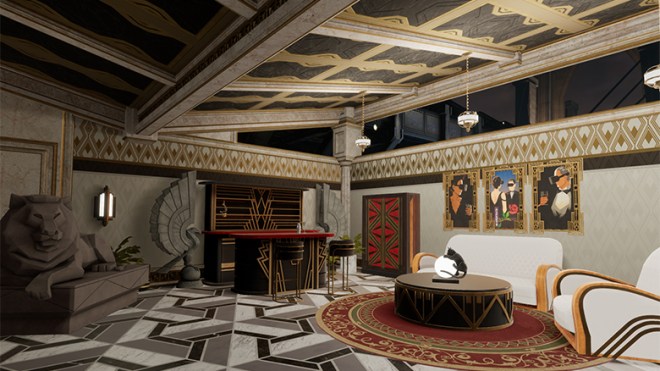
Editorial: Gamification, Second Life, and Sansar

Jim: You playing that game again?

Dwight: Second Life is not a game. It is a multi-user virtual environment. It doesn’t have points or scores. It doesn’t have winners or losers. 

Jim: Oh, it has losers.

— The Office

This well-known clip from the American TV sitcom The Office perfectly illustrates a long-running debate about Second Life: Is it a game or not?

The issue is raising its head again after yesterday’s Sansar Product Meetup, where Linden Lab staff announced several new, game-like features would be added to Sansar, such as XP (experience points), a Nexus, a Codex, and a Prime Portal. Is Linden Lab trying to turn Sansar into a game?

Some users welcome these changes, and others are adamantly opposed to the gamification of Sansar. On the official Sansar user Discord yesterday, after the Product Meetup, several users on both sides weighed in with opinions (this is just an anonymized sample):

A: Well, I see a big problem though. The hub will be slower than the Atlas, which is just an UI [user interface]. There is a new UI, which lists recently visited places. It’s as fast as the Atlas. People will be very likely to just use the history to quick travel, not everyone, but many. And these people are then far less likely to even be aware of new experiences. They’ll mostly stick to the experiences they already visited before…

B: Been to NeosVR Nexus like… place , massive , massive wall of places to go, tools for adding your world, but frankly/honestly after 20 minutes of hoping, so to speak, it was a place you had to go, to go somewhere else, from the place you were. I am hoping it turns out to be more than that. Anxious to understand the vision behind it.

C : I just wanted to throw my two cents in. I absolutely love the idea of the way exploration and questing will work going forward. I was on the fence about jumping back into Sansar and this pushed me over. This is definately the way things need to go to grow interest in the platform. Bravo!

D: What I’m wondering, is how the Lab can give us the same Atlas, when it is not a UI element. How can it be a UI element, when it is specific to the Nexus experience. No UI in Sansar is specific to an experience. So, this means, the Atlas is not a UI element, and is a clickable element. Now think about how bad it will be to navigate thru the Atlas by clicking buttons.

E: I’m a bit upset right now… I imagine LL talking with potential business partners. They want to meet in Sansar to get the feel of it. They create an account, and they are thrown into a tutorial experience with stupid quests to complete . Blank stare. Questioning look. “it will take only 30 seconds”, says Greeter Linden. If I were the would-be partner, I think I’d walk away at that point.

And I myself have concerns about people spawning in the New Nexus as opposed to their private home space, as I have written in an update to my blogpost yesterday.

Let’s provide a bit of history to give some context to this topic. Most SL users probably don’t remember that the earliest version of Second Life had many game-like features. Wagner James Au of the blog New World Notes, who has been writing about Linden Lab and Second Life since its very earliest days, noted in a tweet today:

Second Life had a ranking system and leaderboard up until about 2005, and the company considered The Sims Online to be a direct competitor. The “It’s not a game” messaging was concocted by Linden Lab’s marketing department to (unsuccessfully) sell it as an enterprise platform.

In a blogpost he wrote yesterday, Wagner also commented on the upcoming changes to Sansar:

Smart additions to Linden Lab’s new social VR world, which is starting to see some traction, at least during special live music events from artists on the Monstercat label. Adding an XP system should do much to encourage returning users and more deeply engaged users.

From a corporate perspective, this also represents a major reversal for Linden Lab: Since roughly 2005-2006, the company’s marketing department and executive leadership positioned itself as not making games (even though virtual worlds are themselves a game genre) and pushed the messaging “Second Life is not a game!” so much that many veteran users still accept the statement to be true. (And not market positioning that’s become harder and harder to justify). Since then, the company has resisted adding game systems to Second Life  — or rather, re-adding them, as they existed at launch — and it’s a key reason why Second Life has failed to grow its userbase. But with Sansar still not anywhere near to getting viral growth, it’s past time to junk that marketing strategy.

And I do find myself somewhat in agreement with what Wagner has said here. In particular, the old business-as-usual way of marketing Sansar, which relied heavily on tactics which might have worked for Second Life a decade ago, has has lackluster results so far. Ebbe Altberg and his team are to be commended for thinking outside the box and trying out new things in order to entice new users—and to keep them coming back. As Ebbe himself said on the Discord, in response to the many users questioning the direction Linden Lab is taking with these new features:

Retention retention retention people.

So, we shall see exactly how all this works when the latest update to the Sansar client software arrives, hopefully for next week. Keep your fingers crossed!

Editorial: We Are the Problem and We Are the Solution

I remember when I was first invited into the Sansar closed beta in December of 2016. That early community consisted of content creators who had been contacted by Linden Lab and asked if they wanted to take part in the beta test, and many of us eagerly accepted the invitation, even going so far as to recommend other people that LL could contact to add to the community.

It was a heady, exciting time. People were feeling energized and invigorated by the challenges of working on a brand-new, VR-capable platform. We used Slack as our main means of communication, as well as meetups in Sansar, and together we worked to test things to see what would break, and to report bugs and make suggestions for improvement to the team at Linden Lab. Jenn was out first community manager, working double-duty between Second Life and Sansar in those earliest days.

It’s now August 2019, thirty-two months later. Slack was replaced by Discord. Jenn went back to Second Life full-time, and was replaced as Sansar community manager by Eliot, who in turn was replaced by Galileo. Many new features have been added to Sansar in that time.

Many of the people who were heavily invested in the earlier days of Sansar have pulled back, or pulled out of Sansar completely. Each had their own personal reasons for doing so. Some left because they were frustrated at what they saw as slow development of features that they considered fundamental. Some left because they didn’t like the way that Linden Lab was running things with respect to fees and payments. Some left because of harassers, trolls and griefers, either on the Discord or in-world. Some left because they felt they weren’t earning enough money to make their work worthwhile. Others left because they just felt burned out, and they needed a break, and they simply never came back. And all of these are perfectly legitimate reasons. Communities grow and change over time. Some people leave; others join.

But I have noticed a particularly troubling and dispiriting trend in the Sansar Discord channels lately. In the early days, disputes and arguments were relatively few, and (usually) quickly settled. But the number of disputes, attacks, arguments, and just overall ill-will has risen sharply in recent months. People seem to have shorter tempers, and they seem to be much more likely to start attacking each other personally. And I’m as guilty of this as anybody else.

The earliest members of the Sansar community knew that things were not perfect, but almost all of us felt that Linden Lab was working hard and in good faith to fix the bugs and add the features we wanted to see for Sansar to be a success, if not immediately, then in the future. But now, it almost feels like everybody’s patience has been stretched too thin. We (and I do include myself) are quicker to take offense, quicker to lash out, and quicker to assume ill intentions from the actions of other people and from Linden Lab itself.

This is a problem that can’t be resolved just by moderation on the Discord and ejecting troublemakers in-world. Galileo and Lacie and Harley are good moderators and bouncers, but they can’t be around 24/7/365, and they shouldn’t have to be.

Image by Tumisu from Pixabay

The problem is us. I—we—all of us—need to stop and look in the mirror before pointing fingers at other Sansar users, or at Linden Lab. We all need to address what we do in that infinitesimal gap between the trigger incident that made us upset or angry, and the response we choose to make. The response we CHOOSE to make. Hiding behind a username or an avatar is no excuse.

The solution starts with us. We need to communicate in ways that build people up instead of ripping them down. We need to disagree in ways where we don’t attack other people. We need a return to manners, civility, and etiquette. We need to emulate the behaviour we want to see in newcomers to our community. We need to become better people.

Behavioural scientist and researcher Jessica Outlaw has started a nine-part series on how to build a strong culture in social VR. So far, she has posted the first 3 parts:

Please take the time to read Jessica’s articles, and please reflect on what we can do, individually and collectively, to make the Sansar community the best place it can be. We are the problem, but we are also the solution.

Editorial: Facebook and Oculus Have Too Much Power Over Virtual Reality and the Metaverse

Facebook already has amply demonstrated how little they value the privacy and data rights of its users, in a succession of scandals uncovered by the New York Times and many other news media over the past couple of years (image from Forbes).

Facebook has the resources to capably crush competitors. Strip-mining the data of the estimated 2.7 billion people worldwide who use Facebook, WhatsApp, Instagram, or Messenger each month has been extremely lucrative for the company. (The five billion dollar fine the U.S. FTC recently levied against Facebook for their privacy lapses was a mere slap on the wrist, given the income the company generates each year from advertising. Mark Zuckerberg probably found the money from his couch cushions.)

I have already written about industry gossip that Facebook is plowing resources into creating a metaverse platform for all its Oculus VR hardware users. I willing to bet, dollars to doughnuts, that the Facebook metaverse is going to look a lot like Oculus Home, which is the where you are deposited when you first put on your headset. You can now visit other people’s homes, and recent updates include the ability for users to create their own spaces by uploading their own 3D models.

Some Examples of Oculus Home Interiors

Even better, Facebook gives you free furniture every week you sign into Oculus Home at least once, which you can use to decorate your space. It’s not hard to see how this can compete with social VR platforms like Sansar and virtual worlds like Second Life. And Facebook has deep pockets to fund advertising campaigns that companies like Linden Lab cannot ever hope to match.

And, of course, there is the complete line of Oculus VR hardware, including the popular new wireless Oculus Quest headset, which Mark Zuckerberg recently reported is selling as fast as Facebook can make them.

Which leads to the point of this editorial: in this evolving metaverse of social VR and virtual worlds, is too much power concentrated in the hands of a single, monolithic, profit-obsessed company? I would argue that Facebook is aiming for complete and utter domination of the VR universe, just as they already have in the social networking space, by creating a walled ecosystem with the Oculus Home and the Oculus Store that will have a negative impact on other companies trying to create and market VR apps and experiences. The field is already tilted too much in Facebook’s favour, and the situation could get worse.

Now, you can argue that Facebook has competition from other VR headsets such as the HTC Vive line of products and the Valve Index. And the Steam software distribution platform is an alternative to the Oculus Store. I understand that my purchased programs from the Oculus Store can still be played on an HTC Vive or Valve Index with the Revive software, which is somewhat reassuring to me (although I suppose there is nothing really stopping Facebook if they choose to block that avenue at some point in the future).

More concerning to me is that, at some point, I may be forced to get an account on the Facebook social network to use apps on my Oculus VR hardware. In fact, this has already happened with the events app Oculus Venues, which I recently discovered requires you to have an account on the Facebook social network to access.

Sorry, but after all the Facebook privacy scandals of the past couple of years, that’s a big, fat “Nope!” from me. I asked Facebook to delete its 13 years of user data on me, and I quit the social network in protest as my New Year’s resolution last December, and I am never coming back. And I am quite sure that many of Facebook’s original users feel exactly the same way, scaling back on their use of the platform or, like me, opting out completely. I regret I ever started using Facebook thirteen years ago, and that experience will inform my use (and avoidance) of other social networks in the future.

Yes, I do know that I have to have an Oculus account to be able to use my Oculus Rift and Oculus Quest VR headsets, and that Facebook is collecting data on that. I also know that the Facebook social network probably has a “shadow account” on me based on things such as images uploaded to the social network and tagged with my name by friends and family, etc., but I am going to assume that Facebook has indeed done what I have asked and removed my data from their social network. Frankly, there is no way for me to actually verify this, as consumers in Canada and the U.S. have zero rights over the data companies like Facebook collects about them, as was vividly brought to life by Dr. David Carroll, whose dogged search for answers to how his personal data was misused in the Cambridge Analytica scandal played a focal role in the Netflix documentary The Great Hack (which I highly recommend you watch).

We’ve already seen how social networks such as Facebook have contributed negatively to society by contributing to the polarization and radicalization of people’s political opinions, and giving a platform to groups such as white supremacists and anti-vaxers. The Great Hack details how Cambridge Analytica used Facebook data without user knowledge or consent to swing the most recent U.S. election in Donald Trump’s favour, and look at the f***ing mess the world is in now just because of that one single, pivotal event.

We can’t trust that Facebook is going to act in any interests other than its own profit. Facebook has way too much power, and governments around the world need to act in the best interests of their citizens in demanding that the company be regulated, even broken up if necessary.

Immersed: A Brief Introduction (Yet Another Remote Workteams VR Application, and Why High Fidelity Has Their Work Cut Out for Them)

You know, if High Fidelity expects to break into the remote workteams market with their repositioned social VR platform, they are facing a lot of competition. Just today I stumbled over yet another remote workteams VR product on my Twitter stream, called Immersed:

The tagline in the image reads: “Immersed enables you and others to collaborate by immersing you into the same VR workspace!”. (I had to chuckle at the cartoon man on a tropical beach, merrily multitasking away under a palm tree in his VR headset! Who the hell does that?!??)

Here’s a brief promotional video for Immersed:

UPDATE: this blogpost was automatically cross-posted to my Twitter, where a critic immediately responded to this video, saying:

Vaporware, nobody needs that. If people wanted to share a code screen they can do that already, donning a headset and being an avatar brings little value and help to this in my opinion.

And I must say that I can’t argue with that. (Why would anybody want to wear a VR headset all day while writing software code?)

Immersed supports both the Oculus Go and the Oculus Quest (which makes it somewhat different from other competing products which require a PCVR solution, like the Oculus Rift or the HTC Vive):

Here’s their pricing model:

It looks like the company is charging a one-time US$9.99 fee for 2 collaborators, and a US$9.99-per-month fee for up to 7 coworkers.

Here’s a half-hour YouTube video by RaMarcus covering how to set up and use the 14-day free trial of the Elite level of Immersive (including using the product in an interview with the CEO of the company):

So let’s just run down the list of remote teamwork VR applications I have covered so far on this blog (all in varying degrees of market-readiness):

Probably only one or two of these firms are actually making money at this point (Engage seems to be doing well for itself, and Cisco has deep pockets). And that’s just a list of the business-focused platforms. Many other, more general-purpose, social VR platforms on my list of social VR and virtual worlds would also lend themselves quite nicely to corporate use as well.

High Fidelity is going to have to work extra hard to get noticed in an increasingly crowded and competitive marketplace. Let’s hope they have some good marketing people on their team, and a bit of luck on their side. They’re going to need it. This is not like Second Life in 2003, where Philip Rosedale and his team pretty much had the market to themselves. High Fidelity cannot automatically assume that people will flock to them and embrace them; they are going to have to earn corporate customers by making a better, more fully-featured product. They may have found the consumer market hard to break into; they might find the business market even harder still.

UPDATE Aug. 28th: I have been informed that Cisco has pulled the plug on their Cisco Spark project.