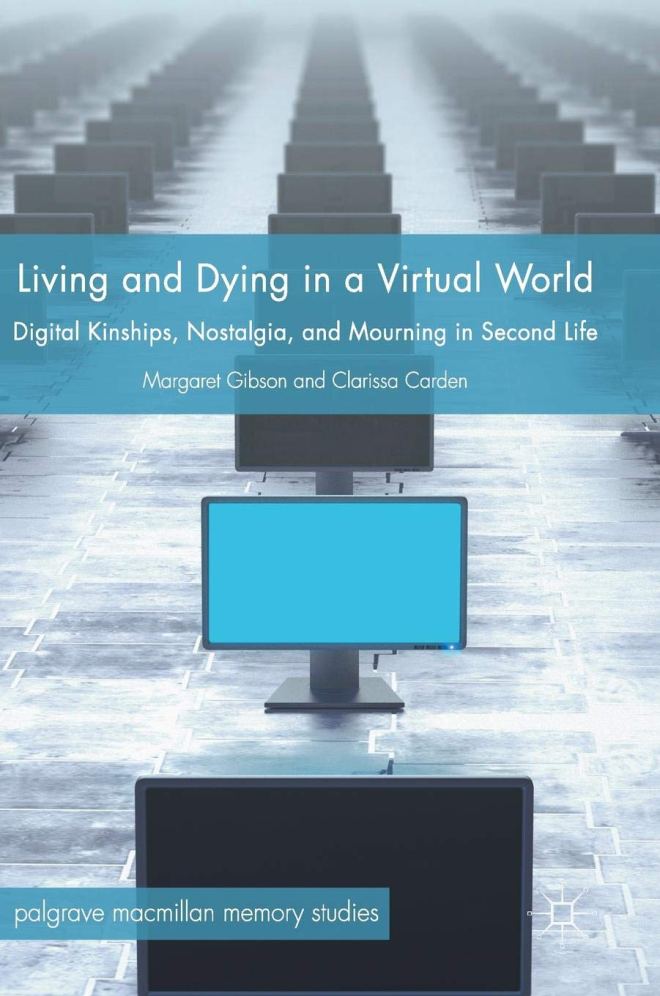
Hi everyone, my name is Dr Margaret Gibson and I am writing a book with Clarissa Carden titled Living and Dying in a Virtual World: Digital Kinships, Commemoration and Nostalgia, to be published by Palgrave Macmillan. See link: https://sociologicalexplorations.com/second-life-living-and-dying-in-a-virtual-world/ We are writing a chapter on sentimental objects in SL and we would love to hear any of your stories. These could be things in your inventory that matter to you because someone died or they remind you of an important part of your SL or RL. If you are interested in participating in the book more fully and being interviewed via chat in SL we would love to hear from you. As you can see from book title we are interested in death, grief, family relationships in SL, nostalgia…
Any responses will be anonymous and if you do not wish for your response on this forum to be included in the book please say so. Thanks!
This book takes readers into stories of love, loss, grief and mourning and reveals the emotional attachments and digital kinships of the virtual 3D social world of Second Life. At fourteen years old, Second Life can no longer be perceived as the young, cutting-edge environment it once was, and yet it endures as a place of belonging, fun, role-play and social experimentation. In this volume, the authors argue that far from facing an impending death, Second Life has undergone a transition to maturity and holds a new type of significance. As people increasingly explore and co-create a sense of self and ways of belonging through avatars and computer screens, the question of where and how people live and die becomes increasingly more important to understand. This book shows how a virtual world can change lives and create forms of memory, nostalgia and mourning for both real and avatar based lives.
The book is rather expensive (Amazon.ca lists it at CDN$93.54), so see if you can get it through your library (I was able to access the electronic version via my university library’s SpringerLink ebook service). Thank God for libraries!
I am looking forward to reading this, and I may write a book review afterwards. Here’s a brief excerpt from the introduction:
Now that it is 14 years old, SL attracts less news attention. Where a reporter is assigned to cover a story relating to SL, their copy carries a faint air of astonishment, as though the author believes that this world ought, surely, to have disappeared by now. The fact that it persists goes against the grain of consumer media logic of upgrading, replacing, and letting go of the old for the new. It also speaks to an implicit recognition that the demographics of SL are not “young people” even though the image culture of avatars valorises the appearance of youth.
Despite this disconnection with media logics, SL has in no sense disappeared. Instead, it has been transformed. We argue in this book that SL is now a mature virtual world. It is a world in which residents have lived and lost. It is a world which has seen significant social changes. This is a typeof virtual world that has never existed—and which could not exist—at any previous moment in history. This is a book about the maturity that has come with age. Inevitably, as an extension of that, it addresses the memory, loss, and grief that have marked the lives of SL residents. It is also a book about the care and compassion residents show towards one another and about the strength of the attachments that are formed online.
After my recent guided tour of VU, I feel very strongly that this is going to be a successful and popular virtual world/MMO hybrid platform, and I want to be a part of it when VU launches their beta this summer. This is the very first blockchain-based virtual world that I actually feel excited about!
I want you to know this up front: this blogpost is a promotion for VU, in exchange for VU tokens. You can follow on this webpage to see how many VU tokens I have earned by completing tasks in this Partner Program if you wish (right now, I am at number two on the VU Token Leaderboard). There’s nothing stopping you from participating in this Partner Program yourself, and earning some VU tokens!
IMPORTANT: VU Tokens are not a real currency. They are ERC-20 based blockchain tokens intended to permit players of Virtual Universe exclusive access to digital assets within a VR game known as Virtual Universe (VU). They are a form of in-game virtual currency. Virtual value attributed to the VU Token will be as a result of in-game efforts by players, and no future value is represented or guaranteed.
Virtual Universe Logo
This summer I have (rather impatiently) been waiting for the beta launch of the Virtual Universe social VR/MMO platform. The company’s original plans were for a private beta launch in July 2018, and a public beta launch in January 2019, and as far as I know, they are still on schedule.
In their whitepaper, VU is described as “part game, part social network, and part social creation platform, blending elements of Minecraft, Second Life and Simcity with innovative artificial-intelligence technologies that drive engagement”, and that is an excellent description of what it tries to be. It’s an intriguing mix of virtual world and MMO/MMORPG where you can collect wood, chop it up, and start a fire, feed worms to the AI-controlled bluebirds, or just explore your surroundings and interact with other users. As I understand from their recent Letter to the Community, explorers will be able to gather resources in the countryside in order to sell them:
Outside the city is our highly immersive LivingVR world, created from the ground up to feel as immersive as possible. Teeming with virtual life, beautiful sceneries and waiting to be explored by you. Let’s say you are exploring further than you have before and suddenly you discover a cave behind a waterfall. Inside it, you find rich copper deposits. You know copper is a desired resource in the citysince its an ingredient in many crafting recipes for a wide variety of building blocks. You mine the copper and haul it back to the city. Once there you list your copper on the auction house and collect the cryptocurrency once someone wins the bid on it.
And it is not just resource gathering that can be done in VU, there will be plenty of questsavailable for you and your friends to experience exciting adventures with plenty of loot to be had!
According to this brand-new website, you will be able to do the following in VU:
Own Property: Buy, sell, and invest in property. Purchase a unique property and customize it.
Start a Business: Generate BTC, ETH and VU through in-game product and service sales.
Find Hidden Treasure: Explore the planet and find hidden treasure. Recover lost artifacts in ancient ruins.
Adventure: Explore the Virtual Universe with your friends. Hang glide, sail, dive, and explore a vast world
Shape the Future: Shape the entire universe with decisions you make. Make your mark in VU.
Here’s the backstory:
THE STORY
You’re awake! Good. We have some catching up to do.
Earth as you know it is gone. Global warming and endless warfare left the planet in ruins. But humanity survived! Sort of… spaceships could make the journey to new planets, but human bodies couldn’t. They can’t survive any exposure to space radiation. The solution? House human consciousness in identity crystals, or IDCs for short, After all, isn’t consciousness that what makes a human, human?
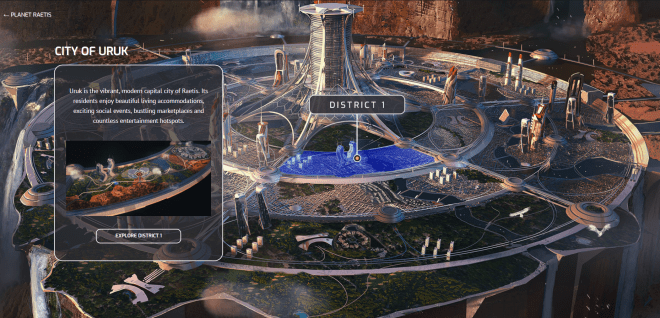
So welcome to Uruk, the first city on the planet Raetis. For the past two years, your robot counterparts have been building Uruk. The ship you arrived on now serves as the city’s power source, which sits at the city center. We call this The Core. You’re joined by the thousands of other humans who continue to live through consciousness alone. It’s all right to not feel like yourself. Your chip has been activated inside an avatar, the way all humans now exist. So what’s next for you on this new planet? That’s for you to decide.
Explore Uruk with your friends. Sell your goods and services for real cryptocurrency. Even try on a new avatar for size – your IDC is compatible with any avatar here in Uruk. You aren’t confined in the borders of Uruk, either. The city relies on rare resources for power, which need to be uncovered and mined. You can help out, or simply explore the rest of your new home planet. But remember, most of Raetis is still a mystery. We can’t be sure what creatures or dangers lie amidst the planet’s rocky and cavernous landscape. The farther you venture from Uruk, the riskier your adventure becomes, so be careful!
It’s your life, do what you’d like. Welcome to your world.
There are six different types of avatars, which at first glance appear to be similar to the character classes in most MMOs/MMORPGs like World of Warcraft:
Starter
Explorer
Creator
Merchant
Prospector
Warrior
And here’s some more details on the gameplay:
Play, explore and discover
Uruk is a gigantic city with endless opportunities. Participate in exciting adventures in the entertainment district, socialize with your friends in the finest clubs of the city and enjoy big community events!
Earn crypto rewards
Yup that’s right, you can earn cryptocurrency for playing our game. Help the community doing daily quests and get rewarded for your time and effort in VU tokens.
Harvest and sell resources
While you are exploring the vast landscape of planet Raetis, you will encounter a wide variety of resources. Gather these resources, bring them back to the city and sell them on the marketplace for cryptocurrency. But be careful, Raetis is full of hostile creatures so make sure you are prepared for battle before you venture into the unknown wilderness!
Shape the world around you
Collect enough VU tokens and you will be able to purchase your own plot of land on Raetis. Once you own your own corner of the world, you can shape it just the way you like it. Plant trees, place rocks, even design and construct your own home!
Customize yourself
Player will have a wide variety of avatars to choose from, all of them are highly modular so you can customize your character to make it unique!
Run a virtual business and earn crypto
If running around the world looking for rare resources is not your cup of tea then there is another major way for you to earn cryptos while playing VU: start your own virtual business! Purchase a commercial plot, construct one of the available player run ventures and start generating cryptocurrencies.
The website says, under the Beta tab:
I did have a question. It says the VU closed beta is “only accessible to pioneers”, and when you click through, “This section is only accessible to pioneers. You can become a pioneer by purchasing VU tokens.” So, how will Chinese, Americans, and Canadians (like me) be able to participate in the VU closed beta if we are legally forbidden from buying VU tokens?
We are working on a way that token holders (not just buyers) can upgrade to pioneer (so that would include people participating in the bounty program). But that functionality is not ready yet.
VU is going to have to find ways to include people from countries where we cannot buy the VU token. Otherwise, they will be excluding a large number of potential players.
The more details that the team at Virtual Universe reveal, the more intrigued about this project I become! I’m looking forward to setting foot on the planet Raetis!
UPDATE July 8th: Virtual Universe has announced an airdrop of VU tokens, and their Telegram server has been inundated with floods of new users! Over half of the 1,000 free apartments in Genesis Towers have already been claimed, and the rest are expected to sell out within the next 12 hours, so if you’re interested, you’d better hurry!
SECOND UPDATE July 9th: The apartments in Genesis Towers have sold out!
Now, some of these do not appear to be social VR apps, so I won’t bother covering them on this blog. But there are a few interesting ones that merit further investigation!
…I refuse to put one cent of my own money into any cryptocurrency at this point, and I advise anybody who wishes to do so, to do every single scrap of their homework before investing in any product or service. It’s simply too risky.
…
The actions of a few bad apples (both individuals and companies) are threatening to spoil the entire barrel. Also, greed is driving investors into ill-informed and risky speculation, and currently, there is a crypto feeding frenzy that is starting to remind me of Shark Week. I fear that this is a financial bubble that will hurt many investors when it implodes. Caveat emptor!
I usually check the newsfeeds of Google News for my news highlights of the day (I rarely watch TV anymore, and I check the newspapers maybe 2 or 3 times a week, max). So imagine my surprise when, on a whim, I searched Google News today for “Second Life 15th anniversary”, just to see what coverage there was of last week’s event:
Zip. Nada. Zilch. Not a single mention of Second Life’s 15th anniversary in any of the current news media sources that Google News indexes! (I got the same results on “Second Life 15th birthday”.)
So I sat down and thought about what this might mean. Why is it that something that was a (relatively) big deal in virtual world news got so little mainstream press coverage, despite (I assume) the best efforts of Linden Lab to do PR and get the word out?
Tie into that the current difficulties that High Fidelity, Sinespace, Sansar, and other firms are having in attracting people to their social VR/virtual world platforms, and I have a theory. Hear me out.
Could it be that the virtual worlds community is so (relatively) small and insular, that it has developed into its own echo chamber? According to Wikipedia:
The echo chamber effect occurs online due to a harmonious group of people amalgamating and developing tunnel vision. Participants in online discussions may find their opinions constantly echoed back to them, which reinforces their individual belief systems. However, individuals who participate in echo chambers often do so because they feel more confident that their opinions will be more readily accepted by others in the echo chamber.
When we talk about virtual worlds, are we pretty much only talking to—and listening to—each other? A closed community that is not listening to the outside world, perhaps thinking that it is more important than it really is? (I have noticed that I have tended to run into exactly the same people on every virtual world platform I have visited over the past 11 years.) Do we tend to stick to our own blogs and discussion groups (hello, Plurk!), and therefore become resistant to messages coming in from the outside? Are the metaverse companies (and their current customers) convincing themselves that virtual world platforms are a more vital and necessary service than the rest of the population believes? Maybe.
It might explain why Second Life never really broke through to the next level, even though it has pretty much kept 500,000-600,000 active user accounts over the past decade or so, despite the addition of thousands of new accounts each and every month.
And, even more ominously, it might just explain why the other, newer virtual world platforms are having some trouble breaking into the marketplace. What if that pool of less than a million people is the entire potential audience that virtual worlds—all virtual worlds—can attract? In other words, is there a hard upper limit in public interest in virtual worlds? Are all these metaverse companies fighting each other over a pie that is never going to get any bigger?
And if that is true, then what happens when most of those people are already happily settled in Second Life, prefer life in their own isolated little world with its echo chamber, and don’t feel the need to venture out any further?
What do you think of these ideas? Sound off in the comments…






 There’s a new website called