Pandemic Diary, September 17th, 2021: COVID-19 Worry and NFT Insanity

Well, folks, it’s been a week.

I delivered no less than seven different training sessions (online and remotely, either from my office at the science library or from home) to various classes of agriculture students. I have been fighting with computer hardware and software problems all week, starting on Monday when I couldn’t get my microphone to work, to yesterday when I got unceremoniously booted out of the the online class I was teaching using Cisco WebEx—TWICE. I am exhausted.

To add to my overall bad mood, the most recent data on breakthrough COVID-19 cases here in Manitoba are somewhat worrying. According to this report from CTV News, while fully vaccinated people are not being affected nearly as much as the unvaccinated, breakthrough cases are happening. And even more worrying, 16 fully vaccinated Manitobans have died of COVID-19 so far. That is not good news.

Mark my words: COVID still has the ability to throw some curveballs at us. For the love of God, if you have not already done so, GET VACCINATED! And please do everything you can—handwashing, face masks, social distancing, etc.—to stay safe and healthy. You do not want to catch this virus if you can avoid it!


However, I can still laugh at the continued silliness in the hothouse of the NFT (Non-Fungible Token) market. Everybody seems to be leaping on the get-rich-quick bandwagon.

I am currently blocking and deleting spam direct messages on Discord (people shilling for one blockchain-based scheme after another), at the rate of about one per day now. It would appear everybody and their dog has come up with some sort of harebrained NFT project to try and part you from your hard-earned dollar.

Today, I got the following spam direct message via Discord (blurred to avoid giving you his name and link addresses):

Hi. A new project Mint will begin in 7-9 days. There will be 10000 Covid themed NFT’s in total. Don’t miss your chance to get in on the start of an incredible cool project. FUCK COVID

Clicking through to the website (and no, I am not going to bother to link to it), and behold!

OMG!!! There’s only ten thousand NFT facemasks, supplies are limited so act now and get that rare collectible!

NOT.

Which reminded me of the following message I received recently via the feedback form on my blog:

Hello there, I’m David from Next Earth – we are the only blockchain and Earth map based metaverse 🙂 We’ve launched in the end of July and now only a few hours left until the end of land pack presale.. By now, more than 150.000 Dollars worth of land tiles has been sold and it’s increasing day by day, just like our community, so we are really excited about our future. It would be awesome if you could help us with spreading the word, and since you have quite a lot followers I can easily offer you a referral code with a fair amount of commission.. I’d be extremely interested in what you think and how we could collaborate, so please get back to me and let’s discuss our opportunities! Best regards, David

Image taken from the Next Earth website (no, I am NOT giving you a link)

Dear David:

NOT!!!

I wrote about what I think about Next Earth, Earth 2, and all the other “buy a virtual piece of earth” scams here.

And I swear to God: the next person who tries to get me to buy into their harebrained, lame-ass NFT scheme is gonna get bitchslapped into next Thursday.

Playable Worlds: A Brief Introduction

Playable Worlds is a new virtual world, still under construction and as yet unreleased, but I wanted to talk a bit about it, because it sounds as if they are doing some interesting things.

In a Sept. 9th, 2021 blogpost, CEO Raph Koster revealed a bit of the technology underlying the Playable Worlds platform:

We have built a metaverse platform. Oh, it’s not done. We’re probably going to be working on this for years. But I say “built” because, well, we have the basics of this stuff working.

We have a working massively multiplayer server. Further, it’s a true persistent state world, where everything you do is saved. Worlds change, evolve, and develop based on player actions (or AI or simulation, for that matter). It’s running on the cloud right now.

But it’s not just a server. It’s a network of servers. Whole MMO worlds can bubble up and go away on the fly based on player demand. It’s a heck of a lot more efficient than something like a headless Unreal server.

And you’ll be able to hop between worlds without needing to switch clients. It permits a single, shardless, ever-expanding, ever-changing online universe.

We’ve already got it working with full server-side game logic. Meaning – each world can have completely different gameplay, without needing to change code or take the server down for updates. We’ll even be able to map your controls from the cloud, because when we say different gameplay, we mean it.

This unlocks things that AAA games haven’t been able to do before, like A/B testing. It means that someday, we can let users write their own code for those servers, and they could earn money from their creations.

When you visit different worlds, or even different parts of worlds, everything comes down on the fly to a thin client. We don’t need to patch to add new content. Every world can look completely different – one might be ours, one might be a 3rd party creator, or a branded world, or built by users. For that matter, it won’t eat your hard drive: assets go in a cache, and the cache throws away old stuff you don’t need.

Raph goes on to day that the next step is to start building a modern sandbox MMORPG on top of this platform. And he is to be credited for his candour:

Look: saying you are building The Metaverse(™) is silly — that’s a project for many people over many years, and any one company that promises it anytime soon is probably biting off more than they can chew.

If you want to make online worlds, you better build a re-usable platform that scales with modern technology. It’s the sensible thing to do.

If you want others to use your tech someday, you better prove that it can deliver high quality content first.

And if you want people to actually show up, you better provide something fun from day one. That’s one of the lessons I’ve learned from decades of online worlds.

That’s why we decided not to talk about our platform until it was already working. There’s enough hype out there already. Most of you shouldn’t care! Most of you want a fresh experience, not a whitepaper about plumbing.

(Of course, if you happen to be someone who does care about plumbing, well, drop us a line. We do think what we have built is pretty exciting).

It’s all good to talk about metaverse dreams. But we’re practical people here at Playable Worlds. We’re not in this for virtual goods speculation. We’re not in this for acronyms.

Given some of the truly ridiculous promises which some metaverse platforms have made (“live forever”, anyone?), this is truly refreshing. This blogger approves!

For further information about Playable Worlds, please visit their website, read their blog, or follow them on social media: Facebook, Twitter, Instagram, and LinkedIn. I will be duly adding Playable Worlds to my comprehensive list of social VR and virtual worlds.


Thanks to Dr. Fran for the heads up!

EDITORIAL: 24 Hours in Second Life—A Wedding, a Light Show, and Some Choreography! (What the Newer Social VR Platforms Can Learn from SL)

As I have often said before, Second Life is the perfect example of a mature, fully-evolved metaverse, which the newer social VR platforms would be wise to study and learn lessons from. Just because it doesn’t support virtual reality does not mean that you can’t learn something from its 18-year history.

One of the ways in which I keep my finger on the pulse of Second Life is to head to YouTube, do a search for “second life”, then sort the results in reverse chronological order by the time they were uploaded (i.e. most recent videos first). Usually, I scroll back 24 to 48 hours to see what the latest SL videos are, and I always find something to delight and surprise me.

So I did this yesterday evening, and today I wanted to share with you three videos which perfectly illustrate all the wild and wonderful ways in which people are using Second Life. Platforms need to attract content creators, and in this SL has succeeded beyond anyone’s wildest expectations! See also this blogpost.

First, the newer social VR platforms need to ask themselves: Can you host a wedding? (In VRChat at least, the answer is “yes”.) Second Life weddings are big business, and you might be surprised to learn that there are dozens of wedding venues, many stores selling wedding dresses and bridesmaid outfits—and even businesses which specialize in making professionally-edited wedding videos!

Another question the newer social VR platforms need to ask themselves: Do you support particle effects? You can see the particle effects in Second Life at work in the fireworks in the previous wedding video, and here is another example of the creativity which can be unleased with the proper particle and light systems!

Finally, I ask the social VR platforms: Can you dance? Second Life boasts what may well be the single biggest selection of avatar animations on any platform (a quick search of the SL Marketplace pulls up tens of thousands of dances), which lets you unleash your inner musical director and create stage shows like the following:

So don’t be so quick to dismiss Second Life as antiquated and outdated! There’s life in the old girl yet! 😉 The creators of the newer social VR platforms might just want to spend a bit of time investigating, and get some ideas for new features or as-yet-unexplored new market niches in the metaverse!

Who knows? You just might yet entice a future wedding videographer, lightshow mastermind, or musical choreographer to your new platform!

Facebook’s Horizon Workrooms Announces a Collaboration with Zoom

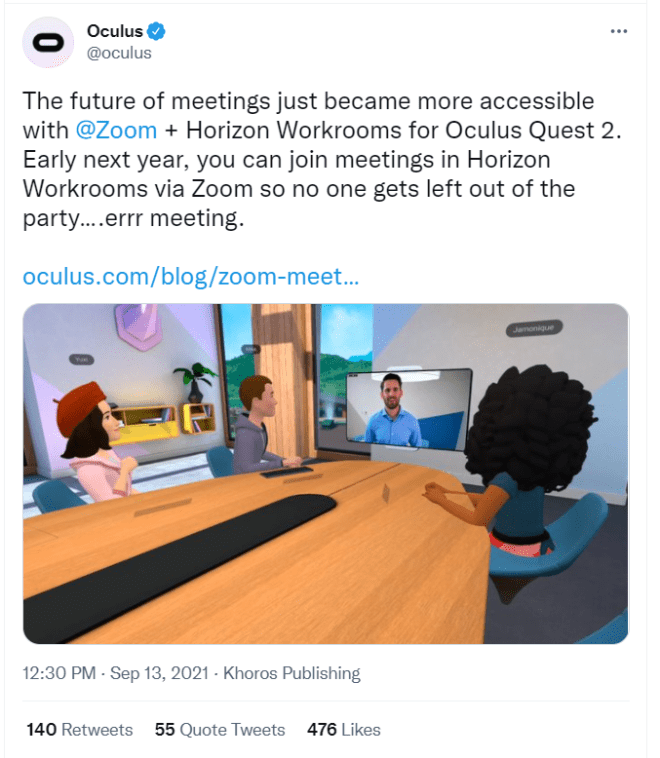
Facebook’s social VR platform for business, Horizon Workrooms (which I wrote about previously here) has announced that they will release a new feature next year: integration with Zoom.

In the official announcement, Facebook stated:

We recently launched Horizon Workrooms on Oculus Quest 2. It’s a new way to collaborate remotely across the world, through the power of virtual reality. And today, we’re excited to announce we’re teaming up with Zoom to integrate Workrooms even more deeply into your everyday workflows, starting next year.

Regardless of physical distance, people can meet up inside Workrooms and feel like they’re in the same room together. With immersive features like avatars and 3D spatial audio, and the ability to access your desktop computer and keyboard seamlessly from VR, Workrooms is designed to improve your team’s ability to collaborate, communicate, and connect. And starting next year, we’ll be taking Workrooms to the next level, letting you easily join Zoom Meetings and use Zoom Whiteboard all from within VR—we’re showing a sneak peek of what it could look like today at Zoomtopia, which you can check out here.

Facebook has bottomless pockets of money (mostly raised by strip-mining your personal data and selling it to advertisers), and it only makes sense that the company will use that income to forge alliances with other well-positioned companies such as Zoom (which I have no doubt profited greatly from the coronavirus pandemic).