Addressing the Elephant in the Room: Social VR Sustainability

Photo by David Clode on Unsplash

I have been enjoying my self-imposed vacation from the blog. It’s given me an opportunity to step back, enjoy the all-too-brief Canadian summer, and reflect a little bit. I’m going to start easing back into blogging over the next week. There’s certainly no shortage of things to write about!

Yesterday, Gindipple shared his most recent compilation of Sansar user concurrency statistics, and while they do show a slight increase in the average number of users over time, it’s clear that users have not exactly rushed to embrace Sansar in the way that Linden Lab has been hoping:

Inara Pey has done her usual excellent job of summarizing last week’s Sansar Product Meeting, and she shares the following item from the discussion:

It’s now almost two years since Sansar opened its doors to the public, and general user concurrency is still only in or around the mid-20s level. This has raised questions of Sansar’s sustainability, and whether the Lab have set any goals for the platform that need to be achieved in order for it to be continued, etc.

Landon McDowell, the Lab’s Chief Product Officer, and the person most directly in charge of Sansar’s development, responded thus to one of these questions:

I am not going to put any date on the board. I think we’re taking this day-by-day, week-by-week, month-by-month, release-by-release, and we want to see what is happening and what is resonating and what isn’t … I believe steadfastly in the future of virtual worlds, that what we’re doing here is really important … Are we happy with the result? I’m not happy with the result; I would want a million people in here today, and we’re obviously not there.

But in terms of sustainability, I think we know what our limits are, and we are proceeding accordingly. If we have 50 people in here in a year then yeah, I’m going to be really massively disappointed. I think everybody here is working hard to make this an absolutely monumental success … I feel that everyone that’s here is here because they’re digging something about what we’re doing, and I want that to spread like wildfire quite frankly. So we definitely have hopes and ambitions.

But again, I’m not going to put a dot on the board of, “this date and this time, this number of users”. I think we want many more users in, and we want them relatively quickly, and we go from there.

While it is good news that Linden Lab appears to have no internal make-or-break date for Sansar, the fact remains that the company is putting time and money into a platform that, so far, is not attracting a lot of use.

The elephant in the room of social VR, not just for Linden Lab but for all companies in this marketplace, is sustainability. Many companies are pouring resources into various social VR platforms, in hopes that they will be able to relight the same spark that ignited over a decade ago with Second Life. Most projects have not had a great deal of success yet. The few social VR platforms which have attracted some attention to date (VRChat and Rec Room) face a daunting transition to an in-world economy, plus a slew of technical problems trying to shoehorn their experiences into wireless VR headsets like the new Oculus Quest in order to reach the broadest possible potential audience. Add to that rumours that Facebook is reportedly working on a major social VR initiative for all its Oculus VR hardware users, which will likely upend the current marketplace. The road ahead is rocky indeed.

Given the significant compromises that have had to be made to VRChat in order to get it to run at all on the Quest, and the rather disappointing results, it seems Linden Lab’s decision to not support an Oculus Quest version of Sansar is a wise one. Inara reports:

Oculus Quest support:  As has been previously indicated, this is not currently on the cards. The Quest processor and general capabilities are seen as being unable to handle to quality of content LL want to provide without massive amounts of auto-decimation, which can be problematic. However, as the capabilities of emerging VR systems continues to improve and Sansar improves in terms of performance limits, the hope is that the two will converge at some point in the future.

And that convergence may come sooner than you think. It is interesting to note that at least one eager early adopter has reported that he is able to use the PC streaming app ALVR to play Sansar on the Oculus Quest. (“PC streaming” refers to the use of sideloaded Quest apps to enable your desktop computer to stream VR games directly to your Quest. You’ll have to sideload the app onto your Quest, and then install a coordinating PC program before you can start playing. These programs, such as ALVR and VRidge, are new, highly experimental, and currently require a certain level of geek skills to set up and use. But they will no doubt become easier to use over time.)

Image by Pexels from Pixabay

However, as Landon McDowell says, I’m still a fervent believer in the future of virtual worlds. I still believe it’s a question of when and where, not if, social VR takes off and virtual worlds have a renaissance. High Fidelity’s recent pivot towards business users is just one example of a social VR company adjusting its sails to meet evolving conditions. Expect more such shifts as the market grows and changes.

Stay tuned! As I often say, things are getting interesting!

UPDATED! Not Taking “No” for an Answer: The Developers Behind The Expanse Have an Unexpected Hit on Their Hands with SideQuest

This story is a perfect example of not taking “no” for an answer, and how what could have been a setback was instead turned into a golden opportunity for one company!

Photo by Nadine Shaabana on Unsplash

I first wrote about The Expanse social VR platform back in April. The company behind The Expanse, a fledgling virtual world, had wanted to launch their product on the Oculus Quest, but they were among the many software developers told “No” by Facebook, which appears to have taken a much more stringent approach to curating content on their new standalone headset. UploadVR reports:

“Originally it was intended to provide a way for us to get our game The Expanse to users of the Oculus Quest headset as our submission pitch was declined by Oculus – something we understood as many more well established apps were also being declined. It then struck me that maybe some of those other developers could also benefit from a super easy sideloading process with things like drag and drop and several apps inbuilt,” Harris wrote to me in a message on his Discord group. “SideQuest is a sideloading tool at heart and actually works with any android device but it has evolved into an unofficial source for apps that you wouldn’t otherwise get on Quest. I would love to see it fill the niche of a testbed for pre-release/alpha/beta testing or for deploying demos for users to try out. I have no plans to monetize SideQuest like a traditional app store as I don’t want to affect the Oculus bottom line and I would love to work with Oculus to become an alternative route for apps and games that have been declined or otherwise or just want to test cutting edge features. I think there has been a lot of discussion around games being declined and I would love if SideQuest could provide a more positive spin for Oculus and Facebook in those scenarios. I guess i see it as a stepping stone to a application for the full oculus store down the line.”

Sideloading is the process of adding apps to your Oculus Quest that are not currently in the Oculus Store. And, as it turns out, there happen to be a lot of software developers (and end users) out there who wanted to be able to sideload their applications. And that’s when the SideQuest project really took off in popularity, and gained a life of its own! (There are other ways to sideload apps on the Quest, but SideQuest makes it simple to do. In fact, in the short few weeks that the Quest has been out, there have already been several iterations to the software to make it even easier to use.)

One very popular feature of the SideQuest software is the ability to add custom songs to the collection of music by which you can play the rhythm VR game Beat Saber. The SideQuest app links directly to the BeastSaber community website, and adding new tracks is as simple as setting up a developer account for your Quest, connecting your Quest to your Windows, Mac, or Linux computer, and clicking a few buttons! Here’s the page with all the details. And here’s a step-by-step YouTube tutorial by the Virtual Reality Oasis:

Congratulations to the team at The Expanse! The SideQuest software is free, but if you want to support their work, here is a link to their Patreon, or you can send a donation via PayPal. If you want more details on The Expanse and SideQuest as they evolve, you can join their Discord channel.

And this whole episode reminds me yet again of the lesson that Friendster never learned— the people who create the software platforms (in this case, Facebook) think they have control, but it’s really the end users who shape the service and build the community that they want to see. Past a certain point, there’s very little that Facebook can do to stop this, short of completely shutting developers out, which they won’t do. And if they’re smart, Facebook will welcome this, and work with it.

UPDATE 6:43 p.m.: This last paragraph has brought a swift rebuttal from a commenter on the Oculus Quest subReddit, who says:

FFS, no. Facebook is 100% in control. They allow SideQuest. Go ask PSVR Beat Saber players how they “shaped the service” to get custom songs on the PS4. Hint: they didn’t. Sony has that shit locked down like Fort Knox. Oculus could easily require sideloaded apps to be signed with a development license to run. It’s only by their good graces that sideloading and modding is as easy as it is, so don’t pretend for a minute that you’re sticking it to the man. Be grateful there’s some cool folk at Oculus who want us to be able to do this.

Some Observations from the First Week of Oculus Quest Sales

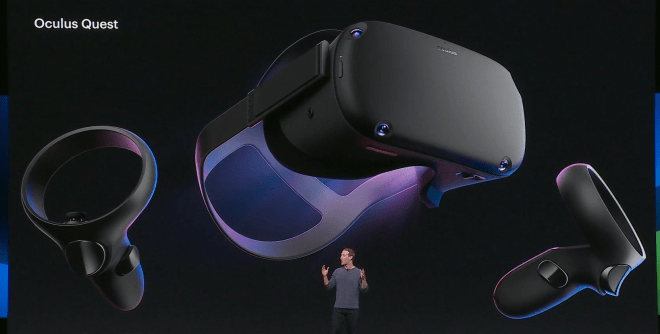
The Oculus Quest has now been shipping units since May 21st, 2019, for exactly one week, and I have been closely monitoring the Oculus Quest subReddit channel and other news sources to find out how things have been going.

And so far, things have been going like gangbusters! Many stores such as Amazon, Walmart, and Best Buy report being completely sold out of the Quest, and some people are posting messages on the Oculus Quest subReddit, desperately searching for a location that can ship the product (or that they can drive to and pick one up) without having to wait weeks. People report making road trips of several hours to find the last store in their area that has a Quest in stock! Right now, Amazon Canada estimates delivery sometime between June 18th and July 11th if you order the model with 64GB memory today. Your best bet might be the Oculus website, which says they will ship by June 7th if you order today. So yes, you can call the launch a resounding success.

Furthermore, many of those early adopters are giving demonstrations of VR to their family, friends, and colleagues, and many of those people are instantly sold on the Oculus Quest, and go out and buy their own device. Virtual reality is one of those things that is best experienced live, and the Oculus Quest is tailor-made to give demos, since it is standalone headset, easy to transport and easy to set up. It’s also a sizable step up from the rather disappointing cellphone-based VR that is all that some people have experienced so far. The Quest is a game-changer.

In my first week, not only have I spent CDN$699 on the Oculus Quest headset with 128GB of memory, I have also spent almost CDN$100 on games and apps for the device:

I understand that Facebook is taking a 30% cut of the sales on the Oculus Store. Some people speculate that Facebook is actually selling the Quest hardware at a loss, just so they can make money on selling games and apps. The astonishing consumer uptake of the Oculus Quest will certainly attract software developers, once they realize that they have a potentially large audience to sell to. Expect a huge increase in the number of apps on the Oculus Store as the year goes on. There’s probably going to be some fantastic Black Friday sales, too! In fact, somebody has already created a website to help you pick out new apps as they are released.

So, what do I think of the Oculus Quest so far? I am absolutely enchanted. The first apps on the Oculus Store appear to be solid. Beat Saber and Dance Central promise to give me a calorie-burning workout at a time when I am already trying to lose weight via Weight Watchers. Wander uses Google Earth 360-degree photography to allow me to wander the world. (I spent some time visiting the pre-fire Notre Dame Cathedral in Paris, and admiring the view from the Eiffel Tower observation deck yesterday evening.) Nature Treks VR allows me to meditate in beautiful scenery. Tilt Brush (which was free for me, as I already had purchased it for the Oculus Rift) allows me to express my creative side. There’s really no downside to this. This gadget is the new iPhone, the new iPad, the new PlayStation. I’m sold.

The only real problem that I have experienced is that I simply do not have enough big, empty space in my rather small apartment to really experience the boundless freedom of the wireless Oculus Quest. Often, especially when I play Beat Saber or Dance Central, I brush my hand up against the Guardian boundary system that lights up and warns me when I get too close to walls or other physical obstacles. It’s annoying, and I want more space! I’m seriously considering completely redecorating my living room, throwing out my coffee table and some other furniture so I can create a bigger open space in which to play.

Now, I do have an obliging empty patch of grass located just outside my apartment that would do the trick for true “room-scale” VR. While Oculus does not recommend using the device outside (because you can easily damage the lenses in the Quest by direct exposure to bright sunlight), many people have reported being able to use the device around sunset outdoors without problem. (Of course, having my apartment neighbours wonder what the hell the fat man is doing as he flails around outdoors in a wireless headset and hand controllers is another problem entirely.)

So, as I predicted, the Oculus Quest is a hit, and it promises to bring many more consumers into virtual reality. And, if you’re sitting on the fence, I encourage you to demo a friend’s unit for yourself, and see what all the fuss is about.

Facebook Doesn’t Have a Coherent Social VR Strategy—But They’re Working on Something Big

Ben Lang of the Road to VR website doesn’t mince words in an article titled Facebook Has Four Separate Social VR Apps, and None of Them Are on Quest:

Facebook’s fragmented approach to social VR hasn’t gotten any better with the launch of Quest. The company now has four separate social VR apps, and none of them are currently available on its newest headset.

With Oculus, Facebook has aimed to build the premiere VR ecosystem, but when it comes to allowing users of the company’s different headsets—Go, Quest, and Rift—to actually interact with one another, it has completely dropped the ball.

And, as I blogged about earlier, Oculus Quest users do not have access to any Facebook-branded social VR platforms: no Facebook Spaces, no Oculus Home, no Oculus Rooms, no Oculus Venues. Facebook has basically left social VR to third-party vendors like VRChat and Rec Room, both of which will probably see a jump in user concurrency figures with the launch of the Oculus Quest headset, which I predict will prove very popular with consumers.

Adi Roberston, a senior reporter for The Verge, posted a tweet about Ben Lang’s article, which led to a very interesting response from Infinite Retina, who apparently has heard some industry gossip and is willing to spill some tea:

Infinite Retina said:

We hear Facebook is working on a major VR initiative that will come out in next 15 months. Code named “Metaverse.” They ended Facebook Spaces to get the programmers to work on this new thing.

My first response to this tweet was “Hallelujah! They’re killing Facebook Spaces!“. (My second response was “Holy shit!“.)

As I have said before, Facebook has the potential to be a major disruptive force in social VR, if they could only get their act together. And it sounds as if that is exactly what they are planning to do. All the current players in social VR had better be paying attention, and planning accordingly. They have only a small window to make an impact with their products before Facebook launches their “Metaverse” product, and when they do, it’s gonna be pretty much the only thing that the news media will be talking about (if the oceans of fawning press coverage over every stupid little upgrade to Facebook Spaces is any indication). And Facebook has very deep pockets for things like programmer salaries and advertising budgets.

Fasten your seatbelts! Things are gonna get really interesting!