Since its public launch on February 20th, 2020, Decentraland has attracted over 10,000 new users, according to statistics shared with me by the company. (Here, “users” are defined as people who visit more than one location in Decentraland.)
The treasure chest hunt has been extended until midnight Eastern Standard Time tomorrow, Tuesday February 25th, 2020. Here is a list of treasure chest locations, as well as more information on the hunt. While some treasure chests are easy to access (particularly within the plazas), others require you to solve a puzzle before you can reach them.
Don’t forget that, as I have written, you will need to have a small amount of Ethereum (ETH) cryptocurrency in your wallet in order to claim hunt prizes!
Congratulations to the team at Decentraland for a successful launch!
I’ll say it again. This has been an amazing week. We have had the first (and second) player created worlds. A record breaking eight concurrent players participating in the weekly Discord Community Test. Daily impromptu player hangouts also reaching up to eight participants. Players helping players make maps. Players helping players make avatars. Rareden was also able to get the Documentation page (work in progress) set up. At the request of a community member, we also added a third person camera to desktop mode. More functionality to come.
The Sansar community has planted its flag firmly in Helios this week as most of our recent Discord members are Sansar alumni. They are bringing with them a passion for creation that is truly remarkable. In fact, both player-created worlds added to Helios this week were from recently joined members.
The newly-created worlds are by Zod and C3rb3rus (who appears to have recreated his Sansar world Cerb’s Lounge within Helios, complete with flying dragon!).
Cerb’s Lounge, recreated in Helios
While the company has handed out 120 early-access Steam keys, going forward they are changing how they are handing out keys:
We’ve handed out over 120 Steam keys. With this in mind and after a good deal of internal debate, we have decided to move to a referral system when handing out keys. This is to make sure that Alpha participants are going to be active members of the community, whether that be showing up at organized tests or bringing their own content into Helios. If you don’t know someone already in the Alpha and still want a key, feel free to ask for one in the request-a-steam-key channel in the Helios Discord. Once we re-open our Alpha to the general public, keys will be handed out on a first come, first serve basis. It is entirely possible that hanging out in the Discord and being an active member of the community will get you a key before that.
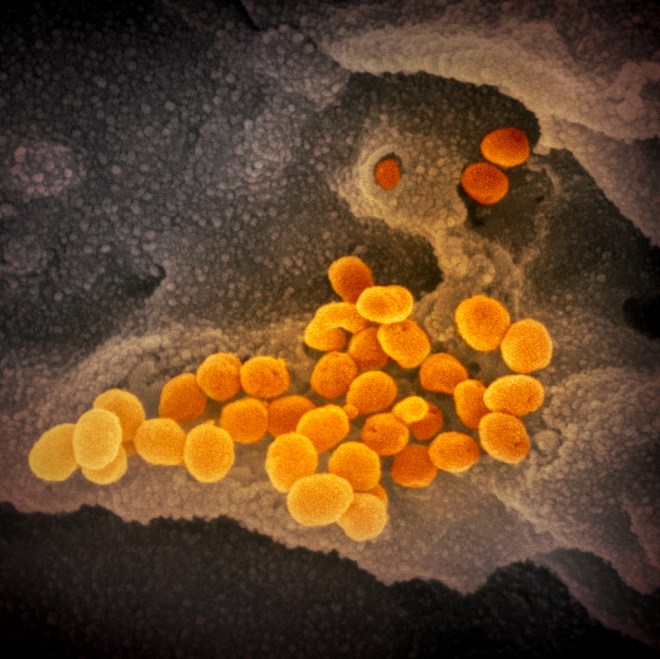
Novel Coronavirus SARS-CoV-2 This scanning electron microscope image shows SARS-CoV-2 (orange)—also known as 2019-nCoV, the virus that causes COVID-19—isolated from a patient in the U.S., emerging from the surface of cells (gray) cultured in the lab. Credit: NIAID-RML
It would appear that outbreaks of SARS-CoV-2 virus (and the disease it causes, COVID-19) are springing up in places far from its birthplace in Wuhan, China: in South Korea, Iran, and Italy, among many other nations, with the coronavirus infection showing up in dozens of people who cannot be easily linked to China.
The Washington Post newspaper reported yesterday, in story titled Coronavirus outbreak edges closer to pandemic (original, archived copy):
In South Korea, coronavirus cases quadrupled over two days, as 144 people linked to a religious sect tested positive. In Singapore, clusters of infection have been traced to two churches, a hotel business meeting, a health products shop and a construction site. In Iran, an outbreak has seeded new cases in Lebanon and Canada — a worrisome sign the disease could be spreading more widely than realized.
There are outbreaks. There are epidemics. And there are pandemics, where epidemics become rampant in multiple countries and continents simultaneously. The novel coronavirus that causes the disease named COVID-19 appears to be on the verge of that third, globe-shaking stage.
Amid an alarming surge in cases with no clear link to China, infectious disease experts believe the flu-like illness may soon be impossible to contain. The World Health Organization has not declared COVID-19 a pandemic and the most devastating effects, including more than 2,200 deaths, are still in China. But the language coming from the organization’s Geneva headquarters has turned more ominous in recent days as the challenge of containment grows more daunting.
…
“What we find is that this virus is going to be very difficult to contain,” said Jeffrey Shaman, an infectious disease researcher at Columbia University and co-author of the study posted Monday. “Personally, I don’t think we can do it.”
Harvard epidemiologist Marc Lipsitch estimates that 40 to 70 percent of the human population could potentially be infected by the virus if it becomes pandemic. Not all of those people would get sick, he noted. The estimated death rate from COVID-19 — roughly two out of 100 confirmed infections — may also drop over time as researchers get a better understanding of how widely the virus has spread.
That death rate, estimated at 2% of cases at present, is significantly higher than that posed by regular seasonal influenza, at 0.1%. While many people (especially the young) have only a mild response to this virus, the latest scientific research shows that approximately 20 percent of those who land up in hospital with COVID-19 are severe cases that often require intensive care. Those who are older, overweight, or have underlying health conditions such as asthma, heart disease or diabetes are more likely to have a severe or even deadly reaction to this virus.
The current fatality rate is less than 0.5% for people under the age of 50. But it rises to 8% for people in their 70s and 15% for people over 80. Meanwhile, nearly 11% of people with diseases of the heart died when infected. As did 7% of people with diabetes and 6% of people with long-term lung problems. The average for healthy people is 0.9%.
Dr. Anthony Fauci, the director of the National Institute of Allergy and Infectious Diseases (NIAID) in the United States, explained in a recent CNN interview why we’re nearly at the brink of a global pandemic with the novel coronavirus outbreak:
Today officials from the Centers for Disease Control and Prevention (CDC) warned that although the agency is taking historic measures to slow the introduction of COVID-19 into the United States, the country should prepare for the possibility of community spread, as seen in China and neighboring Asian countries.
“The day may come when we may need to implement such measures as seen in Asia,” Nancy Messonnier, MD, director of the CDC’s National Center for Immunization and Respiratory Diseases, said in a press conference, referencing the closing of businesses, schools, and churches in multiple countries where transmission is now occurring within the community.
This is no longer a “what-if” scenario for us in North America, or an “over there on the other side of the world” problem that we can ignore. This potential pandemic is already wreaking unprecedented havoc in Chinese society, and that havoc is spreading to other countries now—South Korea, Japan, Hong Kong, Singapore, Iran, and Italy all have documented cases of human-to-human transmission.
In other words, you need to prepare yourself—emotionally, mentally, and physically— for a pandemic. The time to begin preparing is NOW.
When someone first learns about a new and potentially serious risk, the natural, healthy, and useful reaction is, in a sense, an over-reaction:
– You pause – You become hyper-vigilant – You personalize the risk – You take extra precautions
These responses are signs of what psychiatrists call an adjustment reaction. They are part of the process of adjusting to the new risk. Here are the key characteristics of the adjustment reaction to crisis:
1. It is automatic 2. It comes early 3. It is temporary 4. It is a small over-reaction 5. It may need guidance 6. It serves as a rehearsal 7. It reduces the probability of later over-reaction
This is the teachable moment! Instead of criticizing or ridiculing people’s adjustment reactions to emerging crises, smart crisis communicators encourage the adjustment reactions, legitimize them, ally with them, and guide them.
It’s okay to tell people that they’re jumping the gun a little – that there is still time and you advise them to hold off on particular precautions until the risk gets closer, bigger, or clearer. It’s okay to recommend substitute precautions – precautions that are more useful or less burdensome or less likely to backfire than the ones they’re attracted to. It’s okay to remind them that nobody knows yet whether the situation will worsen or blow over, that they should try to stay poised to ramp up or ramp down their level of concern. That’s all part of guiding the adjustment reaction.
What isn’t okay is to suggest that people shouldn’t be worried yet, that they shouldn’t take any precautions or even think about what precautions they want to take until you give the word. It isn’t okay to tell people that their normal and useful impulse to rehearse is irrational or panicky. Healthy people are going to rehearse. They are going to imagine the worst before it happens and before we know for sure if it’s coming. They are going to take premature precautions. An adjustment reaction is a big improvement over being caught unawares. Don’t try to tell people not to have one. Help them have a good one.
In other words, an adjustment reaction is normal, it helps you to begin to take the risk of a pandemic seriously, and it gives you the kick-start you need in order to begin preparing for it.
At this point all the experts are now saying the same thing: that the Wuhan coronavirus will continue to spread worldwide. It cannot be contained, either within the city of Wuhan, the country of China, or the region of south-east Asia. The best that countries outside China can do at this point is to use case isolation and contact tracing to slow down the spread of the virus within their countries, and implement quarantines and social distancing policies to buy more time in order to prepare. As Dr. Amesh Adalja says above, “It is not a matter of if—it is a matter of when”.
No hospital system, anywhere in the world, has enough intensive care beds to deal with a surge of tens of thousands of serious 2019-nCoV cases, as we have already seen happen in Wuhan, China.
As I have written before, throughout history there have been eight tactics used to combat infectious diseases. It is possible—some would say, likely—that national, state/province, and city governments will impose quarantines and social distancing policies in order to try and contain 2019-nCoV outbreaks.
What this means for you, reading this now, is that you need to prepare yourself and your family for the possibility that you will need to stay in your homes for a period of several weeks, avoiding contact with as many other people as possible, as a wave of illness caused by the Wuhan coronavirus sweeps through your community, forcing schools, businesses, and public transportation and public gathering places like movie theatres and shopping malls to close (as we already seen in Wuhan and many other cities in China). The time to prepare for this is NOW.
At least two weeks of food and other supplies (toilet paper, first aid supplies, soap and hand sanitizer, garbage bags, etc.). There are already reports of panic buying in places such as Hong Kong, Singapore and Italy. You do not want to leave it to the last minute! For example, both my local drug store and my local grocery store are now completely sold out of hand sanitizer, and the manager at the grocery store said they’ve been out of stock for two weeks now.
Refills of all your presecription medications, plus a stock of over-the-counter medicines (talk to your doctor and pharmacist about creating an emergency supply of your prescription medication).
Power sources (flashlights, extra batteries, car chargers and adapters for your mobile devices, etc.).
Other things that you should do:
Sign up for any local alerts from your city, state/province, or federal government (or know where to find the information on the Internet). Find out what plans your employer is making (and if they’re not making them now, they should be).
If you haven’t yet, get your seasonal flu shot. It can’t hurt, and it will help to figure out whether or not you do have 2019-nCoV if/when you do become sick. Many areas now give out the flu shot for free.
Train yourself NOT to touch your eyes, nose, and mouth! The SARS-CoV-2 virus can remain viable on hard surfaces anywhere from 2 hours to 9 days (scientific journal article source), and you can transfer the virus from your infected hands to your mouth, nose, and eyes by touching or rubbing them.
Watch the following video from the World Health Organization on how wash your hands! Yes, I know I have posted it before. You may think you already know how to wash your hands properly, but you still might learn something you didn’t know before. Proper hand hygiene will also help you avoid catching regular seasonal colds and influenza, so there’s a net benefit to society.
Good Sources of Information on SARS-CoV-2 and COVID-19
Here is my updated list of good, credible, authoritative resources to learn more about the Wuhan coronoavirus (formerly called 2019-nCoV and now officially called SARS-CoV-2; the disease the virus causes is now called COVID-19):
Another instructive YouTuber to watch is Dr. John Campbell, a British nurse educator who very clearly explains what you need to know
If you prefer to get your informtion via audio, the Infectious Diseases Society of America (IDSA) has started a weekly half-hour podcast on SoundCloud, called COVID-19: What’s Happening Now.
If you want a quick, up-to-date overview of the current situation, here are three good places to check:
2019-nCoV Global Cases (by the Center for Systems Science and Engineering at Johns Hopkins University) UPDATE Feb. 24th: This website appears to be down (temporarily, I hope!); other good statistics dashboards are here and here.
Strawberry Linden has continued on with Lab Gab, a regular talk show on Second Life, hosting solo now that Xiola Linden (a.k.a. Jenn in Sansar) has left Linden Lab. Her guests today were Linden Lab CEO Ebbe Altberg, and Grumpity Linden, the Vice President of Product for Second Life, and she did a absolutely wonderful job as host, asking her guests many questions raised by Second Life’s customers.
Strawberry started off the conversation by asking Ebbe to talk about the current status of Sansar. He said (and this is a paraphrase I transcribed directly from the livestream video) that Linden Lab decided that they could no longer sponsor the project financially, so they are looking for a “Plan B”, and are having conversations with interested parties. There is as yet no deal to announce, however. Moving forward, Linden Lab will focus entirely on Second Life and the Tilia online payments business. He hopes that he can be more specific with details of a deal in a couple of weeks or so.
UPDATE 7:49 p.m.: If you are looking for an exact, verbatim transcript of Ebbe’s words (and an audio clip), Inara Pey has what you need. Thanks, Inara!
Ebbe said that in the process of rightsizing, Linden Lab lost a number of staff, but some “heavy-hitters” were transferred from the Sansar project to Second Life. He said Linden Lab is now in a very healthy financial position, but it was sad to let so many good people go, and they were doing everything they could to help them find new jobs. Out of respect for the people who were laid off, the company will not name the people who were let go, although the laid-off staff could let others know if they wanted to, themselves. (And although I did receive a list of the names of Linden Lab staff laid off in the most recent layoffs from a well-placed source, I will not be sharing it.)
Strawberry (bless her heart!) also asked Ebbe about the rumour that Philip Rosedale, Linden Lab’s founding CEO, was coming back to Linden Lab, and Ebbe said that that was not true. He and Philip do keep in touch regularly, though.
The rest of Lab Gab was about Second Life, and the conversation involved VP of Product Grumpity Linden. Work is proceeding on a large endeavour called Project Uplift, which involves moving much of Second Life’s infrastructure from server farms into the cloud (the hosting of sims, etc.), which Linden Lab expects to complete by the end of this year.
Development is underway on a companion mobile app for Second Life (not a 3D viewer) for chat, customer support for merchants, etc. The idea is to provide a tool for SL users to stay connected with their friends even if they are not on a desktop computer. They expect to have an alpha/beta user test at some point in the future, hopefully within a couple of months. The iOS Apple app will be released before the Android app.
Grumpity Linden’s colourful avatar
The launch of Premium Plus accounts (essentially, super-premium user accounts with even more features and benefits) is “close”, according to Grumpity, but she would not commit to a release date yet. Premium Plus users will pay about US$20 less for the upcoming avatar name change feature than current Premium users. So, you might want to wait for Premium Plus accounts to launch before deciding to change your avatar name.
Grumpity also announced that the cost to transfer a buy-down or grandfathered sim will be cut in half, from US$600 to US$300. There are no other land price change announcements at this time.
Finally, Keira Linden, the Product Manager for the Name Change Project, made a special announcement. Over 2,400 submissions were received for the Second Life Name Changes contest. Eight last names were chosen as the contest winners, instead of just five as they had originally planned. Keira reported the winners here:
Conundrum
Dismantled
Huntsman
Littlepaws
Nova
Ravenhurst
Wumpkins
Yeetly
All the winners will be emailed, and they will get a free avatar name change when this feature becomes available. (Note that there will be a whole bunch of last names available to choose from at launch, not just these eight.)
There were many other topics discussed that I am not covering here, but you can watch this episode of Lab Gab on YouTube: