VBunny Go is quite an entertaining and enthusiastic commentator, as she puts Rec Room through its paces (including playing several levels of a dungeon quest as part of a team). She finds that most of Rec Room’s functionality is still present, despite playing the game on an iPhone.
I need to get a setup like hers, so I can start doing my own in-world videos! She’s a good example of someone who is slowly building a YouTube audience with her videos of her VR gaming adventures.
As a VR only player, I’ve been excited to be able to try the mobile version and see what everyone is ready to complain about. And since today I was invited, I hurriedly downloaded it to finally witness the horror of mobile gaming. And guess what? It’s good. The game runs beautifully and looks absolutely gorgeous. The UI and UX is intuitive and snappy. The controls just make sense. I was literally jealous of the mobile menus compared to the VR version. It’s a smooth, polished ride with all of the content at the ready. It’s GOOD. And you all are going to love it.
I have been enjoying my self-imposed vacation from the blog. It’s given me an opportunity to step back, enjoy the all-too-brief Canadian summer, and reflect a little bit. I’m going to start easing back into blogging over the next week. There’s certainly no shortage of things to write about!
Yesterday, Gindipple shared his most recent compilation of Sansar user concurrency statistics, and while they do show a slight increase in the average number of users over time, it’s clear that users have not exactly rushed to embrace Sansar in the way that Linden Lab has been hoping:
It’s now almost two years since Sansar opened its doors to the public, and general user concurrency is still only in or around the mid-20s level. This has raised questions of Sansar’s sustainability, and whether the Lab have set any goals for the platform that need to be achieved in order for it to be continued, etc.
Landon McDowell, the Lab’s Chief Product Officer, and the person most directly in charge of Sansar’s development, responded thus to one of these questions:
I am not going to put any date on the board. I think we’re taking this day-by-day, week-by-week, month-by-month, release-by-release, and we want to see what is happening and what is resonating and what isn’t … I believe steadfastly in the future of virtual worlds, that what we’re doing here is really important … Are we happy with the result? I’m not happy with the result; I would want a million people in here today, and we’re obviously not there.
But in terms of sustainability, I think we know what our limits are, and we are proceeding accordingly. If we have 50 people in here in a year then yeah, I’m going to be really massively disappointed. I think everybody here is working hard to make this an absolutely monumental success … I feel that everyone that’s here is here because they’re digging something about what we’re doing, and I want that to spread like wildfire quite frankly. So we definitely have hopes and ambitions.
But again, I’m not going to put a dot on the board of, “this date and this time, this number of users”. I think we want many more users in, and we want them relatively quickly, and we go from there.
While it is good news that Linden Lab appears to have no internal make-or-break date for Sansar, the fact remains that the company is putting time and money into a platform that, so far, is not attracting a lot of use.
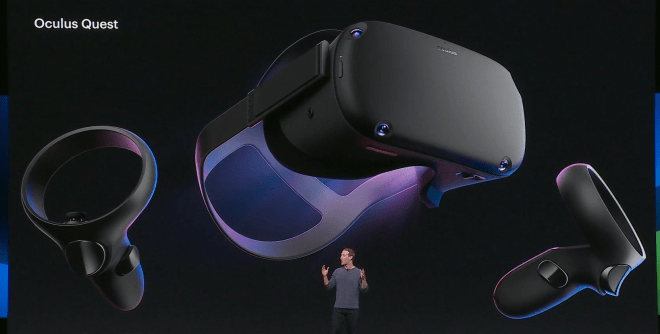
The elephant in the room of social VR, not just for Linden Lab but for all companies in this marketplace, is sustainability. Many companies are pouring resources into various social VR platforms, in hopes that they will be able to relight the same spark that ignited over a decade ago with Second Life. Most projects have not had a great deal of success yet. The few social VR platforms which have attracted some attention to date (VRChat and Rec Room) face a daunting transition to an in-world economy, plus a slew of technical problems trying to shoehorn their experiences into wireless VR headsets like the new Oculus Quest in order to reach the broadest possible potential audience. Add to that rumours that Facebook is reportedly working on a major social VR initiative for all its Oculus VR hardware users, which will likely upend the current marketplace. The road ahead is rocky indeed.
Oculus Quest support: As has been previously indicated, this is not currently on the cards. The Quest processor and general capabilities are seen as being unable to handle to quality of content LL want to provide without massive amounts of auto-decimation, which can be problematic. However, as the capabilities of emerging VR systems continues to improve and Sansar improves in terms of performance limits, the hope is that the two will converge at some point in the future.
And that convergence may come sooner than you think. It is interesting to note that at least one eager early adopter has reported that he is able to use the PC streaming app ALVR to play Sansar on the Oculus Quest. (“PC streaming” refers to the use of sideloaded Quest apps to enable your desktop computer to stream VR games directly to your Quest. You’ll have to sideload the app onto your Quest, and then install a coordinating PC program before you can start playing. These programs, such as ALVR and VRidge, are new, highly experimental, and currently require a certain level of geek skills to set up and use. But they will no doubt become easier to use over time.)
However, as Landon McDowell says, I’m still a fervent believer in the future of virtual worlds. I still believe it’s a question of when and where, not if, social VR takes off and virtual worlds have a renaissance. High Fidelity’s recent pivot towards business users is just one example of a social VR company adjusting its sails to meet evolving conditions. Expect more such shifts as the market grows and changes.
Stay tuned! As I often say, things are getting interesting!
Facebook’s fragmented approach to social VR hasn’t gotten any better with the launch of Quest. The company now has four separate social VR apps, and none of them are currently available on its newest headset.
With Oculus, Facebook has aimed to build the premiere VR ecosystem, but when it comes to allowing users of the company’s different headsets—Go, Quest, and Rift—to actually interact with one another, it has completely dropped the ball.
And, as I blogged about earlier, Oculus Quest users do not have access to any Facebook-branded social VR platforms: no Facebook Spaces, no Oculus Home, no Oculus Rooms, no Oculus Venues. Facebook has basically left social VR to third-party vendors like VRChat and Rec Room, both of which will probably see a jump in user concurrency figures with the launch of the Oculus Quest headset, which I predict will prove very popular with consumers.
We hear Facebook is working on a major VR initiative that will come out in next 15 months. Code named “Metaverse.” They ended Facebook Spaces to get the programmers to work on this new thing.
My first response to this tweet was “Hallelujah! They’re killing Facebook Spaces!“. (My second response was “Holy shit!“.)
As I have said before, Facebook has the potential to be a major disruptive force in social VR, if they could only get their act together. And it sounds as if that is exactly what they are planning to do. All the current players in social VR had better be paying attention, and planning accordingly. They have only a small window to make an impact with their products before Facebook launches their “Metaverse” product, and when they do, it’s gonna be pretty much the only thing that the news media will be talking about (if the oceans of fawning press coverage over every stupid little upgrade to Facebook Spaces is any indication). And Facebook has very deep pockets for things like programmer salaries and advertising budgets.
Fasten your seatbelts! Things are gonna get really interesting!
Road to VR and UploadVR both report that the popular social VR platform Rec Room is expanding to both the iPhone and iPad. If you wish to be an iOS beta tester, you can sign up here.
Rec Room also has plans to create an in-game economy where content creators can get paid. UploadVR reports:
Against Gravity has big plans for Rec Room with the goal that “someone in school with no coding knowledge can build a game in an afternoon and ship it on console, PC, mobile, and VR. We’re already seeing this happen, but we think the ability to instantly build and publish a game gets a lot more interesting when you open up the audience to anyone with a mobile device.”
In addition to cross-platform creation tools, the company is also looking into ways for creators to get paid for their works in Rec Room.
“We’re looking into letting creators charge in-app tokens for inventions they created, costumes, events, and for different things they can build into their games and rooms,” according to the company.
Rec Room is going into some interesting directions!