Now, some of these do not appear to be social VR apps, so I won’t bother covering them on this blog. But there are a few interesting ones that merit further investigation!
…I refuse to put one cent of my own money into any cryptocurrency at this point, and I advise anybody who wishes to do so, to do every single scrap of their homework before investing in any product or service. It’s simply too risky.
…
The actions of a few bad apples (both individuals and companies) are threatening to spoil the entire barrel. Also, greed is driving investors into ill-informed and risky speculation, and currently, there is a crypto feeding frenzy that is starting to remind me of Shark Week. I fear that this is a financial bubble that will hurt many investors when it implodes. Caveat emptor!
And yes, I am part of the Virtual Universe (VU) Initial Coin Offering Partner Program (I’m currently number two on their VU Token Leaderboard). The main reason I am participating in that program is because it’s the only legal way I can earn VU tokens before the social VR space launches later this summer. Here’s a 10-minute video which explains the partner program in a lot more detail:
I think that Linden Lab should consider such a program to pay people in Sansar dollars for promoting Sansar on their various social media.
Well, if you haven’t seen my recent half-hour guided tour of VU, I suggest you set aside some time to watch the whole video. I have been blistering in my criticism of other blockchain-based virtual world projects which are more hype than substance (Decentraland is a classic example) because they don’t have anything that you can actually visit yet. But in Virtual Universe, they not only have a place you can visit (currently, only by appointment), but they also have a very easy in-world content creation tool that is actually fun to use! And I was impressed by the many little added touches such as AI-controlled animals like lizards, rabbits, and bluebirds, even individual insects!
Now, Virtual Universe still has a lot of work left to do. Any virtual world project is a mammoth undertaking, and they still have to polish the user avatars (the current ones are merely placeholders, from what I understand) and other features. But it’s a very promising, and very impressive, start.
So yes, I am eagerly awaiting the launch of the beta version of Virtual Universe, even though Sansar is still my first love (and the reason I created this blog in the first place).
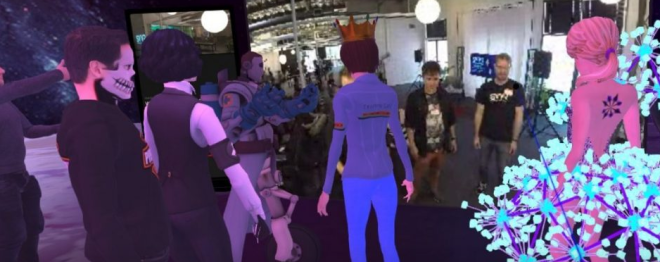
Today is the five-year anniversary for Silicon Valley Virtual Reality meetup, and founder Karl Krantz is announcing a couple of new initiatives as SVVR reorganizes itself as a public-benefit corporation. They’re going to be formally announcing their MULTIVERSE initiative that is going to be bringing Reality Portals to VR events, which will allow people virtually attend VR events put on by SVVR and others through social VR experiences like High Fidelity. They’ve created a screen that can be placed at VR events that provides a low-latency window into a VR world (and vice versa), allowing for serendipitous interactions between co-located events and the virtual attendees.
Among the first participants in this initiative will be High Fidelity, according to this press release:
Celebrating five years connecting the global VR community, SVVR is proud to announce MULTIVERSE — an open design initiative powering real-time, live event communications between real locations and virtual worlds.
Reality Portal is the first project to be launched as part of the MULTIVERSE initiative. It offers ‘natural interaction telepresence’ between people in the real world and people in remote locations, represented as avatars. Serving as a two-way window, Reality Portal enables real-time communications between real world and remote attendees and speakers at live events worldwide.
“Geography, platform fragmentation and exclusivity creates communities in isolation,” says Karl Krantz, SVVR partner and founder. “We’re offering the community an open bridge for overcoming location, closed ecosystems and toxic echo chambers. MULTIVERSE is our vision for fostering an open, sustainable and healthy future for global communications.”
Launching in late 2018, the open-source MULTIVERSE Development Kit will provide creators with everything they need to connect real locations and virtual worlds through pop-up Reality Portals and merged world spaces of their own. High Fidelity, Unity and WebVR/XR SDK support is in active development. MULTIVERSE technologies are currently utilized during live, SVVR-powered events.
“The distance between the real world and virtual reality is getting smaller every day,” said Philip Rosedale, founder and CEO of High Fidelity. “Closing that distance and making it easy for people to interact in-person and with their avatar representations interchangeably, no matter the VR platform, their equipment or location unlocks the true potential of virtual reality. Projects like MULTIVERSE, Reality Portal and the VRBA are all exciting steps along that path.”
In addition, SVVR is joining the Virtual Reality Blockchain Alliance, cofounded by open source VR platform High Fidelity. As a member of the Virtual Reality Blockchain Alliance, SVVR will work closely with the community and VRBA members to connect open metaverse platforms and services to people around the globe. Current VRBA members include High Fidelity, JanusVR and Somnium Space.
I’ll answer that at the end of this blogpost, but first I wanted to talk a bit about languages and virtual worlds.
Virtual worlds such as Second Life attract people from all around the world, who might not speak the same language as each other. (The Second Life website itself is available in English, Japanese, German, French, Spanish, Portuguese, Italian, Turkish and Russian.) Automatic translator software (such as this popular item on the SL Marketplace, which works with Google Translate) is often used to bridge the language gap between users chatting in Second Life.
(A related challenge is to provide voice-to-text conversion so that, for instance, a deaf person can participate in social VR discussions. Thankfully, this is already commonly available using software such as the Dragon line of products. It just needs to be integrated with the various client software used to navigate the newer metaverse products.)
Seamless communication between people of all languages may be coming sooner than you think! 再见!
And now the answer to the question I posted at the start of this blogpost: according to this discussion thread on the WordReference forums, the language with the highest number of irregular verbs is Latin—or perhaps Portuguese.


 There’s a new website called VRCryptocurrencies.com, which has published a list of VR cryptocurrencies. If you’ve been following my blog, you’ll see a lot of familiar names on that list: