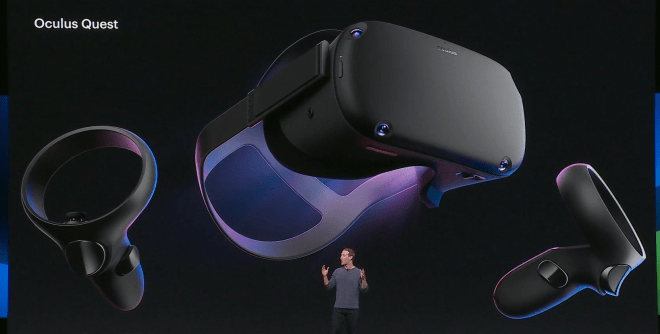
Facebook’s fragmented approach to social VR hasn’t gotten any better with the launch of Quest. The company now has four separate social VR apps, and none of them are currently available on its newest headset.
With Oculus, Facebook has aimed to build the premiere VR ecosystem, but when it comes to allowing users of the company’s different headsets—Go, Quest, and Rift—to actually interact with one another, it has completely dropped the ball.
And, as I blogged about earlier, Oculus Quest users do not have access to any Facebook-branded social VR platforms: no Facebook Spaces, no Oculus Home, no Oculus Rooms, no Oculus Venues. Facebook has basically left social VR to third-party vendors like VRChat and Rec Room, both of which will probably see a jump in user concurrency figures with the launch of the Oculus Quest headset, which I predict will prove very popular with consumers.
We hear Facebook is working on a major VR initiative that will come out in next 15 months. Code named “Metaverse.” They ended Facebook Spaces to get the programmers to work on this new thing.
My first response to this tweet was “Hallelujah! They’re killing Facebook Spaces!“. (My second response was “Holy shit!“.)
As I have said before, Facebook has the potential to be a major disruptive force in social VR, if they could only get their act together. And it sounds as if that is exactly what they are planning to do. All the current players in social VR had better be paying attention, and planning accordingly. They have only a small window to make an impact with their products before Facebook launches their “Metaverse” product, and when they do, it’s gonna be pretty much the only thing that the news media will be talking about (if the oceans of fawning press coverage over every stupid little upgrade to Facebook Spaces is any indication). And Facebook has very deep pockets for things like programmer salaries and advertising budgets.
Fasten your seatbelts! Things are gonna get really interesting!
Road to VR and UploadVR both report that the popular social VR platform Rec Room is expanding to both the iPhone and iPad. If you wish to be an iOS beta tester, you can sign up here.
Rec Room also has plans to create an in-game economy where content creators can get paid. UploadVR reports:
Against Gravity has big plans for Rec Room with the goal that “someone in school with no coding knowledge can build a game in an afternoon and ship it on console, PC, mobile, and VR. We’re already seeing this happen, but we think the ability to instantly build and publish a game gets a lot more interesting when you open up the audience to anyone with a mobile device.”
In addition to cross-platform creation tools, the company is also looking into ways for creators to get paid for their works in Rec Room.
“We’re looking into letting creators charge in-app tokens for inventions they created, costumes, events, and for different things they can build into their games and rooms,” according to the company.
Rec Room is going into some interesting directions!
The first email I got was from Dedric Reid, who appears to be associated with MetaWorld, who told me:
Hey Ryan, you’ve published false information about my product MetaWorld. Want to talk about it?
I responded, asking him for more information, and to specify where I was wrong, but I never got any sort of reply back. Then, just yesterday, another email came, this one from a user of MetaWorld named Emmiren:
I read the article on social VR/virtual worlds, and I noticed that MetaWorld has a warning on it that makes it sound like a scam. I am not part of the development team, but let me reassure you that MetaWorld is still in progress. Production was slowed to a halt for a while since the team had to wait for the Oculus SDK for unity 2019. Now that the SDK is out, progress has resumed and is going pretty quickly. There’s already the first island called “Turtle Islands” in progress by builders who are not part of the developer team, but part of the community. I just wanted to let you know that MetaWorld is still in progress and is not a scam. Again, I am NOT a developer, but I have been constantly watching and active in their community.
I checked, and there’s a 40-second YouTube video showing Turtle Islands that is two months old, which is the most recent information I can find anywhere on the internet about MetaWorld:
So, it would appear that there might be something happening in MetaWorld after all! If that is the case, the company should probably update their website, which still looks to me like it hasn’t been updated in a very, very long time. If they are trying to turn this project around, they’re going to have to do some better work on their communications! Their Facebook and Twitter accounts have not been updated since 2018, for instance.
So, what I will do for now is this: I will remove my “Buyer Beware” warning from the MetaWorld entry on my list of social VR/virtual worlds, but until I get some questions answered about what the hell is really going on with this project, I would still caution any potential investors to be careful, and to do their homework before buying in.
UPDATE 5:42 p.m.: I have had some private discussions with several people involved with the project as a result of this blogpost. These people, who wish to remain anonymous, told me that this project was started with the best of intentions, but they inform me that they do not currently expect to see anything to come of MetaWorld, which is disappointing news.
UPDATE 7:22 p.m.: The official response from MetaWorld (posted to their official Discord server in response to my question about the status of the project):
MetaWorld is still in development. We recently announced Turtle Islands as our first official MetaWorld settlement. The MetaWorld project has been delayed due to lack of up-to-date support and coordination between certain companies (Improbable’s SpatialOS, Unity 2019, and Oculus SDKs specifically). We are finally starting to see cooperation between these players and that should help get MetaWorld ready for a public release.
So, as you can see, I am getting different stories from different people.
UPDATE May 25th: I have decided to extend an invitation to Dedric to talk about The MetaWorld project. Here is the message I sent him via Discord:
Hello Dedric this is Ryan Schultz. You had contacted me via my blog and asked to talk. I emailed you but I have not received any response. I would like to offer you an opportunity to speak on the record about MetaWorld and answer some questions and address some criticisms which have been posted on Reddit and the Road to VR report on your project. Would you be willing to have an interview with me which would be published in my blog? We can talk about the journey this project has taken and your plans for the future. I hope to hear from you.
Many investors (and non-invested observers) are still waiting for Decentraland (DCL for short) to announce the public beta of its much-hyped, much-anticipated blockchain-based virtual world. There’s been quite a bit of discussion on the official Decentraland Discord server about the project, some of which I wanted to summarize here.
If you’ve been following along since the beginning, you already know that Decentraland has had two successful virtual land parcel auctions, and (to my knowledge), all those parcels (which are actually called LAND) have been sold, and there is an active Marketplace for the buying and selling of LAND. In response to a recent user question about whether or not Decentraland will have another land auction, toonpunk (one of the DCL developers) stated:
We will not be creating more LAND for an auction, the focus in on launching the public beta by the end of next month…The public beta will be the first public release of the platform, where you can interact with the world.
So it looks like the general public will finally get its first look at Decentraland by the end of June, 2019. However, it would appear that this first iteration of DCL is not going to be as decentralized as first hoped, nor will it support virtual reality. In response to user questions on the official DCL Discord server, Nico Earnshaw (one of the developers) said:
For our launch, we’re putting our efforts on the desktop client that runs on the browser. To be honest, I’m not sure how well that first browser open beta will run on mobile, we haven’t been testing it, but there’s still a lot of room for optimizations. It probably will run O.K. on Android, but not on iOS. We’re planning to have a native app for iOS further down the line, we’ve been already hiring developers specifically for that, but that won’t be ready to release at the same time as our first open beta.
Our desktop client will be accessed as a web page, as a user you don’t need to download anything. The rendering will be all client side. The data for what’s stored on each parcel will be on what’s today a single centralized server for now, where all the files have unique hash codes that can be verified. We plan to decentralize that single server in the future. The same goes for the sharing of data between users: position, chat, and changes to scenes… that’s also handled by a single centralized server for now, but our plan is to decentralize it too in the future. Also, any scene developer can choose to rely on using their own server to keep scene data in sync between players that are on that scene. VR support is still not on our immediate road map. At this stage, we don’t have plans to support it in the near future, and we haven’t started any development towards that goal yet. Of course it would be a great thing to have, but we need to focus on one thing at a time.
In a discussion thread on the RyanSchultz.com Discord server, one observer made the following argument:
DCL hype was built on it being the first (1)decentralized (2) VIRTUAL REALITY world. Without having both, it’s just another virtual world, of which we already have plenty.
Carl Fravel, who has always been a strong supporter of the Decentraland project from the very beginning, responded:
Land ownership and content uploading decisions are decentralized. I have visited my scenes in Oculus Go. Decentraland is on the path to fulfilling the vision…Another issue with HMDs is that there isn’t something like MetaMask in them yet, for identity or commerce.
Well, it’s fine to say that land ownership is decentralized. However, until such time as a truly decentralized server system is deployed, there’s absolutely no guarantee that Decentraland won’t just fold and shut down the whole project, with zero recourse for the many people who invested thousands of dollars on plots of virtual real estate.
I’m not surprised that Decentraland will not support users in VR headsets, although some customers do seem disappointed. Frankly, they’re going to have their hands full supporting what they are offering to start: a low-poly virtual world that you can only visit via desktop browser, and perhaps an Android app.
And this is what drives me crazy about the Decentraland project. I have no doubt that the founders are sincere people who genuinely want to build a working blockchain-based virtual world. But the hyperbole surrounding this project from the very beginning (inflated by some frankly misleading early advertising and a greed-driven buying frenzy that drove LAND prices to insanely high levels), has led to impossible-to-meet expectations by DCL’s userbase. No matter what happens now, some people are going to feel bitterly disappointed.
And there’s still no market research out there which shows that a blockchain-based virtual world is something that people actually will want and use. This is a venture built entirely on up-front speculation, which has driven the whole endeavour. As I have said before, building and selling a platform based on virtual land scarcity simply doesn’t work when your company is competing against much better-developed, much more fully-featured platforms which are based on models of virtual land abundance, such as Sansar and Sinespace.
Who is Decentraland’s target audience? How will they advertise their product? How do entrepreneurs expect to make money off the platform? How will they entice people to visit and invest in an untested platform, one of countless others in this increasingly crowded marketplace?
I will continue to follow Decentraland’s developments with great interest. But I still have this nagging feeling that we’re going to see the company go through some pretty massive growing pains. And I still worry that many investors who bought when the market was at its fever pitch will be waiting a very long time to see any profit from their ventures in virtual real estate.