In an effort to promote their social VR/virtual world platform, Sinespace has unveiled a new user referral program.
The details are on this page. You will have to sign in using your username and password, and you will receive a unique referral link:
Here are the details of the referral program:
How to refer? To refer a friend, copy the referral link above and share it via email, social media or message it to your friend.
Rewards 1. Whenever your referred friend purchases gold, you get an extra 2% gold of the total amount e.g. if they buy 10000 Gold, you get 200 Gold. 2. If you refer 5 friends who become Premium members, you get your Premium membership free while they are subscribed!
Gold is one of the in-world currencies in Sinespace (the other is called Silver). So if you have family, friends and acquaintances whom you want to introduce to Sinespace, there’s no better time than now!
In fact, here’s my personal referral link, I’d be absolutely tickled pink if you decided to use it to join Sinespace! No pressure, though 😉
High Fidelity, the open-source VR software platform, today released Virtual You: 3D Avatar Creator on the Apple App and Google Play stores. It enables people to produce a customizable avatar ready for High Fidelity in less than five minutes.
Powered by VR/AR developer Wolf3D, the free Virtual You app generates a 3D avatar from a selfie. Users can then choose from thousands of wardrobe combinations and customize every aspect of their appearance, such as hair, makeup and body shape. Virtual You avatars are sent directly to a user’s High Fidelity account and are compatible with any virtual environment that uses its open source software.
Virtual You on the iOS App Store
“As VR begins to transform our daily lives, we will often want to easily appear in virtual worlds as we do in the physical world,” said Philip Rosedale, CEO and Co-founder of High Fidelity. “Avatars have always been a pillar of VR and virtual worlds, but unless you’re a dedicated enthusiast, creating them hasn’t been easy. By making 3D customizable avatars available through a mobile app, we’ve cleared an important step towards bringing VR to billions of people.”
Now, obviously, you’re not going to get the high quality results you would see with a multiple-camera, full-body scanning service such as that offered by Doob, but it’s still an attractive option for a somewhat personalized avatar. So I decided to give Virtual You a spin, using my trusty iPhone SE.
I downloaded and installed the app, following directions to take off my glasses and slick back my hair to get the clearest possible face shot. The app then walked me through choosing my hair colour, hair style, eye colour, and style of glasses. You are then presented with a first draft of your avatar, so you can make various adjustments to skin tone, body shape (height, weight, etc.), head shape, eyes, nose, lips, hairstyle, hair colour, makeup, eyebrows, glasses, and clothing:
Here is the final result:
I was then asked to sign into my High Fidelity account, and it sent my avatar off to High Fidelity!
I had to wait a while for the “Sending your avatar to High Fidelity” to clear. From start to finish, the process took me fifteen minutes!
Then I signed in to High Fidelity to see my avatar in-world. The avatar was immediately available in my inventory:
And here is what my customized avatar looks like! I am actually rather pleased with the results.
It’s hard to take good selfies in HiFi; there’s a mirror mode (which I used to take these pictures), but there doesn’t seem to be a freecam mode to allow me to zoom in on the bottom half of my body, or take a side view of my avatar.
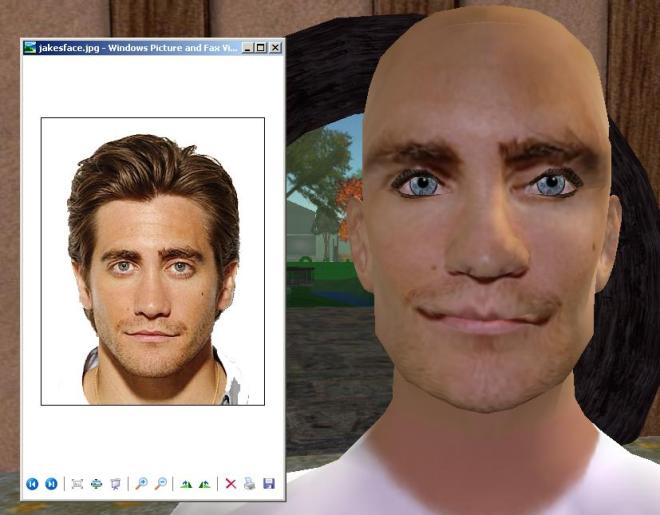
There was once a service in Second Life that generated a classic system (i.e. non-mesh) avatar skin based on a single selfie, but the results were pretty abysmal, as you can see from this old photo I took, comparing the original photo of actor Jake Gyllenhaal with the resulting avatar:
I created this avatar to play Jack Twist for Brokeback Mountain roleplay in Second Life over a decade ago, and I thought the result was good enough at the time for that purpose:
The create-an-avatar service eventually shut down, and I never found a replacement for it. I only used it a couple of times. I also made a Heath Ledger-lookalike avatar to play Ennis Del Mar, but the results were even worse than they were for Jake:
I couldn’t find a really good, well-lit full-frontal facial photo of Heath Ledger, so the result doesn’t really resemble him at all, in my opinion!
So you might just want to download the Virtual You app to your iOS or Android mobile device and try it out for yourself! This is a service that I would like to see more social VR and virtual world companies provide. Perhaps Wolf3D could be convinced to export its app-generated avatars into other virtual worlds? I do think that there is a market for this.
In the December 2017 issue of The Atlantic magazine, Leslie Jamison wrote an article about Second Life. The webpage for that article has the original article title, Second Life Still Has 600,000 Regular Users (which you can check for yourself by doing a Google search):
However, it would seem that Leslie’s editor at The Atlantic wanted a somewhat punchier title, and so we have The Digital Ruins of a Forgotten Future, which shows up when you click on that link. (I’m pretty sure that Linden Lab is less than pleased with that particular editor.)
There’s a quote from that article which is, to my knowledge, the most up-to-date statistic we have about how many people still use Second Life:
Of the 36 million Second Life accounts that had been created by 2013—the most recent data Linden Lab will provide—only an estimated 600,000 people still regularly use the platform.
“Only” 600,000? That still makes Second Life, far and away, the most popular virtual world. And yet, somehow, the mainstream news media continues to portray Second Life as quaint, outdated and underused.
Now, I am not going to dissect all the gory technical details of that announcement here. But one statistic did happen to catch my eye:
Let’s get this out of the way first: 542,967 unique users across 9.9 million sessions spending 17.7 million hours logged into Second Life on Firestorm over the last 30-day period.
That is our most recent set of metrics regarding Firestorm usage in Second Life, directly from Linden Lab. Those are mind-blowing figures. Although we don’t have metrics for how many OpenSim users run Firestorm, it is safe to say it isn’t anywhere near that. My estimate would be somewhere around 2,000 users. But still… THAT’S NOT WHY!
It is because of those numbers that we prioritize Second Life, but those numbers are NOT why we struggle with OpenSim.
So, in other words, over the past 30 days, 542,967 unique Second Life account holders used the Firestorm viewer to access Second Life. Now, Firestorm is by far the most popular viewer. Let’s assume that all the other viewers combined (including Second Life’s own native viewer) have only 10% of the market that Firestorm occupies, which I think is a fairly reasonable assumption.
10% of 542,967 is 54,296. Adding 54,296 to 542,967 (or just multiplying 542,967 by 1.10) gives us…597,264.
Which means that Second Life, still, has approximately 600,000 regular users in the past month.
What is the secret to Second Life’s “stickiness”? In a word, it’s investment: investment of time, investment of money, investment in an avatar representation, and investment in community.
Until a social VR/virtual world platform comes along that can offer everything that Second Life does, it is going to continue to be the most commercially successful and most popular virtual world around, and a reliable cash cow for Linden Lab.
One day, one of the newer social VR platforms like Sansar, VRChat, Rec Room, or perhaps even Facebook’s upcoming “Metaverse” project, will steal that crown. But not today. And not tomorrow.
Whether you like it or not, and whether the news media admits it or not, Second Life is still relevant and still rules. Competing metaverse platforms would kill to get the level of usage Second Life still gets, even after 16 years of continuous operation, even as it has been all but written off by mainstream media.
Need to vent? Some companies make it easier than others to give feedback. (photo by Icons8 Photo Studio, via Unsplash)
I have been thinking about writing this editorial for quite some time. Social VR and virtual worlds have been a part of my life since I first encountered Second Life back in 2007 (in a story I relate here). I have set foot in literally dozens of different worlds, old and new, and I have shared many of my experiences with you, my faithful blog readers, over the past couple of years.
In those 12+ years of metaverse hopping, I have seen all kinds of interactions between the staff employed by the companies that are building the various social VR/virtual world platforms, and the customers of those platforms, including the content creators. And I have seen many examples of both good and bad communication between employees and users. So I think it’s an opportune time to focus specifically on this topic, especially in light of this week’s events.
It is, of course, entirely up to the company to decide if, when and how it communicates with its customers. Some have taken a highly informal approach, where you can simply grab the person you know is in charge and bend their ear. This works very well for platforms with one-or-two-person development teams (like NeosVR and Cryptovoxels), but obviously, it doesn’t work well for larger and more formally structured companies like Linden Lab, VRChat, and High Fidelity.
The current level of access Sansar users and content creators have to Linden Lab staff via the official Sansar Discord is unprecedented, as many people have already noted. Staff up to and including the CEO, Ebbe Altberg, are available to answer questions. Regular in-world meetings are held with the users. While we should take advantage of that openness, we also can’t abuse this privilege.
And frankly, we should not expect that this unprecedented level of openness will stay that way forever. Why not? Because it simply doesn’t scale effectively. In the early days of Second Life I have been told that it was much the same, but over time, as millions of user accounts were created, Linden Lab has had to put various formal systems and structures in place to handle that load, and insert a bit of distance between their staff and their userbase. That’s an inevitable step as a product becomes popular, just to maintain some sanity for people providing product support. It happened with Second Life, and it will happen over time for Sansar as well.
In the case of High Fidelity, I have been sharply critical of how the company has essentially abandoned its original userbase in its recent pivot to focus on enterprise use of their platform to support remote teamwork. It’s not so much what they did that upsets me as much as how they chose to do it. For example, High Fidelity shut down the regularly scheduled community meetings where regular users could pose questions and raise issues.
It is now so hard to actually reach anybody at High Fidelity, and the company is now so thoroughly insulated from its user base, that in desperation I had to resort to using a HiFi staff member’s personal Twitter account to report this week’s problems with the livestreams. (I have now been asked by that person to not use that method to contact her about High Fidelity business in future.)
The current sad state of affairs is best illustrated by something that happened to me last Friday. Early that afternoon, I had been in contact with a magazine writer who was planning to write a story about virtual reality, and who asked me (via my blog) about people she could interview in an upcoming trip to San Francisco. I suggested she pay a visit to both Linden Lab and High Fidelity, and interview Linden Lab CEO Ebbe Altberg and High Fidelity CEO Philip Rosedale.
I posted a request to the official Sansar Discord, and within ten minutes, a Linden Lab employee was in touch with me and gave me the name of a contact within the company that I could pass on to the writer.
And High Fidelity? After posting requests for assistance on both Discord servers and the official High Fidelity user forums, and waiting all afternoon for someone from the company to get back to me, I finally posted in exasperation:
“Is there NOBODY from High Fidelity monitoring these forums?!?? I got a response back from Linden Lab within half an hour, with the name of a contact person. I’ve been waiting all afternoon and nobody from HiFi has given me the name of a contact person that this writer could set up a meeting with. Seriously? SERIOUSLY?!?? This is potential marketing for your platform.”
Eventually, one person (someone not associated with the company) suggested I message Jazmin Cano, High Fidelity’s User Engagement Manager, on Twitter, which I finally did late Friday evening. Jazmin was able to provide me with information that I could pass on to the writer.
High Fidelity’s community manager, Emily, did finally get back to me on Monday morning—a whole weekend later. It seems pretty clear that HiFi staff are not monitoring the Discord servers or the official community forums on a regular basis. And I don’t blame Emily or any one person for this current state of affairs. This is a sad case where the company has pretty much completely abandoned its original user base, the raving fans who were the platform’s best advertisement.
High Fidelity is a textbook-classic example of how not to communicate with your customers. The current situation is now so bad that its own users have rebelled and formed their own discussion forums and their own Discord server, in opposition to the company’s own official forums and Discord. To have generated such a level of distrust is truly amazing. You have to really work at it to screw things up that much!
Now let us contrast this with Linden Lab. Yes, yes, I know, I know…Linden Lab has often made some stupid mistakes in communication throughout its long history. You can find numerous examples in this blogpost of the Top 20 Controversies in Second Life.
A more recent example was the whole handling of what I now call “the Tilia thing” in Second Life, which eventually led to such an uproar that they held an in-world town hall meeting just to address all the questions and misconceptions that people had. Unfortunately, these types of mistakes have led to a sort of ingrained mindset among many longtime Second Life users that automatically assumes ill will or malicious intent on the part of Linden Lab, which is really rather unfair to the company and its employees.
However, Linden Lab, particularly under the capable leadership of its CEO Ebbe Altberg, has shown a remarkable willingness to make themselves available, to discuss issues of contention with its users, and to incorporate changes to their policies based the feedback they receive. A good recent example of this was the decision not to cut the number of groups that basic, non-Premium Second Life accounts could belong to (please see the update at the end of that blogpost for the company’s official statement).
And every day, I marvel as just how accessible, engaged, and helpful so many Linden Lab staff have been on the official Sansar Discord. A perfect example of that was the lively discussion that took place after yesterday’s blogpost, which, I will openly admit, was biased more towards the content creators than the company. Galileo, Harley, and various other Linden Lab employees took the time to educate this blogger about some of the bigger issues that weren’t so immediately obvious, and they also provided some valuable context as to why (for example) Sansar simply can’t have Ken and Barbie-like naked avatars, and why “ample coverage” is so important.
But the point that I am making in this very long-winded editorial (and yes, there is one!) is that companies like Linden Lab, which engage with their customers, listen to their concerns, and address their questions, are much healthier than companies like High Fidelity that passively (or even actively) discourage such communication.
Does that mean that everybody is happy with everything that Linden Lab is doing? No, of course not. Some end users and content creators are still very upset. Some have voted with their feet. But at least, we can talk about that corporate response in a way where we feel we are being heard. And that goes a long. long way towards happier customers overall.
I have talked about only two companies in this editorial: High Fidelity and Linden Lab. But there are many other examples of good and bad communication between employees and customers throughout the metaverse. We need both to applaud examples of good corporate communication, and to critique examples of poor corporate communication. And I intend to continue to do both on this blog.
Do you have any examples of good (or bad) communication between metaverse company employees and customers that you would like to talk about? Please feel free to leave a comment on this blogpost. Also, there’s the RyanSchultz.com Discord server, the world’s first cross-worlds discussion forum! I’d like to extend an invitation to have you join us and participate in the many discussions and debates that take place there.