Ca’lum (a store which previously released four different dollarbie Bento heads for men, which I wrote about here) has now released four corresponding women’s heads, each with a distinctive nose shape as shown below:
The creator says in the SL Marketplace listings:
This is not a high quality head to compete with the other head makers on the market. It is a product for people who do not have the resources to have a more or less modeled mesh head, so it will not have or do great things like the others. Sorry about that, but I’m not an expert on modeling and animating heads in Second Life.
Each head costs one Linden dollar; here are the SL Marketplace links:
Each head is materials enabled, and includes teeth, as well as a HUD to hide the ears or parts of the skull, as well as choose from 4 different sets of Bakes on Mesh eyelashes:
These are Bakes on Mesh heads, and they do not come with skins, but that shouldn’t be too much of a problem nowadays, as you can buy good quality BoM skins from many places. Here’s what the upturned nose head looks like, paired with the Elvira skin in maple from 7 Deadly S[k]ins, an Advent calendar gift from a previous year:
I’d probably play around with the default head shape and eyebrow shape a bit (the package includes both), but you get the general idea…this is a very attractive Bento head, at a price you simply can’t beat! I will add these heads to my ever-expanding list of free and inexpensive female heads and bodies. Happy freebie shopping!
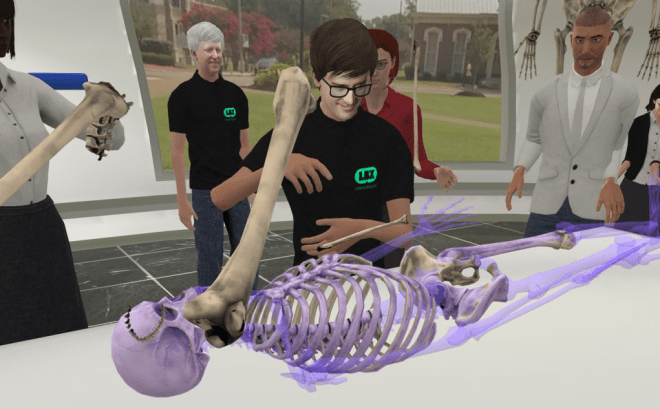
Fisk University, a private, historically Black university located in Nashville, Tennessee, will launch a virtual human cadaver lab for its pre-med and biology students this fall. The cadaver laboratory will use the social VR platform ENGAGE, in a partnership with Fisk University, HTC VIVE, T-Mobile, and VictoryXR (an educational content creator company using ENGAGE as a platform).
Inside the lab, students will examine the internal organs of various human systems, and the professor can even remove the organs from the body and pass them around for students to hold and open. Students will have the ability to enlarge the organ to a size large enough where they can even step inside to better learn how it works. In addition to organ systems, the cadavers will also include complete skeletal and muscle structures.
“With this cadaver lab, our pre-med students will no longer need to rely on other universities for advanced anatomy and biology classes,” said Dr. Shirley Brown, Dean of Fisk University. “Virtual reality technology takes our university to a level equal to the most advanced schools in the country.”
In the past, Fisk University has not purchased cadavers due to the high cost and maintenance. But with a virtual cadaver lab, the university can offer state-of-the-art scientific learning that’s affordable and easy to maintain. Virtual cadavers do not degrade, and over time additional specialties can be added to the software such as surgical procedures, comparative learning between human and animal as well as microbiology at the cellular level.
Here’s a two-minute promotional video for the project:
Tony Vitillo (a.k.a. SkarredGhost), an Italian man whose blog, The Ghost Howls, often has reviews of products and interesting news reports about the VR industry, paid a visit to the virtual laboratory and reported:
The…costs to own a cadaver lab is in the order of magnitude of millions of dollars. Not all universities can afford that. There is at the moment a slightly better alternative, that is using ultra-realistic synthetic cadavers, that are also able to simulate some motions of the human body (e.g. the heart pumping), but the cost of each one of them is $60-100,000. This means that to own them a university must invest much money anyway.
We all know that virtual reality can replicate real objects pretty well, so VictoryXR had the idea of trying to reproduce a cadaver lab in virtual reality: apart from the fixed cost for the 3D elements, this laboratory would scale pretty well with the number of students and would need almost no maintenance cost. This is a very smart solution to make education more accessible for medicine students. Thanks to this, many more universities would be able to afford to have a virtual cadaver lab, even in non-wealthy countries. We always talk about VR being able to democratize education, and this is one bright example of how it can do that.
Students assemble a skeleton puzzle in Fisk University’s virtual human cadaver lab
Tony came away from his brief demo favourably impressed:
I had just a short demo with the virtual lab, and I think that it is a good start for Fisk University and VictoryXR. I don’t think that at the moment it can replace the real experience with a cadaver because you miss all the tactile sensations, the weight, and also the creep of having a real organ in your hands. But it can be a good substitute to start learning about the human body, to observe the organs in detail, to start getting confidence with having a bone or a part of the body of someone else in your hands. It could be able to offer a good course, and after that, maybe the students can have just a few final lessons with real corpses in another location. It is a good way of giving value to many medicine universities not only in the U.S. but in the whole world, especially the ones that can’t afford to have real or synthetic cadavers for tests.
What impressed me the most is the potential that this solution can have in the future. There are things that VR can give to students that are hardly possible in real life. The fact that you can enter with your teacher inside an organ and examine it both at macro and micro level is one amazing thing for instance. The possibility of organizing minigames (like the puzzle) that are engaging and improve the learning efficiency via interactivity is something that VR enables and that would be too creepy to do in real life. The possibility of doing many simulated surgeries on the cadavers with the possibility of repeating every operation at no additional cost is another cool thing.
Studying the muscles of the human body in ENGAGE
Thanks to Chris Madsen/DeepRifter of ENGAGE for the heads up, and Tony Vitillo/SkarredGhost for his report and pictures! You can read Tony’s review in full here, and I strongly recommend you follow his blog as well as my own!
NOYS VR is a social VR platform for live music performances, by a Hamburg, Germany-based startup, and based on the Unreal game engine.
According to their website, they describe their project as follows:
INTERACTIVE MUSIC EXPERIENCES IN VR
The social platform for music experiences and concerts, native to virtual reality.
NOYS VR is a new way to connect musicians with their fans and listeners. Instead of replicating an already existing concert in 360 [degrees], we co-create concerts natively to virtual reality! Enabling everyone to have fantastic and never before seen music experiences.
Fans have complete freedom of movement, are able to meet like-minded [people] from all over the world and experience their favorite artists close up.
Last year, NOYS VR hosted a virtual edition of the Elbjazz Festival, the real-life version of which takes place at the harbourfront in Hamburg, Germany:
Raspberry Dream Labs is bringing to the world its brainchild –– the social WebXR event platform for progressive arts & entertainment – Raspberry Dream Land! A mecca of electronic music and alternative nights, creative hub and multisensory playroom opens its doors with an invite-only soft launch event in all major regions worldwide.
Our platform celebrates the solarpunk future coming into existence by uniting art, technology, sustainability and cyber-sexuality. Lose your avatar on the dance circuit to the live deep techno tunes, join the Central Plaza stage for the artists and brand talks, discover community generated 3D worlds, and experience the one-of-a-kind ‘Sense Magick’ Cyber-Tantra Ritual in the Underworld, the erotic playspace of the Future.
There’s not a whole lot of detail on the website so far, but the project has already attracted a number of artists:
Some of the artists associated with Raspberry Dream Land
There’s also a statement from the founder:
From multisensory academic VR study, 25+ IRL and VR events to [the] world’s 1st Burning Man in VR – over the past two years at Raspberry Dream Labs we explored how the potential of technologies-of-today can redefine self-expression, social entertainment and intimate connections.
While the interests in our events kept growing, we faced censorship from existing VR platforms which made us realize that while there is growing interest from users across the globe, there is no such platform that caters to these needs.
We are excited about our mission and the societal impact of what RD Land is going to unlock.
—Angelina Aleksandrovich, Founder, CEO and Creative Director of Raspberry Dream Labs