Virtual Reality Headset Demos for Newbies: Some Do’s and Don’ts

When you’re starting out, keep it simple (Image by Pexels from Pixabay)

There is a fine art (some would call it, a black art) to giving a VR demonstration to someone who has never been in virtual reality before. And, as someone who does it fairly often, I wanted to share some of what I have learned (often, the hard way!) in giving a number of people at my workplace (the University of Manitoba Libraries) their first taste of VR.

In fact, just last week, I had a recently retired coworker (who had never experienced virtual reality before) come in, at my invitation, to try it out for himself. My current set-up at work is an HTC Vive Pro 2 Office Kit, with the traditional Vive “wand” hand controllers, the same set-up which I am proposing for the virtual reality lab project that I am currently working on. (The standard Vive controllers feel more like tools, as opposed to hand extensions, and I can only imagine how much more of a newbie learning curve setting up the Knuckles controllers would be, given how much fidgeting and adjusting I have to do to get my set at home to work “just right”).

Here are some of my tips, tricks, and recommendations for giving inexperienced users a virtual reality demo.

  1. Safety first: clear your demo space! Remove anything and everything that the user can run into or trip over. I very strongly recommend that first-time VR users stick to seated apps, rather than standing ones, and stationary ones instead of ones where you have to move around, “run”, aim weapons, etc. If you question the wisdom of this advice, there is a whole subreddit community called r/VRtoER which consists of nothing but mishaps from people in VR headsets!
  2. Make sure all your equipment is ready to go and up-to-date. For example, if you use a headset with Steam, run SteamVR ahead of time and let it update. Make sure that any software you plan to demo is fully updated to the latest version. Fully charge your headset and/or hand controllers to ensure that they are ready. Nothing is worse than having to end a session early because a device has run out of power!
  3. Explain what VR sickness is and emphasize that they should stop, and NOT push through it, when/if they start to feel sick. Also impress upon the new user that it takes time and patience to build up your tolerance in a VR headset; expecting an inexperienced user to be able to handle anything over 15 minutes at one stretch is too much. It’s also very important to give the new user time between separate virtual reality experiences, even if it is only a few minutes.
  4. Adjust the headset to the user (head straps, interpupillary distance/IPD dial, etc.), explain to the user how to put the headset on and take it off, and practice that first. You want to do everything you can to make sure that the new user’s experience is optimal. I have found that it is better to have the user learn how to make adjustments to the headset themselves, although I may fiddle with the head straps and IPD dial a bit, after they have put it on, if they are having problems with the comfort or view.
  5. Start off with an app where the new user just sits and looks around. When I used to give demos at work using my Oculus Rift, I always started new users with a couple of introductory VR programs, where they did not have to use the hand controllers. One of them which I can recommend highly is the excellent Introduction to Virtual Reality by Felix & Paul Studios*, which consists of a series of three-dimensional videos of various scenes, e.g. Cirque de Soleil jugglers; a boat in a floating market; a scene inside a round Mongolian yurt where a family is sharing a meal. The reason I start off with something like this is because I want the user to get comfortable with the immersive aspect of the technology (how the scene changes in the headset when you turn your head, look up and down, etc.), before adding on the hand controllers.
  6. Do NOT put the new and inexperienced user in any app which might make him nauseous! It’s tempting to throw the newbie into the deep end, just to get a reaction from him; I get it. However, do you want to be responsible for making him ill in his first virtual reality experience, and perhaps souring him on VR forever? Save Aircar and the roller coaster simulations for later, once they have gotten their VR legs. 😜

For the demo to my retired coworker last week, on my new Vive Pro 2 headset, I tried to find something similar to Felix & Paul’s Introduction to Virtual Reality, only to realize that all the Felix & Paul titles were Meta/Oculus exclusives. Damn! After a frustrating hunt through Steam to find something similar, and striking out, I decided to use a favourite tropical beach world in VRChat, called Deep Blue. I wanted something relaxing for a first experience; getting into a VR headset can be stressful! (Note that I had already logged into VRChat, and set up the world before my coworker arrived; all I had to do is get him set up and put on his headset.)

First, I just had him sit on the dock and look around, to get used to the way it felt to have the headset on, and how the view changed when he looked around. Then, after 5-10 minutes or so, I gave him the hand controllers, and explained how the buttons on them worked, and had him move around in the environment: explore the beach hut, walk along the beach, even go underwater to see the sea turtle!

Then, after I was satisfied that he was handling that experience well, without any VR sickness, I loaded up Il Divino: Michelangelo’s Sistine Ceiling in VR. This app nicely illustrates one of the main selling points of virtual reality, in my mind: the ability to visit and explore places that you would not normally be able to go see, unless you bought a plane ticket! Also, the app has very simple, teleporter-type movement control, which is easy to explain to a new user (and the difference in movement controls between the first and second apps is a good teaching moment to explain that every app is set up differently, and has different controls).

Next, I introduced my coworker to Google Earth VR, the virtual reality version of the already-familiar Google Earth. What I like about Google Earth VR is that you can always see at a glance how the buttons on the hand controllers work, and there are easy-to-navigate menus with some of the most popular locations, such as the statue of Christ the Redeemer high over the city of Rio de Janeiro. I just let him explore to his heart’s content, wherever he wanted to go! He really was amazed how he could zoom out and see the entire Earth from outer space, too.

My VR demo with my retired coworker went so well, that we actually did move on to Aircar, piloting a flying car in a rainy, Blade Runner-esque urban sci-fi environment (although I very strongly impressed upon him that he should stop as soon as he began to feel sick, which he did). He loved it! Some people take to VR like a duck to water. (However, see point 6 above; for 95-99% of first-time users, this is a BAD idea. And, on the other end of the spectrum, I have also had to stop VR demos after ten minutes because of VR sickness. Monitor your newbie carefully and stop as soon as they feel nauseous! This is not something you can just “push through,” trust me.)


I hope that you found this list of do’s and don’ts to be helpful! And if you have any particular programs, platforms, or apps which you like to use to give newbies demos, please drop a comment and let us know what they are and why you like them. Thanks!


A special thank you to John, for being my guinea pig, and the first person to whom I have demoed my new HTC Vive Pro 2 headset at work!

*You can experience this title in 360° video on YouTube:

Pandemic Diary: Some Thoughts on Three Years of Pandemic Living (And Why COVID-19 Is Not Quite Finished With Us Yet)

Photo by Martin Sanchez on Unsplash

The WHO declared COVID-19 a pandemic on March 11th, 2020, and the world entered lockdown. And now, three years later, I wanted to pause and reflect a little bit on how my life has changed since then. I’ve been working on a rough draft of this blogpost for several months, picking it up and putting it away again, and now seems like a good time to finally publish it.

I had a bit of heads-up, before COVID-19 was on most people’s radar, because I had been watching and preparing for an influenza pandemic. So, it was on January 24th, 2020 that I wrote my first blogpost about a virus which was circulating in and around the city of Wuhan, China. I wrote:

I’m a weird person. (But then, if you’ve been following this blog at all, we’ve already established that fact pretty firmly.) Throughout my life, I have had a somewhat lamentable tendency to go off on weird tangents.

And, back around 2006, my tangent was bird flu. I became obsessed with following and discussing the latest information about the H5N1 avian flu virus with other flu preppers (a.k.a. “flubies”), which for a time looked as though it would develop into a global pandemic. (I just checked, and I still remember my username and password from the FluTrackers.com discussion forum!)

Me and my fellow flubies were constantly worrying, analyzing, and obsessing over the latest case data and news reports.

At the time, I used my very rudimentary PhotoShop skills to create and share some funny pictures with my fellow “flubies” on the FluTrackers.com discussion forum, in an effort to inject some levity into what was a grave and potentially life-threatening global situation. I firmly believe that a sense of humour is a sense of perspective; if you can laugh about (or at) something, it necessarily means that you can look at it with a bit of external perspective. Thankfully, H5N1 bird flu turned out to be somewhat of a bust (although millions of chickens and other birds have been killed, and even as recently as last month, there have been reports of strains of H5N1 influenza jumping from birds to mammals, such as mink and seals).

However, as everybody knows, we were not so lucky this time around with COVID-19, and it was definitely not a laughing matter, either. The very next day, January 25th 2020, I posted my very first coronavirus update on the RyanSchultz.com blog. I felt very strongly, as a librarian who works at a university science library, that I should connect you to the best, most up-to-date sources of information, to help you make the best decisions. And, from time to time, I would hijack my blog to continue to provide the best information I could as the pandemic spread. Many of my blog readers were confused and upset by the sudden change in direction!


Because I have underlying health conditions which put me at a higher risk of a severe case of COVID-19 if I were to become infected, I am vaccinated (6 times now, including both bivalent boosters!), I still wear facemasks indoors in public spaces, and I still avoid leaving my apartment. I let my guard down rarely, and I have (to my knowledge) not been infected with COVID—but it’s been at a cost.

After three years of pandemic living, I am an extrovert-turned-introvert (or, perhaps more accurately, a social person turned anti-social). I find it ironic indeed that my passionate hobby and research area—virtual worlds, social VR, and virtual reality—allows me to connect with other people from the safety of my own home or office! The only times I leave my apartment are:

  • going to work (my university still has an indoor facemask mandate in public and shared spaces, although I can take my mask off when I close my office door);
  • going to doctor’s appointments (I talk to my psychiatrist via Zoom still, though);
  • visiting my mother and stepfather in their lifelease condo across town; and
  • picking up the groceries I ordered online via the Walmart website (I always schedule this for Sunday mornings between 7:00 a.m. and 8:00 a.m., to avoid other people!). In fact, I can count on one hand the number of times that I have actually set foot in a supermarket over the past three years.

Other than that, I stay at home, which has been the biggest change in my life. I used to be one of those people who would often go out to cafés and restaurants, either alone or with friends. Now, instead of going out to eat at restaurants, I cook for myself at home, and this is perhaps the most firmly established new habit that I picked up over the past three years. I am far from a chef, but I have simple tastes, and I now feel much more confident in the kitchen!

One silver lining of the pandemic is that I finally learned how to cook! Photo by Alyson McPhee on Unsplash

While I have met up with friends at outdoor restaurant patios during Winnipeg’s all-too-brief summer, I must confess that I still have not embraced indoor restaurant dining (a coworker, who had a similar rule, broke it only once, and came down with a case of COVID). Again, I can count on one hand the number of times that I have taken off my facemask to eat something indoors with other people: a catered brainstorming session with my coworkers; and the first face-to-face meeting of my arts and entertainment group in 3 years just last month, where we had a potluck.

Even my tastes in music seem to have changed because of the pandemic. Often under stress and struggling with both anxiety and insomnia, I would seek out ways to calm and recenter myself. One day in 2020, I was browsing in a virtual store in Second Life, where the store owner had set the parcel’s audio stream to something called Calm Radio. I was so taken with the peaceful music, and the soothing voice of the woman promoting the service, that I sprung for a subscription! (In fact, I am listening to the Spa station—one of dozens of expertly-curated stations on Calm Radio—as I type this.)


I realize that I can’t keep my guard up forever, of course. I am still living in a kind of limbo, a form of suspended animation, in many respects. And I find myself wondering when things are going to get back to “normal” (and even how to define what “normal” is). While other people have basically decided that the pandemic is over, the fact remains that millions of people have died from COVID-19 (well over one million Americans alone, a statistic which staggers me). Millions more people have been disabled with long COVID, some after only mild initial infections.

This is something that you can’t just shrug and move on from, no matter how much you want to get on with life and pretend nothing serious happened. I am absolutely terrified of getting the “brain fog” associated with long COVID, because I make a living with my brain! And I already have asthma; I certainly don’t want COVID to fuck up my lungs, either! The coronavirus has definitely made me think a lot about my quality of life.

The pandemic also forced me to think about my own mortality, and start preparing for my inevitable death. I have finalized my will with a lawyer my financial planner recommended to me, although I do still need to visit a funeral home to make arrangements for my cremation, and set up a spot at the cemetery, where my final ashes will rest. But when you know people who have passed away from COVID (like my best friend’s 92-year-old mother, last November), it is a powerful motivator to get things like this taken care of, before you need it. It’s just one less thing for your family to deal with when you do die.

Early hopes that a one-and-done (or two-and-done, etc.) vaccination, which would protect against all strains of COVID-19, have unfortunately failed to materialize, as the coronavirus continues to mutate, and people get reinfected. I suspect that we are going to be facing a situation with COVID much like the flu, where you get an annual or semiannual shot which is developed against whatever the predominant strains of the virus are. Scientists are also learning more about how a COVID-19 infection attacks the body (e.g. microclotting), which hopefully should lead to new and improved treatments and prevention measures.

Many of us are still dealing with the situation day by day, and the future seems uncertain. Things even feel a bit precarious to me at times, and I still sometimes struggle with anxiety, insomnia, and depression. There are days when I have problems with motivation, both at home and at work. I feel angry and discouraged that something as science-backed as COVID vaccination was turned into a polarizing political issue. A crisis that should have brought us together seems to have highlighted the divisiveness within society, and just how selfish some people can be. And, of course, many of the ripple effects from the pandemic (such as supply-chain problems) are still impacting us all.

Whether you choose to believe it or not, the pandemic is not over.

Photo by Fusion Medical Animation on Unsplash

Terje Jansen, 1963-2023: Grieving a Loss in the Sansar Community

Today is a sad day.

Terje Jansen was a vital part of the small but dedicated Sansar community, known for his welcoming friendliness, his story-telling, and his Norwegian accent. He loved Sansar so much that he became a member of the new Sansar team, and his presence will be sorely missed by many.

Terje passed away on Feb. 13th, 2023, but it was not until yesterday afternoon that word of his death reached the Sansar Discord server, where it was met with shock and sadness.

There will be a number of events taking place in Sansar this week, an open mic chat on Monday, March 13th for those who knew Terje, plus a couple of memorials taking place on Saturday, March 18th. Please check the Sansar events listing for details on the times and locations of these and many other events.

If you wish to pay your respects, the Ebbe and Terje virtual in-world memorial is located here. Terje’s virtual tombstone sits on a small hill under an oak tree, right next to that of Ebbe Altberg, who was the CEO of Linden Lab, the company who originally created Sansar (he passed away in 2021).

Throughout the afternoon (my time), avatars would come and pay their respects, using text chat to share reminiscences and offer each other support.

There’s also a memorial webpage (it’s in Norwegian; please use your in-browser translator to read the tributes in English).

Sixteen Years of Second Life Landmarks: A Trip Down Memory Lane

My oldest Second Life avatar, with the legacy name of Heath Homewood, was created on March 20th, 2007, which means that in a couple of weeks he will be sixteen years old! (And yes, I can blame a work committee at my university library for falling down that particular rabbit hole; more details here in a blogpost I wrote in 2017.)

This evening, on a whim, I loaded Heath up, opened up the landmarks folder in his voluminous, never-cleaned-out-in-sixteen-years inventory, and tried teleporting into various saved landmarks, out of curiosity, just to see if they were still around.

Many were long since gone, of course; over 16 years, sims had often changed hands. More often than not, I got an error message that the non-mainland destination no longer existed at all on the Second Life grid. Sometimes, the new owner of the sim or parcel had set up an intruder alert system, which warned me that I was trespassing on private property and that I needed to be somewhere else within X number of seconds (the rude ones set it to 5 seconds, and in one case, 1 second!).

The virtual recreation of a Tim Horton’s coffee shop, one of the few places where I could meet up with other Canadians in Second Life, has also vanished into pixel dust now. (I have fond memories of sitting around a campfire set up outside the store, swapping stories with my fellow avatars. We used to get quite a varied crowd! It’s amazing how many virtual worlds recreated the concept of a central campfire as meeting spot, a concept we have seen again in newer metaverse platforms like AltspaceVR and VRChat.)

Similarly, the extremely detailed virtual recreation of Dresden’s Old Masters Picture Gallery, where I spent many hours wandering around the paintings, is no more (but you can get a sense of it from this September, 2007 WIRED article). Of course, Second Life is home to countless art galleries and museums, but I wish that this particular build were still around! It was a wonderful showcase.

Likewise, my landmark to the Body Doubles store, where you could purchase shapes and styling cards (with detailed information on what to buy where) to create avatars which looked like celebrities, past and present, is long gone. I suspect that they might have gotten into some trouble with the real-life lawyers representing the real-life agencies who owned and/or managed the rights to famous dead and living people!

However, I still have my Marilyn Monroe alt (no doubt created using the style card from Body Doubles), and I like to trot her out for special occasions, just to surprise people. I likewise have a late-stage Elvis Presley avatar, complete with black sideburns, sunglasses, a white glittery jumpsuit, a microphone with singing animations, and even some wearable, white-hot stage spotlights! I still pull him out from time to time, and have him sing and gyrate in some unsuspecting public space, like London City, just for the hell of it. Or have Elvis wander around the grid, looking for Priscilla… 😜


But amazingly, my first-saved and oldest landmark still worked after all these years! The Lost Gardens of Apollo is one of those historical builds which appears to have been preserved for posterity by Linden Lab (which does happen sometimes), and it remains very much the same as it was when I first visited it in 2007, with no modern mesh additions or replacements.

The Lost Gardens of Apollo

You can even take a self-guided balloon tour of the sim (with narration in one of nine different languages), to explore the fantastical architecture: the harbour, the soaring towers, and the floating islands. This used to be a popular place back in the day!

You can tour the Lost Gardens of Apollio via balloon

Another venerable Second Life landmark, the Ivory Tower of Primitives, functioned as an immersive teaching centre, where the first generations of SL builders learned how to create, modify, and assemble primitives (prims), well before the advent of mesh on the grid. It sits on Natoma, one of the first 16 so-called “mainland” sims created by Linden Lab in 2003.

The importance of this place cannot be underestimated. Innumerable Second Life content creators, who perhaps have since moved on to design for other, newer metaverse platforms using tools such as Blender, first got their start by working through the detailed, step-by-step tutorials at the Ivory Tower of Primitives! I was one of them myself (although I never really designed anything truly beautiful or useful, or ever set up a store for my rather limited creations).


There were a few places in Heath Homewood’s landmarks folder that still are around, even sixteen years later! The oldest store landmark that still worked for me was the Bahia Tiki beach house and decor store, which is still in operation (albeit with more modern, mesh offerings). I must have bought something there for my very first set up, a sandy beach on the Maso Ariol sim, a parcel I bought in 2007 and built on and tinkered with to for a little over a year, until I became one of the first tenants in the Bay City mid-century-themed neighbourhood in May of 2008.

The Bahia Tiki store is still around!

Another sim from my landmarks folder, which has stood the test of time is Neufreistadt, inspired by the pubs, cafés, and narrow streets of the real-life Bavarian town, Rothenburg ob der Tauber (here’s a SLURL that takes you to their Marktplatz, where there is a charming bookstore which I had landmarked back in 2007). It was somehow reassuring that, in a virtual world that was full of changes, I had found yet another place where time seemed to stand still.

An aerial view of the town of Neufreistadt

Neufreistadt is one of six regions operating under a long-running, over-arching government, the Confederation of Democratic Simulators, which bills itself as the oldest democracy in Second Life, dating back to 2004 (you can read more about its rich and eventful history here).


I then loaded up my librarian avatar, Notecard Writer, whom I created March 21st, 2007, as my “professional” avatar, as opposed to my “fun” avatar, Heath Homewood. And out of curiosity, I once again began checking out a few of the locations I had saved in the landmarks folder in Notecard Writer’s inventory, dating back to 2007.

Of course, the virtual library reference desk at the Second Life Library, where I used to volunteer evenings and weekends, and the other buildings at Info Island have long since been shut down, as part of the scaling back and downsizing of library services in Second Life (I wrote about it here in 2018). It turns out that expecting patrons to learn how to use SL to ask a reference question was too steep a learning curve, which makes sense. It was an interesting experiment while it lasted, though.

However, I am happy to report that one of Notecard’s landmarks, which still worked after 16 years, is the beloved International Spaceflight Museum, an educational project which was started in late 2005, and which has been at its present location on the Spaceport Alpha sim since early 2006. Here, you can explore models of the many rockets and shuttles which have taken humans into outer space over the decades.

The International Spaceflight Museum

Another spot still around after sixteen years is the Renaissance Island historical roleplay sim, which features a virtual reproduction of the Globe Theatre (exact SLURL), where works by William Shakespeare and other 16th and 17th century playwrights were produced. I don’t think the virtual version has been used for plays for several years now, though (and yes, that was definitely a thing!).

The Globe Theatre on Renaissance Island

Another SL store which has stood the test of time is The Omega Concern, a military vehicle vendor still in the same location after 16 years! I’m not even sure why I saved this as a landmark back in 2007, since I am not into military roleplay at all. I checked my inventory, and lo and behold, it turns out that Notecard Writer bought an anti-griefing tool called the Omicron from this store, to use while working shifts at the reference desk at the previously-mentioned Info Island! I believe the Omicron was recommended to me during my virtual librarian training, to keep those early SL griefers from launching me into orbit… 😜😜😜

The Omega Concern has been operating in the exact same location for 16 years!

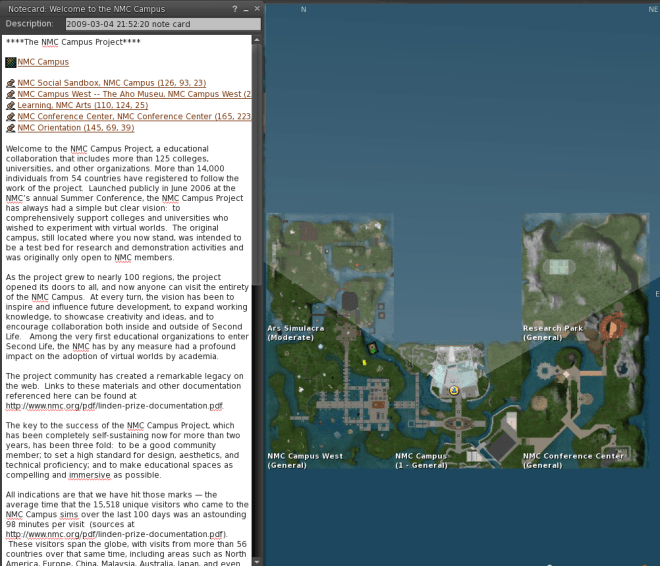
One thing that I struggle to understand is why some long-disused locations are still up and running. For example, the NMC Campus sims are still on the Second Life grid, but utterly deserted; I can’t even remember the last time that any of them had been used for events. The notecard you receive upon teleporting in, which appears to date from 2010, speaks glowingly about the project and the first four years of its history, but frankly, most universities and colleges have long since moved on from Second Life at this point.

The NMC Campus sims appear to have been unused for quite some time
An aerial view of the deserted NMC Campus

But, apparently, somebody is still paying Linden Lab for the five non-mainland sims for the NMC Campus, even though nobody seems to have been using it for years. Or perhaps LL has taken those over as historical regions, as well. Strange. I wonder how many of these “ghost” sims are still on the grid.


I spent a very enjoyable evening teleporting around Second Life, and I plan to spend some more of my off-hours revisiting old landmarks in my avatars’ inventories, and take a trip down memory lane! I have (re)discovered places that I haven’t thought about—or visited—in years!! It was fun.

I hope that, as we approach the 20th anniversary of the surprisingly resilient virtual world of Second Life, this blogpost will make you decide to shake the cobwebs from your landmarks folder in your own SL inventory, and perhaps pay a return visit to some old haunts. You might be surprised to see what’s still around!