Editorial: Upon Reflection…

Taking a much-needed break from blogging has given me an opportunity to reflect a bit on my journey over the past three years, and ponder where I might go from here.

Photo by Joshua Earle on Unsplash

Frankly, I never expected to become a journalist covering the ever-evolving metaverse, with a growing audience; this blog started off as a tiny little niche blog, where I wrote about my (mis)adventures and explorations in Sansar. And everything that happened after that—writing about more and more social VR platforms, hosting the Metaverse Newscast show, focusing on freebies in my beloved Second Life—just kind of happened organically. I didn’t have any sort of plan; I just made choices along the way that led to this point.

But for me, the seeds for this journey were first planted in Second Life 14 years ago, which since its earliest days has been this strange and marvelous phoenix that keeps rising from the ashes, again and again, confounding and bewildering many casual observers who continue to predict (wrongly) its failure. Even a cursory glance at the official Second Life Community News feed (curated by the highly capable Strawberry Linden) reveals the absolute torrent of creativity that the platform has provided to so many people. Second Life is not going anywhere, honey.

Source: My Dark Fantasy

SL is a fully-evolved, vibrant, mature virtual world which has become the model which other metaverse companies have spent countless programming hours and (in some cases) millions of dollars to try and recreate, with varying degrees of success.

I think that the ones that have been the most successful (so far) are NeosVR, ENGAGE, AltspaceVR, VRChat, Rec Room and, somewhat to my surprise, three blockchain-based worlds: Cryptovoxels, Decentraland, and Somnium Space. And there are many other platforms slowly but surely building up their business, taking advantage of the unexpected opportunities presented by the coronavirus pandemic (one example is Sinespace, a company which is patiently and cannily playing the long game, and which is extremely well-poised to snatch Second Life’s mantle, if and when it is ever dropped).


And, during my break, I have been also thinking a lot about Facebook/Oculus and their impact on virtual reality in general, and social VR in particular. I have decided that, despite my new, personal boycott of Facebook products and services, I will continue to write about their upcoming social VR platform, Facebook Horizon, as it launches in public beta, probably before the end of this year.

I, like many other people, now absolutely refuse to have a Facebook account as a matter of moral principle. In August of 2019 I wrote (and yes, it bears repeating at length here):

In this evolving metaverse of social VR and virtual worlds, is too much power concentrated in the hands of a single, monolithic, profit-obsessed company? I would argue that Facebook is aiming for complete and utter domination of the VR universe, just as they already have in the social networking space, by creating a walled ecosystem…that will have a negative impact on other companies trying to create and market VR apps and experiences. The field is already tilted too much in Facebook’s favour, and the situation could get worse.

…

More concerning to me is that, at some point, I may be forced to get an account on the Facebook social network to use apps on my Oculus VR hardware. In fact, this has already happened with the events app Oculus Venues, which I recently discovered requires you to have an account on the Facebook social network to access.

Sorry, but after all the Facebook privacy scandals of the past couple of years, that’s a big, fat “Nope!” from me. I asked Facebook to delete its 13 years of user data on me, and I quit the social network in protest as my New Year’s resolution last December, and I am never coming back. And I am quite sure that many of Facebook’s original users feel exactly the same way, scaling back on their use of the platform or, like me, opting out completely. I regret I ever started using Facebook thirteen years ago, and that experience will inform my use (and avoidance) of other social networks in the future.

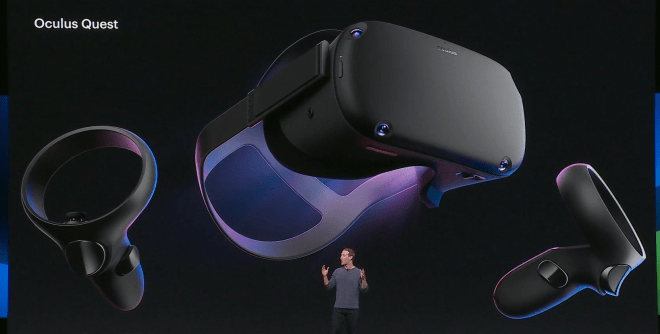
Yes, I do know that I have to have an Oculus account to be able to use my Oculus Rift and Oculus Quest VR headsets, and that Facebook is collecting data on that. I also know that the Facebook social network probably has a “shadow account” on me based on things such as images uploaded to the social network and tagged with my name by friends and family, etc., but I am going to assume that Facebook has indeed done what I have asked and removed my data from their social network. Frankly, there is no way for me to actually VERIFY this, as consumers in Canada and the U.S. have zero rights over the data companies like Facebook collects about them, as was vividly brought to life by Dr. David Carroll, whose dogged search for answers to how his personal data was misused in the Cambridge Analytica scandal played a focal role in the Netflix documentary The Great Hack (which I highly recommend you watch).

We’ve already seen how social networks such as Facebook have contributed negatively to society by contributing to the polarization and radicalization of people’s political opinions, and giving a platform to groups such as white supremacists and anti-vaxers. The Great Hack details how Cambridge Analytica used Facebook data without user knowledge or consent to swing the most recent U.S. election in Donald Trump’s favour, and look at the f***ing mess the world is in now just because of that one single, pivotal event.

We can’t trust that Facebook is going to act in any interests other than its own profit. Facebook has way too much power, and governments around the world need to act in the best interests of their citizens in demanding that the company be regulated, even broken up if necessary.

Of course, Facebook is well within its corporate rights to insist that, henceforth, Oculus Go, Quest, and Rift users have to use Facebook accounts. Just as I am well within my rights to avoid providing another smidgen of personal data for Facebook to strip-mine for profit. It will be very interesting to see how more the consumer-privacy-oriented First World countries (such as Canada, and those countries within the European Union) will respond to the Facebook juggernaut.

I also have absolutely zero doubt that Facebook will continue to use every single lawyer, lobbyist, tool and tactic at its disposal to fight to maintain its market dominance, even as the Facebook social network continues to foster divisiveness, bleed users and lose advertisers. Believe me, Facebook would not have taken the unprecedented step of forcing Oculus device users to set up Facebook accounts if they weren’t afraid of losing the younger generations of users who have, thus far, resisted joining the social network their parents and grandparents belong to. (Of course, most of them are already on Instagram, which is owned by Facebook.)

It is relatively easy to bypass the tethered Oculus Rift VR headset and its associated Oculus Store ecosystem with competing PCVR products and services (such as the Vive headsets, the Valve Index and Steam). However, it is difficult—frankly impossible at present—to find a non-Facebook alternative to the standalone Oculus Quest VR headset. I have no doubt that the market will throw up a few capable competitors to the Quest over time, but Facebook has built up a huge lead, and it will be very difficult to unseat from its dominance in that particular market segment.

So, as you can see, I have been doing quite a bit of thinking while I have hit the pause button on this blog. I will continue to spend the rest of my summer on my self-imposed vacation from this blog, and no doubt I will have other thoughts, insights and opinions to share with you when I return, hopefully feeling more refreshed.

I feel that with this blog, after a few stumbles and setbacks, I have finally found my voice, and you will continue to hear it over the next three years, and probably far beyond that! Enjoy the rest of your summer! I will be back in September.

Photo by Jason Rosewell on Unsplash

Catch the Cannes XR Marché du Film Festival in the Museum of Other Realities, Only Until July 3rd!

Have you ever wanted to strut and pose on the red carpet for the paparazzi* at the world-famous Cannes Film Festival?

Photo by Joel Ryan/AP/Shutterstock: Model Bella Hadid pose for photographers upon arrival at the screening of the film La Fille Inconnue (The Unkown Girl) at the 69th international film festival, Cannes, southern France La Fille Inconnue Red Carpet, Cannes, France – 18 May 2016 (Source)

Well, this week, you can! The Museum of Other Realities (MOR), a social VR platform devoted to art and media, is hosting the Cannes XR festival, which (like so many other real-world events) has been cancelled due to the coronavirus pandemic. According to MOR’s Steam page:

We’re excited to partner with Marché du Film, Tribeca, Kaleidoscope, and Veer VR for a groundbreaking online event, Cannes XR Virtual. With a curated program keen on covering the full ground of immersive technologies and artwork, in connection with the art of storytelling and the film industry, this virtual event is dedicated to immersive entertainment.

Virtual reality has been linked to new technology and evolving modes of stories telling, the Cannes XR Virtual is known to serve as a meeting point for a futuristic, collective imagination. Professionals from the filmmaking industry, XR artists, producers, tech companies, and (location-based and online) distributors are known, and likely, to attend this event.

The virtual event will pan over 3 days, between June 24th and June 26th, 2020. Cannes XR Virtual aims to be a genuine growth accelerator for the XR ecosystem, fostering ties between XR players internationally, helping them to promote and develop their activities in collaboration with the film industry.

In this reimagined edition of the festival, Cannes XR Virtual will be presented in different formats on several platforms:

• All VR content will be available through the Museum of Other Realities within a new architectural design conceived for the festival. Several XR works and Cannes XR events will also be experienced in 3D, with social events, showcases, and networking possibilities giving center stage to inspiring tech leaders and artists to share their insights on VR as a new technological frontier and its impact on the global film industry.

• Cannes XR Virtual 2D live video stream: Conferences and pitching sessions/projects presentation will be accessible on the Marché du Film Online platform, and the websites of our partners, Kaleidoscope and Tribeca Film Festival.

• Curated in association with Kaleidoscope, the Cannes XR Development Showcase will announce 23 of the leading latest virtual and augmented reality titles currently in-development to be pitched and showcased.

• VeeR 360 Cinema: This program dedicated to 360 VR films encourages creators to push the limits of immersive storytelling. The selected films will be showcased in the inaugural VeeR 360 Cinema during Cannes XR Virtual

• 12 selections from the 2020 Tribeca Virtual Arcade are scheduled to make an exclusive debut. The line-up is curated by Tribeca Immersive’s 2020 programming and includes World Premieres which were intended to debut earlier this year, before the postponement of the 19th Tribeca Festival.

• Selected international directors, artists, and creators will be considered for the inaugural Positron Visionary Award at the 2020 Cannes XR Virtual.

• A network of Location-Based Entertainment (LBE) partners in several major cities in the U.S., China, and France will offer access to Cannes XR Virtual to journalists and guests who do not have a VR headset.

While visitors will experience the events live from June 24 to 26, they can be accessed anytime in the MoR up until July 3. Free access for attendees!

I popped in this morning to take a few snapshots to share with you, before work. This is definitely a do-not-miss VR experience! Be sure to visit the tutorial room first to learn how to properly navigate:

To take these snapshots, all I had to do is hold up my hands as if I were making a frame, and press the trigger! Very intuitive.

There is a handy map at the entrance to the sprawling virtual exhibition, next to a booth where you can customize your avatar, which will allow to you teleport to any part of the festival:

You can even see where both you and other avatars are currently located on the map!

The art installations on display run the gamut from whimsical to menacing. Many incorporate motion and animation. Sculptures bend, twist, and morph; colours shift. Schools of virtual fish and strange sea creatures win through the air. This is the cutting edge of immersive art. In some cases, you can even shrink down to tiny size and walk around inside the artwork!

Other pieces of art, created by artists using tools such as Medium, are static.

If you have a higher-end VR headset tethered to a gaming computer with a good graphics card (i.e., PC VR, as opposed to standalone VR headsets like the Oculus Quest), then I would strongly encourage you to purchase the Museum of Other Realities app from Steam, the Oculus Store, or Viveport, and explore this wonderful virtual exhibition! MOR is not a free VR app, but in my opinion it is worth the cost.

Please note that to see some of the films and media, you will need to separately download DLCs, which will require a significant amount of hard drive space!

Kent Bye of the Voices of VR podcast has posted an excellent, informative Twitter thread with his impressions of the Cannes XR festival, with recommendations on what to see and experience! He says:

Two ways to download MuseumOR content (free for next 3 days). #1.) If you have 65GB of space, then I’d recommend downloading the beta: Right click on MOR > Properties > Betas > “cannesallfiles” > Close > Install. Takes 1-8 hours depending on download speed.

If you don’t have 65GB of free space, or want in faster, there’s Download buttons in world. Navigate to MuseumOR Auditorium > Go to Cannes Space > Find & click Download > Find the Add to Wishlist Button > Exit MOR > In Steam, go to Store > Wishlist > find 4 MOR Watch Now DLCs

Cannes XR is a mind-expanding experience with virtual art, film, and media, and it is simply one of the best VR experiences that I have had all year! Highly recommended.

*Although there is plenty of red carpet throughout this exhibition, I’m afraid there are no paparazzi included in this experience 😉 but don’t let that stop you! Get your friends to come with you, and you can take pictures of each other!

Immersive Learning Research Network Conference in VirBELA and AltspaceVR, June 21-25, 2020

iLRN 2020, the 6th International Conference of the Immersive Learning Research Network, is running in VirBELA and AltspaceVR from June 21st to 25th, 2020, one of many real-life conferences that have moved to social VR and virtual worlds because of the coronavirus pandemic. This year’s conference theme is Vision 20/20: Hindsight, Insight, and Foresight in XR and Immersive Learning:

Conference attendees must download and install a white-label version of VirBELA to attend most of the conference presentations and events. Here’s a look at the spawn point next to the information booth:

VirBELA is a virtual world I have written about before on this blog, which is very similar to Second Life (Here is a link to all my blogposts tagged VirBELA, including this one).

A view of the iLRN main stage in VirBELA

However, VirBELA is intended for corporate and conference use, as opposed to the more open-ended uses of SL, so it’s a good fit for the iLRN conference. (It looks as though AltspaceVR is primarily being used for social events associated with the conference through the Educators in VR group, according to the AltspaceVR Events calendar.)

The iLRN 2020 Expo Hall in VirBELA

If you’re interested, you can register for free for this conference via EventBrite (I got in free through an early-bird ticket special I wrote about here). I plan on attending a few presentations in between working from home for my university library system.

See you there!

Book Review of Charlie Fink’s Remote Collaboration and Virtual Conferences: The Future of Work

I will be blunt: this is a rather perplexing (and downright irritating) book.

First, let’s deal with the irritating parts. In an afterword, a preface to the advertising sponsors (yes, this book has advertising, like a magazine), it reads:

There isn’t much of a business in books, especially if they are rushed to market in ten weeks by an academic team without the resources to pay for design, printing, the Kindle version, websites, and social media, which adds up to tens of thousands of dollars.

That rush to market is all too readily apparent in the final product. Here is an actual screenshot of one of the pages of the book, which I took using SnagIt from the Windows Kindle app at 100% zoom, because I had to share the horror of it with you all (the red notes are mine):

As you can see, it is riddled with typography and font problems, with parts of headings cut off or overlaid with diagrams. The text in the Windows Kindle app (even at 125% or 150% zoom) is frankly unreadable. Page 101 is mistakenly left blank, which means that somebody’s essay (Charlie’s?) starts off in mid-sentence.

This is a mess. Did nobody proof-read this before it was set to sale on Amazon? Test it out on a few Kindle devices to see how it actually looked? After paying CA$20.00 for this book, I feel like asking for my money back, just for the poor quality of the publication alone. You should know that, up front, before you pay for this book.

Thankfully, the text was somewhat more legible on the Kindle app on my iPad, so I settled in for a good read. And this is where we get to the rather perplexing part of the book: the content.

My understanding is that this book is the result of a undergraduate-level course Charlie Fink was teaching on virtual and augmented reality at Chapman University’s Dodge College of Film and Media Arts, which was interrupted by the coronavirus pandemic. The eight students in his class were sent home to practice good social distancing with Oculus Quest VR headsets, and collaborated to write the one-page profiles of each of the companies which appear in this book. And this book still feels somewhat like a class project; some profiles are better written than others, and the coverage is a tad uneven.

And, as I said when I first reported on the publication of this book last weekend:

Now, the problem with a book (even an electronic book) is that it only provides a snapshot of a rapidly-moving and evolving industry, and as such, it will very quickly become out of date.

And, as a book, it will indeed age very rapidly. Given the rapid rate of change in this industry, six to twelve months from now, it will likely already be out of date (is this why it was rushed out in such an hurry?). Frankly, I’m not sure I understand why this was published as a static book in the first place. (Why not a website, which could at least be updated in real-time or near real-time?)

As somebody who has spent the last three years writing a blog about social VR and virtual world platforms, I feel I am in a somewhat favourable position to judge how well a book covers the territory, to wit, “remote collaboration and virtual conferences”. (You can disagree with me. I’m not perfect. I probably would write a lousy book myself. But I’m not trying to write and sell a book. I’m a blogger who wants to disseminate accurate, timely news and my own personal editorial viewpoints, informed by my own perspective and experiences in the metaverse.)

Here’s another screenshot (this time from my iPad, since the Windows version has the same horrible, blurry font) to show you the list of companies selected for inclusion in this survey (and yes, the headings are all smashed together and cut off on this page as well):

Now, as you might expect, five of the six corporate sponsors of this book (Arthur, Flow, Nreal, Streem, The Wild, and VirBELA) have entries describing their products. Obviously, Nreal doesn’t have an actual collaboration platform to talk about (at least, not yet), but they did provide an advertisement that looks like it came straight from a fashion and lifestyle magazine:

Which leads me to another concern of this book: separating fact from hype. Too much of this book reads like it was cut and pasted directly from the company’s promotional copy or website, without any real independent critical assessment, or sometimes even without proper characterization and categorization, of the products discussed and where they fit in this rapidly-evolving marketplace. It’s a broad-brush approach, and sometimes unlikely things get lumped together under a category heading.

For example, under the heading Social VR in the book are listed seven platforms, all of which I have written about on my blog in the past:

  • Bigscreen
  • Fortnite (?!??)
  • Hoppin’
  • NeosVR
  • Rec Room
  • VRChat
  • Wave

Now this is a rather haphazard selection of social VR platforms, meant for different purposes, and at wildly different stages of development and deployment. It’s almost as if they were picked out a hat at random, and I know (I know, trust me) that there are many platforms missing. This is far from a complete survey of social VR; it’s more of a random sampling. Oh, and Fortnite is categorized as social VR? While yes, technically, it appears you can play Fortnite in a VR headset, I would hardly call it social VR. Again, a sign of a rushed process.

Perhaps Fortnite would have fit better under the Virtual Worlds category? Here are the five platforms listed under Virtual Worlds:

  • Decentraland
  • Second Life
  • Teeoh
  • VirBELA
  • Somnium Space (which probably should be listed under social VR)

Again, it’s like these five platforms were picked at random from a hat. Again, a lot of virtual worlds are missing from this book. This is, at best, a very random sampling of the current marketplace.

The whole book is like this. For example, Coursera and EdX are listed under Remote Education, but they are vastly different beasts from all the other entries in this section: Victory XR (used for a variety of VR education purposes); Acadicus, Fundamental VR, Holo Anatomy, and Precision OS (all medical VR/AR teaching platforms); and Nanome (a VR platform for molecular chemistry).

As a librarian, all this miscategorization of platforms bothers me. A lot. This whole book reads like a rush job from start to finish.

And, tucked into the Telepresence category, is probably to me the most ludicrous inclusion of all: a page discussing the $2,000-to-$15,000 line of Beam robotic systems (basically, a video screen with wheels):

Beam is a robotic telepresence system that allows users to inhabit a distant location embodied—not as an avatar—but as themselves, piloting a 2D tablet computer through a 3D world and interacting with other people as if physically present.The robots have four wheels…a wide-angle navigation camera, a monitor to show the user’s face and a speaker to communicate with others.

Beam is lumped in with Avatour (which should have been categorized together with Hoppin’, since it’s another 360-degree video platform); and Spatiate (an augmented reality workplace collaboration app that should have been placed in that section). What the hell?

If this book were free, I would understand and forgive, but I paid good money for this and I’m feeling like I wasted that money. You will get an unpolished, uneven, uncritical, disorganized, and seemingly picked-at-random sample of what’s currently out there in the VR/AR/XR collaboration marketplace, written by undergraduate students for a course credit as a class project, in a format which will make it practically useless in six to twelve months. I feel like asking for a refund.

It might have made a great class project, but that doesn’t necessarily mean it makes a great book.

P. S. I hope that Charlie Fink shares whatever proceeds he earns from this ebook with the students who wrote all the company profiles!