UPDATED! Hoppin’: A Brief Introduction

Today I received the following message via the Contact Me page on my blog:

Hi Ryan,

I wanted to reach out as I think our technology could make for a great article on your platform. We have the first Social VR platform that allows for multi-user immersive remote teleportation using 360° videos.

Companies can use this to promote key destinations and experiences by facilitating guided location-based VR meetings and conferences. As a user, you can download Hoppin’ to meet friends, family or prospective clients at the Eiffel tower, European beaches, ski slopes and any other location or experience that is uploaded to our platform. Hoppin’ also unleashes powerful capabilities for enterprise remote presence, revolutionizing the way we do global sales, tours, surveying and training.

It gives businesses the opportunity to cut through any financial and mobility barriers to showcase a location and build preliminary interest towards what they are seeing. This is useful across any industry that would benefit from teleporting their stakeholders directly into their location and meeting with them in-(virtual)-person, in a controlled pre-recorded environment or in a live video stream.

I’d be happy to jump on a quick call to give you a demo (or ideally we can even meet in the application if you have an Oculus Go!)

So I went over and took a gander at their website:

Here’s the requisite promotional video:

What sets Hoppin’ apart from previous products along the same lines (such as DiveReal, which used 360-degree photographs) is that Hoppin’ supports 360-degree video. Now, again, there are already lots of social VR platforms that already support 360-degree video (such as the educational platform ENGAGE, and Sansar), so this is not something that is terribly new here. The “teleporting” feature mentioned here (really, all you’re doing is loading another video), has also been a feature of many social VR platforms and virtual worlds for years (in VRChat and Sansar, for example, you can easily drop a portal to have your friends all join you in a particular location).

Also, the only VR headset that Hoppin’ currently supports is the Oculus Go, which of course is slowly being phased out by Facebook as part of a wholesale move towards more powerful headsets. If you already have an Oculus Go headset, you can certainly download Hoppin’ from the Oculus Store and give it a try. I don’t, and personally, I really don’t see much of the appeal of this product (although I am probably not the target market here; this seems to be aimed at families, friends, and businesses who just want to meet up together in a 360-degree video).

Here’s a second, brief promotional video showing some of the features:

But if this sort of thing is up your alley, visit their website, and check them out. They are also active on various social media: Facebook, Twitter, Instagram, YouTube, and LinkedIn. And, of course, I will be adding Hoppin’ to my list of social VR platforms and virtual worlds!

UPDATE June 16th, 2020: Yesterday I received an email from Joaquim Miro, a founding partner and CGO of Hoppin’, regarding my review of Hoppin’ World:

First and foremost thanks for writing about Hoppin’ and giving your honest review.

I wanted to ask, do you have an Oculus Go? We will be on the Quest and other headsets soon, but for this quarter there’s a strong chance we will still be only the Go, and soon have a WebXR version…

I believe your generally negative review is not very fair, as unlike Sansar or Engage, our user interface is not made in the same manner, does not focus on the same use cases, and creates an easy method for companies, 360 studios, and any users to easily upload 360 videos/pictures and then be able to give live walk-throughs of real-world areas, together within the space. We do not have to recreate full solutions for companies each time like Engage, and it is all in real-world footage vs being mostly in virtual location.

Furthermore, the videos can be pre-recorded as you mentioned, but they can also be live. If you had to compare we would be closer to NextVR or Avatour, rather than Engage or Sansar… However unlike any of those companies, we are currently completely bootstrapped and will be going for our seed round over the summer. This is why I was mentioning we are the first in this field, since it’s a relatively new market in the grand scheme of things.

Well, as I said up top, I don’t agree with Joaquim that this is so “new” (although I must admit that I haven’t yet heard of any platform that supports live 360-degree video, so I grant them that).

I’ve signed up for a group tour of Hoppin’ as part of the iLRN 2020 conference later this month, so hopefully I will have an opportunity to experience the platform as part of a group (however, if it is still Oculus Go-based only, then I will have to miss that too). I find the choice to launch on the Oculus Go rather than aim for the much more popular Oculus Quest to be an odd one, personally. It limits their market.

Herding Cats, Part III: Taking a Third Step Towards Developing a Taxonomy of Metaverse Products by Categorizing Social VR Platforms by Architecture, Game Engine, and Scripting Language

H’yaaah, little kitties! H’yaaahh!!

OK, I have shared a first draft of the following infographic to as many social VR Discords as I could find, and I got a fair bit of feedback, so I’m reasonably certain that this will stay Version 1.0 for a little while longer than my thrice-updated Venn diagram of social VR platforms by purpose (here, and the original blopost is here).

As with the previous infographic, I have set this one to CC BY 2.0 CA. Feel free to reuse and remix this, just give me credit, please.

The following diagram is available to view and download in various sizes from Flickr, up to a whopping 800 by 2000 pixels.

Please note that this is an updated and expanded version of the information from the last three columns of this table (my original blogpost). I really need to update that table too, especially since things are evolving so quickly in the social virtual reality marketplace.

As always, comments and corrections are welcomed. Thanks!

I created this infographic using Canva.com, which happens to be a great tool for this sort of thing.

Meditation and Mindfulness in Social VR and Virtual Worlds

Photo by Simon Rae on Unsplash

We live in a crazy world—which the coronavirus pandemic has made even crazier. People who are struggling with self-isolation, lockdowns and quarantines are seeking some peace, and some are turning to social VR platforms and virtual worlds as places to practice meditation and mindfulness, and to connect with like-minded souls, at a time when social distancing makes group practices in the real world difficult.

Please note that I will not be covering solo, standalone VR meditation apps like Guided Meditation VR and Nature Treks VR, since that is a separate category from the more open-ended social VR platforms and virtual worlds I write about on this blog. (By the way, I use and recommend both programs highly for meditation.)

AltspaceVR and EvolVR

EvolVR was founded by Rev. Jeremy Nickel, an ordained Unitarian Universalist minister, and calls itself “the world’s first VR Spiritual Community”. According to the FAQ on their website:

Why Meditate in Virtual Reality?

Meditation can be beneficial alone or with others.  VR is a convenient way to meditate with others. Social Meditation has a long history and is part of the foundation of the monastic experience.  Meditation can be practiced by individuals at any time.  In fact, we are ultimately meant to be living each moment mindfully, which means meditatively.  Meditating with other people can act as an amplifier that can help strengthen our own practice.

How Can I Meditate with a Brick on My Head?

We often use the breath as an object of meditation.  The VR headset is just another distraction.There is always something that’s not supposed to be going on when we meditate, like a bad back or a bad day or a bad relationship. The practice of meditation teaches us to manage our attention, to help us put it where we want it to be.  So a VR headset is just another itch to be noticed.

It is a program which I believe had its start in Sansar, based on the following short promotional video, but it has since moved over to AltspaceVR:

EvolVR hosts one or two guided meditations every day, as well as daily group discussion circles on various topics (here is their calendar of upcoming events). They also have a Discord server you can join, with a little over a hundred members.

ENGAGE and MindWise VR

The ENGAGE educational social VR platform has been home to mindfulness workshops hosted by Caitlin Krause, which I have heard good reports about:

This has evolved into MindWise VR, which appears to be hosting regularly scheduled workshops, including an event on May 16th, 2020 (more info from her website):

Sansar

There is certainly no shortage of worlds in which to practice meditation and mindfulness in Sansar, just do a search on “meditation” in the Sansar Atlas (you can also try searching the Sansar Atlas using the term “mindfulness”, for even more suggestions of places):

Meditation Spaces in Sansar

In this case, especially if you prefer solo to group meditation, the fact that Sansar is not as popular as other social VR platforms, such as VRChat and AltspaceVR, means you can probably snag a semiprivate space to practice meditation and mindfulness on your own without too much trouble. Also, Sansar’s frankly gorgeous graphics and advanced lighting model mean that some truly beautiful, evocative, and mood-enhancing virtual environments are available for you to use for your practice.

Sansar Studios’ Zen Garden

Of particular note is the Meditation Station, created by DisneyHuntress, which offers links to five different meditation spaces, including a yoga studio, a forest, a labyrinth, a group meditation room, and even an ecstatic dance space to give your full-body tracking a workout!

Second Life

We end with the venerable, long-running virtual world of Second Life, which is home to so many virtual spaces devoted to meditation and mindfulness, some of which have been in operation for many years. So I trotted out my shaman avatar (because, OF COURSE, I have a role-playing alt who is a shaman!), and I set out to visit a few of them on a field trip.

My shaman avatar at Commune Utopia
(shaman robe from Spyralle)

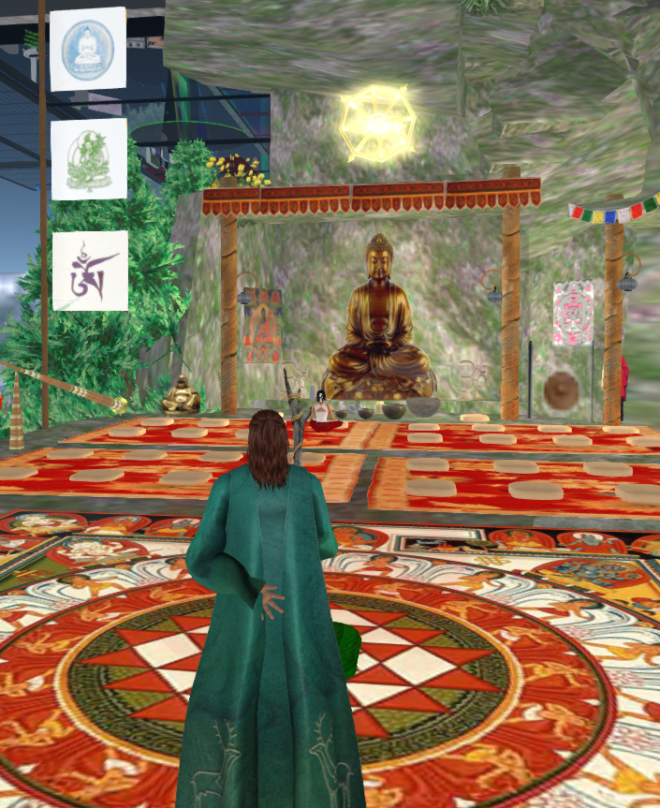
Divine Mother has been around just about forever (since 2007), and the four-sim region features a healing pyramid, chakra meditation pillows, belly dancing, a pagoda for tai chi, an inspiration garden (with guided light meditation in English, French, Italian, Dutch and German), a dance floor featuring Bollywood music, a multi-story shopping mall with Indian fashions, a glass labyrinth, a marina, and even an international airport (?!). Handy teleporter panels whisk you away to dozens of meditation spots scattered all around the landscape.

The Buddhist Centre at Divine Mother

Free Spirit Farms is the hippie/bohemian commune you never knew you needed! If you join their free group, the owners even let you set your home location to this sim (which comes in handy sometimes). On the grounds is a campground, cottages to rent, a large rustic lodge, and game tables, all located in a beautifully landscaped, park-like environment and set to a groovy Sixties soundtrack. Free Spirit Farms offers a couple of live performers every Monday evening at 7:00 and 8:00 p.m. SLT.

Gather ’round the campfire at Free Spirit Farms

You are spoiled for choice at Shambhala Sanctuary! Teleporters at the spawn point take you to (among many other places):

  • a chakra pavilion
  • an underwater sanctuary
  • a healing pool
  • a poetry barge
  • a spot where you can play the game Go
  • DreamLand, where you travel down the wishing well to a charming seaside community and boardwalk
DreamLand at Shambhala Sanctuary

The sanctuary building itself helpfully offers a wall with information (and SLURLs) about many other meditation and mindfulness sims and communities in Second Life:

Among these places are:

So, as you can see, there is lots to see, do, explore, and experience in SL! Peace out, man. Om shanti shanti shanti…

Photo by Zoltan Tasi on Unsplash

Version 2.1 of the Infographic: Social VR Platforms Organized by Primary Purpose(s)

Okay, more feedback, more thinking, more changes to my Venn diagram (as before, the following diagram is available to view and download in various sizes from Flickr, up to 1024 by 768 pixels, just click on it):

Social VR Platforms by Purpose (Version 2.1)

Summary of the changes this time around:

  • I decided that NeosVR, after all, was not primarily a business, conference, and remote workteams platform after all (sorry, guys!).
  • I have been told that Mozilla Hubs is used by some educational institutions, so I needed to move it.
  • I have seen art galleries in Sinespace, so I moved it over to join Sansar.
  • And finally, in response to a request/complaint, I have replaced the pesky copyright symbol with a Creative Commons-BY licence. Feel free to reuse and remix, just give me credit, please.

I am happy with Version 2.1…for now. I have also updated my original blogpost with this new infographic. (Check back tomorrow, when I will no doubt release Version 2.2, with yet more changes. Then again, maybe I’ll stop fiddling with it for a while.)