Another big announcement is that they are doubling the amount of free land that Premium members get, from 512 to 1,024 square metres. So that’s actually a benefit that may entice some people to upgrade to a Premium account. Maybe. (I’ve always thought that Linden Lab doesn’t give nearly enough perks to Premium members. 60 groups instead of 42? Big whoop-dee-do. As an SL fashionista, I need at least 100!)
It’s no secret that Linden Lab is sitting on top of lots and lots of unused/abandoned Mainland, so maybe this is a way for them to sweeten the deal somewhat, in order to encourage more land ownership. I’m rather skeptical that this move will work, but we’ll see. People who were fed up with the high land prices in Second Life either downsized long ago, or packed up and moved to one of the Opensim-based virtual worlds.
Art galleries and virtual worlds are a natural fit. (Second Life has been home to hundreds of art galleries over its fourteen-year history.) I wanted to highlight some pioneering work which has been done in this area in the new social VR space, VRChat. (Yes, you can use it for more than just being a general jackass! There’s culture, too.)
VRChat user GM3 (a.k.a. Godfrey Meyer III) has created and curated four separate collections of paintings, photography, digital artworks, animated installations, and virtual sculptures. To find his galleries, simply search for “gallery” in the pop-up user interface in VRChat. You will find:
VR Art Gallery: ASCEND Art Show
Art Gallery: LEVITATE
“Three” Art Gallery Show
Art Gallery: FOUNDATIONS Art
Here’s a three-minute video overview of his ASCEND gallery, created last June:
And one of FOUNDATIONS:
And one of LEVITATE:
He is currently at work putting together art for the fifth show in VRChat. He has recently published an open art call for NEON ECHELON, created in Google Tilt Brush:
Here are some pictures I took at each of the four galleries created and curated by Godfrey (and yes, there’s even virtual wine and cheese!):
I highly recommend you visit each of Godfrey’s galleries. It’s a great way to immerse yourself in some thought-provoking art! I posted about my visit to GM3’s ASCEND art gallery opening last June to Google+.
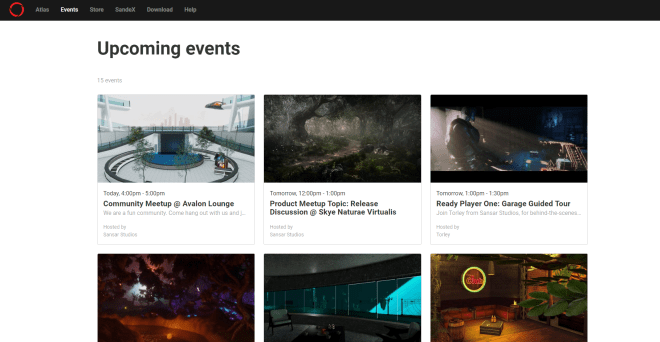
Linden Lab has just launched a new Upcoming Events page, in an effort to highlight the many regular and one-time events that are happening in the virtual world.
Torley, who has been named Sansar’s Event Manager at Linden Lab, says:
If you have an event you’d like listed in the Atlas “Upcoming events” for the interest of other Sansarians, please email “events@sansar.com” with the following essential info in this format:
TITLE
URL of experience
TIME(s) in Pacific Time
DESCRIPTION
See http://atlas.sansar.com/ and scroll down for how current ones look. This is your friendly event manager speaking and lemme know if you have questions and stuff.
God, there are days when I miss Friendster. Anybody remember Friendster?
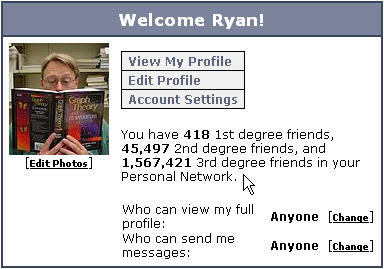
Friendster was founded by Canadian computer programmer Jonathan Abrams in 2002, before the wider adoption of MySpace (2003), Facebook (2004) and other social networking sites. It was my first introduction to social media. Hell, it was most people’s introduction to social media. This was a brand new world! The hype about social networks then was similar to the hype over virtual reality now.
Jonathan Abrams originally meant for Friendster to be a dating site, but the people using it had other ideas. People began to game the system by connecting to each other to form ever-larger social networks. Friendster would give you statistics on the number of your connections, out to three degrees of separation (that is, friends of friends of friends). And people began to compete with each other to see who could amass the largest social network. We called ourselves “Friendster whores”.
Actually, danah boyd, then of the School of Information Management & Systems at the University of California, Berkeley, was (as far as I am aware) the first person to define the term “Friendster whore”. She was, at the time, researching Friendster and other online social networks, trying to understand how people present their digital identity, negotiate social contexts and articulate their relationships. (I actually did submit some stats of my huge, eventually-3-million-plus Friendster network to her.) Her definition, which I adopted, was taken from her blog Connected Selves, September 1, 2003: “Friendster whores — people who simply collect as many people as possible”
On top of that, people begin creating fake Friendster accounts called Fakesters (“Hi, I’m Jupiter, a huge swirling ball of gas!”). The Fakesters became a way for Friendster pranksters to connect with each other, and expand their merry mayhem even further.
Of course, the people running Friendster were not too terribly keen on people creating fake accounts, and they would delete them as fast as they could. (These agents were termed the “Friendstapo”.) That only made some people redouble their efforts to create fake accounts, and some of them were truly hilarious and inspired.
My favourite Fakester was someone who channeled the late-night-infomercial fake-Jamaican tarot-card-reading shaman Miss Cleo, who declared a run for President…
Dat’s right babies! Da will a’da spirits be dat
I should lead dis wonderful nation trew da comin
times! Due ta m’overwhelmin popularity and trust
wit’in da Friendster community, Miss Cleo be
runnin fer president! So call me now ta cast yer
vote!
Friendster turned into a very different beast from what Jonathan Abrams had intended. Now, who would have predicted that?
My main point is this: the people who create the software platforms think they have control, but it’s really the end users who shape the service and build the community that they want to see. Past a certain point, it’s completely out of the founders’ hands. Linden Lab understands this and, for the most part, they get out of the way of the insanely creative people who have built Second Life into what it is today. Nobody could have predicted all the fantastic directions that SL went into. And I can see the same thing happening already in Sansar, High Fidelity, and other virtual worlds.
Surprisingly, it’s the often-anarchic world of VRChat which is currently following the rigidly-controlled Friendster corporate playbook that’s doomed to failure. For example, from their Community Guidelines page, there’s this gem:
Petitions & Protests
All questions and concerns should be emailed to moderation@vrchat.com. Any effort to organize a petition or protest on official VRChat channels is forbidden. These include but are not limited to VRChat, the VRChat subreddit, and the VRChat Community Discord.
Hmmm…let’s see how long this little edict lasts, shall we?
I do remember reading somewhere that Philip Rosedale, the founder of Linden Lab and the creator of Second Life, was truly surprised when people took his platform and basically recreated the real world (big mansions, fancy cars, etc.), as opposed to creating things that were impossible to have in real space and time. Of course, that came about too, over time. But it turned out many people simply wanted to live out their fantasies of the Lifestyles of the Rich and Famous. I just came across this ad from the March 2018 issue of the SL magazine, Attention:
Which goes to prove my point. You can’t predict what’s going to happen. People may take social VR spaces and virtual worlds into as-yet-undreamed-of and unanticipated areas. Nobody can predict what the metaverse is going to look like.



 Jonathan Abrams originally meant for Friendster to be a dating site, but the people using it had other ideas. People began to game the system by connecting to each other to form ever-larger social networks. Friendster would give you statistics on the number of your connections, out to three degrees of separation (that is, friends of friends of friends). And people began to compete with each other to see who could amass the largest social network. We called ourselves “Friendster whores”.