Altair VR: A Brief Introduction

Well, this is certainly different! Altair VR bills itself “the first VR platform for world discovery built on blockchain technology”:

Altair VR 4 July 2018.png

What the company behind Altair VR is trying to build is a next-generation, VR-based Wikipedia, which I think is a fascinating concept!

We have been working in the field of additional education for over 7 years. During this time, we managed to build the largest network of mobile planetariums in Russia and the CIS, thereby introducing more than 500,000 children to astronomy.

We wanted to improve the quality of our planetariums as well as find ways to make them globally accessible. We found a solution in Virtual Reality technology.

Earlier this year, we launched the Amazing Cinema application. In just six months, over 300.000 people downloaded the app and in April we launched the Virtual Planetarium franchise, which already works in 18 cities.

The next stage is the creation of a platform that will allow to virtually discover the world through teaching and interactive games – a type of Virtual Encyclopedia for natural sciences including, but not limited to chemistry, physics, biology, geography, and history.

We have created a VR encyclopedia in which anyone can create their own content and share their interpretation of knowledge. Content on the site will be generated according to the users’ preferences and selected through a voting process.

Here’s a YouTube promotional trailer for Altair VR:

They plan to launch their platform sometime in late 2018. What I don’t really understand, though, is why they decided to use blockchain technology for this particular project. They give three reasons why on their website:

  • Decentralized storage of data on the blockchain is the key to maintaining the system’s independence and stability
  • The community manages the content created through transparent voting
  • All payments on the platform are completely transparent and commissions are low. Furthermore, we maintain full control of copyrights and content royalties

This still sounds somewhat like blockchain as a solution looking for a problem, if you ask me. But if you are as intrigued by this project as I am, there is more information in their whitepaper. Here’s an excerpt:

From atoms to the edge of the universe

The first axis, the zoom axis, can be depicted as an axis going from the microcosm to the known edge of the universe. Each level, the «floor» – is an open world where the user can navigate in the virtual space, and visit the VR experiences placed there.

Example: at the «Microbes» level, the user can visit the world of microbes and go through various portals leading to VR applications and microorganisms, learn something fun and new, then go back one step, or move to another level.

Time Machine in VR

The next axis is the time scale. Suppose, while the user is at the level of Earth, the user can “fly” in the era of dinosaurs, see their life up to the smallest detail, and then go to battles in the Middle Ages and take part in them, or stroll through the famous castles, witnessing ancient legends. Of course, you can also get into the numerous versions of the world of the future: there are no restrictions.

The concept of “the time machine” in VR is an infinite space for creativity and creation of VR experiences, becoming a vividly fundamental textbook of history. History is interpreted from different points of view in different countries. We solved this question by giving the opportunity to study the same events from different points of view. We propose collecting dozens of view points on different historical events in one place, making the event as clear as possible. Many countries have implemented internet censorship and block websites that disseminate objectionable points of view.

Censorship might include persecution of authors, site owners, and hosting sites, where problematic materials and resources are located. There is a solution: blockchain technology. Blockchain technology stores data in a decentralized manner. Using blockchain, we do not use a single server that falls under the jurisdiction of a particular country. This is one of the important blockchain applications in our project.

You can follow the development of the Altair VR platform on Facebook, Twitter, Instagram, YouTube, and LinkedIn.

Note: While interesting, as far as I can tell from their website, this is not a social VR app, so I am not including Altair VR on my social VR apps and virtual worlds list.

InWorldz: A Brief Introduction

InWorldz_logo.png

InWorldz was founded in 2009 by three people: Beth Reischl, John Arnolde, and David Daeschler. From a 2010 interview with the founders:

Q. Tell me something about the history of InWorldz.
A. It started out at the end of 2008 / beginning of 2009 with a few of us in a chat room discussing  if we could even DO a full virtual world, it was a testing phase for us. Then we had people who were actually interested in seeing if we could really pull it together, and lo and behold, we had a live world. I had the time and dedication to devote to it, so we started looking at what could be used, worked on, where it really was in grand scheme of things, and by February 2009 we started our testing, and by April 2009 we actually allowed residents to come in and take a look for themselves. We got our first paying customer that same month, talk about our celebration, we were amazed!

Q. What are your goals and aims for InWorldz?
A. First and foremost, to become a viable platform that is comparable to Second Life. Then move on to advancing that platform. This will include things that we’ve spoken about as far as physics, meshes, and so on. These are all things we’d like to tackle later on to improve the platform.

I usually lump InWorldz in with the OpenSim-based virtual worlds, although Talla Adam, in a comment to this blog,  notes that the InWorldz software has branched off from the OpenSim project:

Inworldz, by the way, is not regarded as Opensim anyway, although its roots are in OpenSim. InWorldz runs on the in-house developed Halcyon platform while OSGrid runs on current OpeSim.

InWorldz has been one of the more popular and commercially successful OpenSim-based virtual worlds, not as popular as Second Life, but an attractive, cheaper alternative for many people who were tired of high virtual land prices in SL. Many Second Life vendors set up branches of their businesses in InWordz, and other people built new businesses from scratch. The virtual world uses its own currency, called the I’z.

Unfortunately, InWorldz appears to be going through a period of some growing pains. There are reports of users leaving the platform, and some people are expressing concern. In January 2018, Hypergrid Business reported that a group of InWorldz’s content creators were concerned about the grid’s future:

“I am in InWorldz where I have a shop and we have seen a drastic decline in sales and residents,” one merchant told Hypergrid Business.

The merchant requested anonymity.  “If Elenia [grid owner Beth Reischl] doesn’t like what any of us report, then she could ban us from the grid because she has done that in the past,” the merchant said.

Residents have also complained on social media that the founders haven’t been paying attention to their concerns. Of the top managers, owner Reischl moved to Panama and founder and CTO David Daeschler has mostly moved on to other projects.

In an apparent effort to stem the flow of bad news, the grid shut down the public discussion forums a couple of years ago and stopped publishing monthly user statistics last spring.

According to the owners, there was too much drama in the forums and moderation would have been too expensive.

“Our forums have literally cost us thousands of dollars in customers,” Reischl said in a forum post in 2015.

Staff developer Jim Tarber followed up with a very confusing statement about why InWorldz doesn’t need to have a public discussion forum.

“It’s not InWorldz’ core business, we are not a social network like Facebook, we’re a software development organization providing an online service,” he wrote.

There has been some worried discussion among users about InWorldz’s future in their Residents Corner (thread one, thread two). But InWorldz, unlike many other OpenSim-based grids that have foundered along the way like Avination, keeps moving forward.

To learn more about InWorldz, visit their website or their wiki. InWorldz founder Beth Reischl also has a YouTube channel, with episodes of her show, called iNewz.

OpenSim: A Brief Introduction

OpenSim.png

OpenSim (short for OpenSimulator) does not refer to one virtual world, but to dozens of virtual worlds! The main webpage of the OpenSim project states:

OpenSimulator is an open source multi-platform, multi-user 3D application server. It can be used to create a virtual environment (or world) which can be accessed through a variety of clients, on multiple protocols. It also has an optional facility (the Hypergrid) to allow users to visit other OpenSimulator installations across the web from their ‘home’ OpenSimulator installation. In this way, it is the basis of a nascent distributed Metaverse.

OpenSimulator allows virtual world developers to customize their worlds using the technologies they feel work best – we’ve designed the framework to be easily extensible. OpenSimulator is written in C#, running both on Windows over the .NET Framework and on Unix-like machines over the Mono framework. The source code is released under a BSD License, a commercially friendly license to embed OpenSimulator in products. If you want to know about our development history, see History.

Out of the box, OpenSimulator can be used to simulate virtual environments similar to Second Life™, given that it supports the core of SL’s messaging protocol. As such, these virtual worlds can be accessed with the regular SL viewers. However, OpenSimulator does not aim to become a clone of the Second Life server platform. Rather, the project aims to enable innovative feature development for virtual environments and the Metaverse at large.

None of the OpenSim grids is anywhere near as popular as Second Life. I sometimes still pop in to visit OSGrid, the most popular of the OpenSim-based virtual worlds, with about 65,000 user accounts created. I also visit InWorldz, which is not really considered a true OpenSim grid, because although it has its roots in OpenSim, Inworldz runs on the in-house developed Halcyon platform, while OSgrid runs on current OpenSim software.

There is a very active Google+ community called Opensim Virtual, where people post news and events happening in various OpenSim-based virtual worlds. The great thing about OpenSim is that there is nothing stopping you from setting up your own virtual world, which other users can visit! Many people have already done exactly that.

Thanks to Talla Adam for her comments urging me to include OpenSim on the list of virtual world platforms I have written about on the RyanSchultz.com blog!

UPDATE July 5th: Talla tells me that this is a more up-to-date list of OpenSim virtual worlds: Active OpenSim Grids (maintained by Hypergrid Business).

Ever, Jane: A Brief Introduction

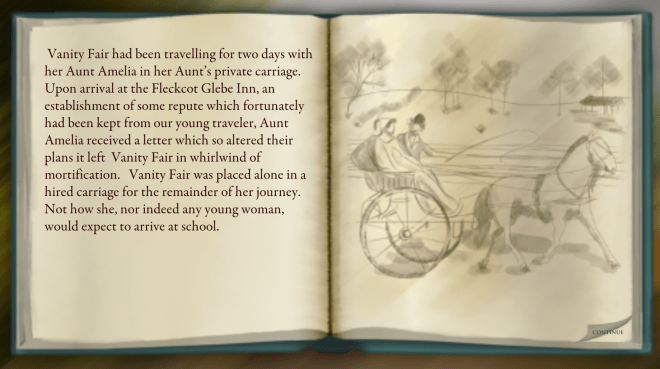
Ever, Jane is a very different type of virtual world. set in the works of Jane Austen:

Ever, Jane is an on-line role-playing game set in the virtual world of Regency England and the works of Jane Austen. Unlike many multi-player games, it’s not about kill or be killed but invite or be invited. Gossip is our weapon of choice. Instead of raids, we will have grand balls. Instead of dungeons, we will have dinner parties.

The village of Tyrehampton is centered round a tree-lined village green, with houses where you may own and redecorate to your taste any available terraced home as of our Open Beta Update 3 (Released 9 December 2016). Please feel free to role-play with your friends in and around the village. Drive a carriage to explore around the town or travel to the Estate for dancing. There are several “stories” to get you started. We are busy adding many more stories, dinner parties and other features for your enjoyment.

The client software is a free download, either from the website Marketplace or the My Account page (the client was last updated in June 2018) The client did not properly recognize my screen resolution the first time I ran it, but you can set it when you restart the program. Setting up your character is pretty straightforward, although there were still some resolution problems with the display of some text:

Ever Jane 1 1 July 2018.png

I had a good laugh when I was presented with the three tutorial options:

Ever Jane 2 1 July 2018

Absolutely perfect! I did notice that the “Tell Me Everything” tutorial seemed to get stuck at a certain point.

Here are a few more screenshots to give you a general feel for Ever, Jane:

Ever Jane 3 1 July 2018Ever Jane 4 1 July 2018Ever Jane 5 1 July 2018

I didn’t encounter any other avatars in-world, but I did a little exploring. Since your interactions with other people form the basis of the game (showing proper etiquette, etc.), you pretty much have to have to group of people in-world at one time to really appreciate all that Ever, Jane has to offer.

Ever, Jane is a fun, quirky virtual world that you should visit at least once. And it’s a must-visit if you are a fan of the novels of Jane Austen.