Linden Lab has issued a major update to the Sansar client! The team was working on it all day yesterday and well into the evening. I was tired, so I went to bed around 8:00 p.m., and woke up at 2:00 a.m. this morning to discover that the update was ready to download and install, so I put on a pot of strong black coffee and set out to explore! This is my first blogpost about the new update, and there will be many more throughout the week.
There’s quite a lot to unpack in this new update, so I’m going to take things slow and capture pictures and some video to show you what I’m talking about. For a complete list of new features, here are the release notes. But for now, let’s start with the new avatars, the much-anticipated Avatar 2.0 project. Also note that I am starting with a fresh, brand-new avatar with zero inventory, for illustration purposes.
When you first sign in to Sansar, you are presented with a choice: select a pre-made humanoid avatar, or create and customize your own (see the red arrow below):
Here’s a look at the ten starter avatars. As you can see, they are all of a stylized, vaguely science fiction theme:
Now, let’s take a quick look at the avatar customization module. At first glance, it resembles the old system we had before:
There’s a very limited selection of clothing for male and female avatars, again in a futuristic, sci-fi style:
There is a similarly limited selection of futuristic hairstyles, 6 for men and 6 for women, with the same colour and tinting options as before:
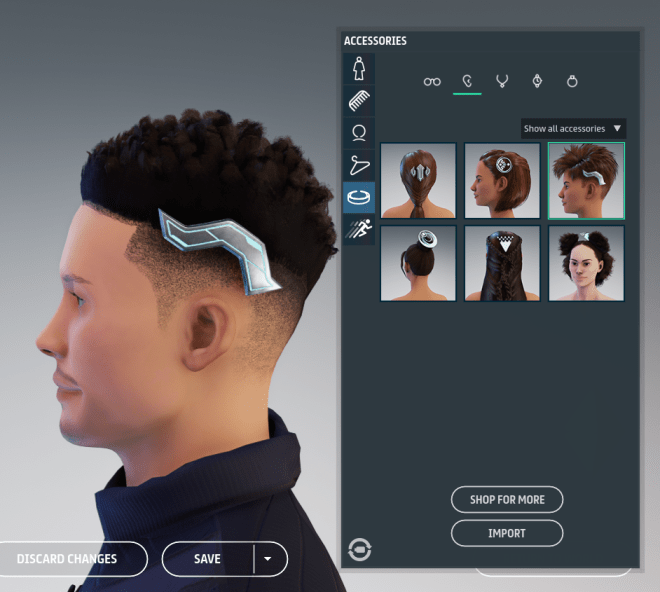
And there are a half-dozen science-fiction-type head attachments, like this over-the-ear piece:
The Face tab offers a bunch of new tools, including a variety of face presets, skin colours, eye colours, as well as various sliders to control various aspects of your face, as before:
Here’s a short video to show you what changing the face presets, changing the skin colour, and changing the eye colour looks like:
Now comes the fun part: the brand new interactive face deformation tools! See these top two rows of buttons that appear over your avatar’s head when you click on the Face tab? These are the new face deformation tools:
The top four buttons are (from left to right):
Head – Allows you to modify the entire head.
Section – Allows you to modify large sections of the face.
Feature – Allows you to go deeper and modify facial features.
Part – Allows you to go even deeper and fine tune specific parts of facial features.
The second row of buttons controls the movement/position, rotation, and scaling/size of whatever section of the head you picked using the top row of buttons:
These are pretty much the same move, rotate, and scale tools that you should already be familiar with from Second Life and other virtual worlds.
So, let’s take a look at a very simple first example video: moving, rotating, and scaling the entire avatar head:
Notice that whatever area you are working on is highlighted (in this first example, the entire head). If you were to select a section, feature, or part of the head, you would use your mouse to highlight that section/feature/part before you move, rotate, and/or scale it.
So, by using combinations of the existing face sliders and the new facial deformation buttons, you can pretty much make infinite adjustments to achieve your desired avatar look. It’s a complicated but powerful system, and this blogpost is just a brief introduction, so feel free to play around and see what you can come up with! I expect it’s going to take hours of trial and error to see all the different combinations you can achieve.
There is more—much, much more—in this new release, and over the next few days this week I will write about other new features in the client. Have fun!
UPDATE 4:53 p.m.: Istari, a Linden Lab employee, shared the following animated GIF which gives a real good ides of how you can edit the various facial features of your avatar using the new facial deformation buttons (see image right):
Don’t forget to register for the upcoming Decentraland Game Jam, where you have an opportunity to win a share of 2,500,000 MANA cryptocurrency tokens and 200 LAND virtual land parcels, prizes worth an estimated US$275,000 in total value. You don’t need to own any land to take part in the contest, and they’re even offering training sessions all next week (online via Twitch and at various real-world locations) on how to use the Decentraland SDK to create contest entries.
Although the blockchain-based virtual world Decentraland (DCL for short) is still in closed beta test, with countless users impatiently waiting for their chance to be admitted, the first casino has already opened! So this evening I decided to pay a visit, take some photos, and even play the slots!
Chateau SatoshiA closer look at the rotating Decentral Games logo
The demo is now accessible to core community members and is hosted on our site and viewable in a Chrome browser. We felt this was the best means to gain valuable feedback on gameplay, scene design, on-screen UI, and overall experience. After testing and optimization, we will deploy this casino scene to 19 parcels of LAND at the entrance of Vegas City, Decentraland.
In this closed beta demo, the default gameplay is in fake PLAY currency with no blockchain interaction. It may take a few seconds for the scene to render and the games to be playable. The Free-to-Play version serves as a taste of the Decentral Games experience, without the need to register an account with us. However, in the on-screen UI gameplay box found in the lower right hand corner there’s a toggle that allows the user to switch to the MANA Payout and ETH Payout gameplay.
(For those not familiar with the terminology being used here, LAND is the name of the 16m-by-16m virtual parcels of land in Decentraland, MANA is the cryptocurrency used in DCL, and ETH is, of course, the Ethereum cryptocurrency. Gambling using MANA and ETH are not yet available, but the company says they will be available soon.)
Here’s a few more shots of the casino interior, which is decorated in a luxurious gold-and-white Art Deco style with many grand staircases throughout:
The box in the bottom right-hand corner of the screen pops up automatically when you enter the casino grounds, and it helpfully informs you how many credits you have left, what your current bet is, and how much you have won:
Here’s a look at the slot machines, located at the main entrance of the casino, next to a soaring spiral staircase:
As you can see from this short video clip I recorded, they are actual working slot machines (I won 25 credits on the pull just before this one!):
To comply with online gaming legislation, the MANA and ETH Payout versions will require age and location verification. We will also request authorization to transfer MANA on behalf of the player. Although an early implementation of this process is currently offered on our site, we are still optimizing its ease of use. Please just test our Free-to-Play gameplay for now.
Using the link provided above, I did a quick check and Decentral Games is clearly screening out Americans, although it’s not clear what other countries will be banned from gambling. The company adds:
We’d like to give a big thanks to the Matic Network and Decentraland teams who have been very supportive throughout development. If you don’t yet have access to the closed beta and you’d like to join the community dialogue, join our Discord channel, direct message us on Twitter, or reach out to hello@decentral.games to request access. We’d like to welcome any feedback the community may have regarding improvements to the slots game or suggestions for new games to build in the future.
For more information on Decentral Games, here is their website. It would appear that the company is planning to produce more types of gambling games than just slot machines, including roulette wheels:
Decentral Games website
I was actually very surprised to see this already up and running in Decentraland! And this is not some cheap-looking low-poly building; it is a very attractively-designed virtual casino, one of the nicest builds I have yet visited in-world. One thing I will say: there are a lot of people who have a lot of incentive to make DCL work, because they invested millions of dollars of their hard earned money into it. And obviously, gambling is going to be one way to monetize the outrageously expensive LAND which some people have bought.
It will be interesting to see what impact gambling will have on Decentraland, how successful it will be, and how DCL and Decentral Games will deal with the jumble of regulations around online gambling around the world. It is estimated that the size of the online casino market is roughly $40 billion or $50 billion a year, and obviously many DCL investors hope to put their LAND to good use to capture some of that money. And no doubt, there will be customers.
But I do wonder if Decentraland is going to land up looking more like a gaudy, low-poly, crypto-crazed Las Vegas strip, with nothing but gambling sites everywhere you look. Not to mention the impact on people who are susceptible to gambling addictions, who might find it hard to stay away when the casino is as close as their keyboard. I guess we’ll see how this all plays out.
One thing is certain: you can bet on interesting times ahead 😉
Have you joined the RyanSchultz.com Discord yet? Discuss and debate anything and everything related to social VR and virtual worlds, on the first cross-worlds Discord server! More details here.
Dale Glass as written a follow-up to his first guest editorial, What’s Wrong with High Fidelity. Here is a very lightly edited version of the article he sent me (apparently, Dale is not a firm believer in the use of commas 😉 ). I have taken the liberty of adding my own images to illustrate his text.
Imagining a Successful High Fidelity
by Dale Glass
Now that I’ve discussed what I think is wrong with High Fidelity, I’m going to try and propose a working model that would preserve as much of it as possible. I’m going to ignore solutions that involve a radical reorganization, because I think the interesting question is whether HiFi could make money being what it currently is, rather than doing things the easy way by turning it into a Second Life clone, for instance.
A successful High Fidelity will need two parts to it: a thriving community, and a thriving company. The company hardly can succeed without having users, so I will start with them.
HiFi needs content, because not everyone can make their own artwork, or code. It’s hardly an inviting proposition to join a new virtual world to find out it’s a virtual desert devoid of anything interesting, and that if you want a nice looking house, your only resort is to spend a lot of time learning how to use Blender. So one of the very first things HiFi needs is a large amount of content creators churning out a large variety of things: avatars, clothes, houses, toys, tools, scripts, etc.
To start with, here’s what I think won’t work: imitating Second Life. SL creators expect there to be asset permissions, which don’t exist in HiFi, and don’t make that much sense since without a central asset server and servers being under user control, any restrictions can be ignored. SL creators also won’t be happy with that scripts are just as vulnerable as 3D assets, because many rely on scripts to make their creations harder to clone. HiFi has made a token effort towards content protection by attempting to verify that something was officially bought on the High Fidelity Marketplace, but this is an entirely opt-in scheme, which is unlikely to make creators happy.
Any attempt to make SL businesses establish themselves in HiFi, as-is, is likely to end badly, as they will find people can do anything they want with their assets, and that there’s nothing in place to deal with it, and no solutions on the horizon, either.
How to do business in such an environment, then? My suggestion is basically Patreon and commissions. Rather than trying to shoehorn the SL business model into High Fidelity, it would be a lot better to go with a model that doesn’t need to fight against HiFi’s nature at every step, and Patreon seems to be that. A lot of artists on Patreon release work to the general public on places like YouTube, and thus don’t need to be concerned with ensuring only the right people can get at it. Patrons contribute money to creators voluntarily, wanting specifically to support the artist and not to buy a single copy of a product.
Patreon homepage
I realize that this is a rather tricky proposition, but it’s the only thing that would seem to work in such an environment. Doing things the Second Life way either requires drastically changing High Fidelity, or results in creators leaving for greener pastures.
Another thing HiFi users need is a lot of small improvements to the way the platform works. It’s missing many of the features needed for large groups of people to communicate and manage themselves – groups, group permissions, land and object ownership, to name just a few. HiFi shouldn’t stop at replicating SL here – surely one can do even better. HiFi would be well served to listening to what long time SL users have been complaining about and trying to give their users that.
Of course, the company’s business model also needs to be considered, and the problem is that in the previous article I concluded that there’s nothing much HiFi can earn money from. So what now? I see two ways forward.
The first is pivoting towards an “Open Source business model”, in which the company sells technical support, custom work, and perhaps additional functionality to primarily corporate clients. The public is allowed to play with the code without much support on the part of the company, mainly for the sake of publicity, testing, and gathering third party fixes from people who never were going to pay for a 24/7 support contract anyway. Here HiFi could benefit from changing to a “scary” license like the GPLv3 or AGPLv3, which, while perfectly okay for the general public, makes many companies deeply uncomfortable. This creates another potential source of money by offering an alternate license scheme to those who don’t like this. HiFi is under the rather oddly permissive terms of the Apache 2.0 License, which allows anybody who wants to take all their work, do anything they want to it, and contribute nothing back. This is very generous, but a dangerous way to try to earn a profit. A license like the GPLv3 ensures that any third party work also benefits the company.
GPL Version 3 Logo
Some of this already seems to be happening on HiFi’s part to some extent, and on the whole I think it’s a pretty sane direction to head in, except for that, currently, it’s not really clear what is it that High Fidelity has that other companies would want to pay for. Second Life already gave this a try, and it ended up fizzling out. It’s also a pity that this seems to involve disconnecting from the community.
How about High Fidelity being profitable by serving the users, like Second Life does? That’s rather trickier, but I think there’s some potential. HiFi would need to move to a community supported model. Since it gives everything away, there’s almost nothing that absolutely must be paid for, so the only thing that can be done is asking nicely.
This isn’t as crazy as it sounds. This idea is usually adopted by non-profits and Open Source projects like Wikipedia, KiCad and Blender, but there exist some rare for-profit examples. For example, Reddit partly works a bit like this, selling premium memberships that don’t give the buyer much, since the base access is free.
Following this idea, HiFi could offer some sort of premium membership. For instance, you could get your name listed among the list of sponsors, get some sort of distinctive sign or title next to your name, and perhaps get some privileges, like access to test servers or technical support.Most such advantages would probably be largely symbolic, but I think there’s a fair amount of people who’d send some money HiFi’s way if the cards were played right.
High Fidelity also could, and in my opinion, should at least try, offering domain and asset hosting. While they couldn’t compete with established vendors like Amazon on price, they can offer something Amazon doesn’t have: a deep knowledge of the platform. Having HiFi host your stuff should result in it being taken care of by people who know very well how it all fits together, and who are very close to the original developers. HiFi itself would also benefit, in that this would allow them to have a much better idea of how exactly the software is being used, and what problems the users run into.
A harder-to-get-right possibility would include paid custom work, on a level accessible to average people. For example, one could create bug and feature bounties where people could pledge money in exchange for features. This would be fairly tricky, but I recall that for instance OpenSim used to have bounties. Paying to be able to talk to a member of the team is another thing comes to mind. It could be useful to just be able to pay to speak to whoever wrote a given piece of code for half an hour.
To add another revenue source, I would consider selling merchandise. Things like T-shirts and coffee mugs seem like a no-brainer, providing both income and advertisement in exchange for little effort.
Developing a digital economy and taxing it is another possibility, but I do not think such a thing can amount to much in the early stages.This would be more of a long term plan, as a large user-base is needed for this to amount to anything. If High Fidelity catches on, however, this could be a pretty nice source of income.
A crucial part of such a plan would be removing all roadblocks possible for paying the company. This would involve accepting payments by every method that’s remotely practical, as well as removing every possible roadblock to content creation in general. It could be worthwhile to improve in-world creation abilities, so that something can be accomplished without needing to learn or install anything besides HiFi itself.
Let’s resume, the issue of making money by trying to sell pretty much anything that can be sold. HiFi being what it is, making a profit off it isn’t going to be trivial, so I think no possibility should be left unexplored. While HiFi’s openness allows third parties to take all their hard work and do their own thing with it, the company has the most knowledge about their own platform, and by playing their cards right, and taking advantage of an established user-base, they could outrun any competition without that much trouble.
For all this to work properly, HiFi would also need to improve its relationship with the community. By that I mean more openness and more communication, with regular meetings with users, easy access to the developers and in general a sustained effort on HiFi’s part to say “we care”. If you’re going to depend on the users’ goodwill, you have to convince them that you’re a lovely bunch of people well deserving of money.
I don’t have a whole lot of hopes on High Fidelity doing anything of the sort, of course. Part because that’s really unlike what I’ve seen of them so far, but also partly because this is not the way they’ve chosen, and it would take an awful amount of work, as well as restructuring the company and probably shrinking it by quite a bit.
What I think is a bit more likely is some third party giving this a try. Given that the code is out there, nothing technically stops anybody from taking it and trying to go in their own direction. Somebody would need to fork it on GitHub, set up a pretty website explaining their ambitious plans, put in a lot of hard work both to improve the code and to communicate with the current community, and regularly mention “please support us on Patreon”. This would be a tricky gamble to pull off given the small size of HiFi’s community at present, so I think if somebody ever does this, it’ll be an effort from an established community member.
If HiFi survives, what I think might happen is those two things, run by different entities. High Fidelity seems to have committed itself to corporate work and abandoned its original user community. But if it keeps delivering code that’s useful enough for a community to use, and the userbase grows enough, then I expect that eventually somebody will try to make a community edition. From there it doesn’t take much to fork the source, and start accepting donations, and that could get the ball rolling again.
Did you know that you can help support my work on this blog (as well as the Metaverse Newscast show), and get some great rewards in return? Here’s how.
The company is slowly letting more and more users onto the closed beta test platform (around 50 to 75 new people per week since July, last week they raised it to 150, and this week they raised it again to 400). DCL is also running weekly stress tests to see how well Decentraland performs under maximum avatar load. I have been participating in the stress tests when I can.
A quaint little lowpoly cottage I visited during today’s Decentraland stress testAnother picture taken during today’s stress testingA closer look at the variety of avatar customization options
There are several new features in their web-based Decentraland Explorer client: a mini map in the upper-left corner so you can see where you are (a much-needed feature!), and a small user profile icon in the upper-right corner which, when clicked, displays information about your avatar. Also, they have finally integrated the avatar customization system on their website, so that your avatar now looks the way you designed and clothed him, and has the name you selected for him.
Prior to this, your avatar just had a randomly-generated appearance, and had a name of the form Guest ####, even if you had paid 100 MANA to register a custom avatar name. At current exchange rates, 100 MANA works out to about US$3.00. I still believe that charging for a custom username is a tactical mistake, and a potential roadblock to the average, non-crypto consumer that DCL will need to market to. On the other hand, it might cut down on the number of alts, which tend to be abused by the griefers who plague other virtual worlds such as Second Life.
Many people are busy building wonderful scenes on their virtual parcels of LAND, and there is already much to see. There’s even a spreadsheet making the rounds, listing all the places the DCL sightseer can visit!
Life on the Blockchain (a tower with scenes of everyday life), a Decentraland scene built by Interweaver
Don’t forget to join the Decentraland SDK Hackathon (which seems to have been renamed as the SDK Game Jam), running from Sept. 16th to 30th, 2019, where you can win a share of 2,500,000 MANA and/or 200 LANDs (with a total cash value of over US$250,000)! Just click the link above for more details on the contest, and how to apply. Good luck to all the contestants!
However, one of the things that I do find a little troubling about this virtual world project is that there seem to be a lot of people who have piled onto the cryptocurrency bandwagon, and rather blindly invested in MANA (Decentraland’s cryptocurrency) or LAND (Decentraland’s virtual land) without doing a lot of proper research into the project. Some people still think (wrongly) that DCL supports virtual reality, for example. I find that people are asking the same newbie questions over and over again. It’s not hard to scroll through and find comments like the following over on the official Decentraland Discord channels:
A: Can I explore without an invitation? I set up an avatar etc.
B: Does anyone know how to get early access to DCL?
C: So can we build things & bring them into Genesis city, for example?
D: hi all. i am new. i dont know how this works. what is the first step i should take here?
E: Hello I have one parcel. Can I rent it ?
I almost get the feeling of the Yukon Klondike Gold Rush, where everybody and their dog headed north, eagerly in search of gold, fueled by greed and tales of the few people who became millionaires. It will be fascinating to watch Decentraland’s economy evolve over time.