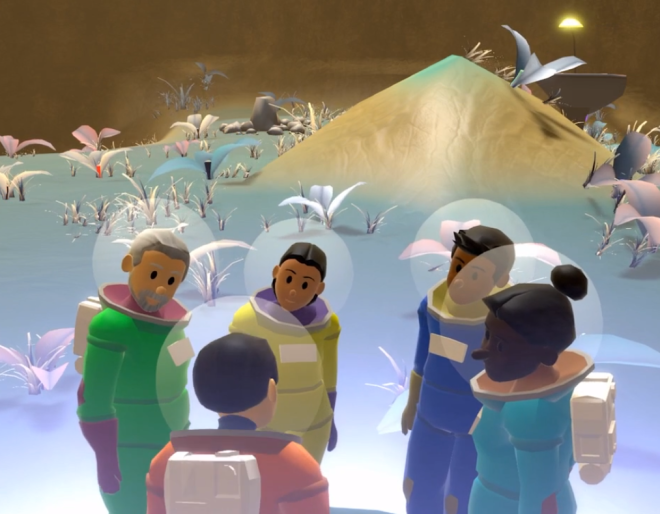
Someone on the Ryanschultz.com Discord server alerted me to yet another platform which is intended for the corporate market, to support remote work teams, with the rather clever name of Remotely:
What sets Remotely apart from all the other remote workteam platforms out there is that all interactions take place with astronaut avatars, on alien planets!
Their website boasts an impressive 61 integrations with tools such as Microsoft 365, G Suite, and Slack, with a promise to soon include video chat in the mix:
This is not a platform which supports virtual reality; it’s a virtual world that you access and navigate via your flatscreen computer desktop (here’s an example image from their fairly extensive user documentation):
I should note that the idea of having business meetings in exotic locations is hardly new to Remotely (for example, Dream lets you hold meetings in a cave!). Frankly, this is sort of like holding team meetings in Second Life, only you have far, far fewer options for avatars to use and worlds to meet in. Aside from the high number of software integrations that Remotely currently offers, and the admittedly cute and appropriate name, there’s not much to set it apart from all the other YARTVRA platforms out there, in what is rapidly becoming an oversaturated market (for reference, here is my most recently-updated list of YARTVRA platforms).
In summary, I don’t think there’s enough to the outer space gimmick to reel in business users, many of whom may not see the need for such a product, even during a coronavirus pandemic when everybody is working from home. In my opinion, there are now way, waaay too many products chasing after potential corporate users, which means that those platforms whose companies can more effectively advertise themselves (and promote the features that set them apart from the competition) will prevail.
UPDATE June 13th, 2020: I mistaken tagged this blogpost with the tag YARTVRA, which of course it isn’t (it doesn’t support virtual reality), so I have removed the tag and renamed this blogpost accordingly.
Well, according to the calendar, I am now in day 67 of my self-imposed isolation in my apartment, working from home for my employer, the University of Manitoba Libraries. I have not set foot in a supermarket since March 16th, and I have not set foot in a pharmacy since January 30th, choosing instead to have my groceries and prescription medications delivered when I come close to running out. Aside from a few short trips to my office at the university to pick up some papers, my office chair, my Oculus Rift VR headset (as an emergency backup), and my keyboard and wireless mouse (also as backups), I have stayed at home and helped flatten the curve.
I consider myself fortunate to live in a province (Manitoba) where, to date, we have only had 290 cases of COVID-19 so far, in sharp contrast to the provinces of British Columbia, Alberta, Ontario, and Quebec, and the sea of red that is the United States:
We here in Manitoba have truly benefited from the fact that we live in a relatively geographically isolated area of North America, while the coronavirus pandemic hit other parts of the world first, giving our provincial and city governments valuable time to prepare and implement strict social distancing restrictions. While Canada’s chief public health officer has admitted that they should have closed the borders sooner, Canada is in a much better position overall than many other countries, particularly the United States, Russia, and Brazil, which have seen a surge in cases due to haphazard or even non-existent government responses to the crisis.
I have already explained, via this blog, that I have several underlying health conditions at the age of 56: I am significantly overweight, and I have hypertension, type II diabetes, and asthma. All four conditions (which, of course, are interrelated) put me at much higher risk for a severe, possibly even fatal, case of COVID-19 if I should become infected with this novel coronavirus. And it means that I will probably be among the last group of University of Manitoba Libraries employees to return to the campus. I could be in self-imposed lockdown until there is a vaccine.
I have made peace with this fact, and I have now settled into a kind of routine in working from home, becoming more comfortable with virtual staff meetings held in Webex and Microsoft Teams (our university seems to have largely abandoned its use of Zoom).
The librarians of the Sciences and Technology Library are currently hard at work developing a for-credit university course in information literacy for undergraduate science students, which is to start in September 2020. The University of Manitoba has announced that all its classes in the fall term will be taught remotely, and the head of our libraries system has told us that she does not expect us to return to our physical library offices before January of 2021. The science librarians had been originally planning to deliver our information literacy course in-person and in the classroom, but we are now pivoting to package and deliver the course remotely using Webex.
As part of my little one-man crusade to destigmatize mental illness, I have been honest and up-front with my blog readers about my own struggles with depression and anxiety during the pandemic. In addition to taking antidepressant and anti-anxiety prescription medication, I also have biweekly sessions via telephone with my psychiatrist. On the whole, while I still have some bad days, I am doing pretty well.
You might be interested to learn that, in addition to the above-mentioned supports, I have also entered into a peer mentor/support relationship with a friend of a trusted friend, who has experience as a peer counselor in a healthcare setting and has worked as a volunteer at a telephone crisis hotline in the past. We actually meet up every couple of weeks or so in my Linden Home in Second Life!
I log in as my avatar, she logs in as her avatar, and we have a conversation using voice chat. This is an opportunity to get things off my chest and gain another person’s perspective on my mental health issues, and where I can even talk how I sometimes use Second Life to cope with my self-isolation, without having to provide the kind of contextual, background explanation I would need to make to a real-world counselor! I can also ping her via Discord anytime I feel I need to vent in a safe, supported space.
This person is currently considering setting up a peer listening/support service in Second Life, and I am a sort of guinea pig for her, a test to see how well that would work. She’s also pretty new to Second Life, still working her way up the steep learning curve and getting her bearings, and I have shared many of the things I have learned from my 14 years of experience in SL with her—like the concepts of alts, furries, Gorean role-play, and the absolutely critical importance of ankle lock 😉 .
So, how are you holding up during the pandemic? Feel free to join the RyanSchultz.com Discord server, where we have a fairly active #coronavirus-chat channel, or just leave a comment to this blogpost. I’d love to know how you are doing!
I logged into Twitter this morning to discover that I have hit a milestone: I now have 800 people following me! I realize that I am nowhere near people such as Kent Bye of the Voices of VR podcast with 24,000 followers, or Robert Scoble with his whopping 407,000 followers (both of whom follow me and sometimes retweet my tweets), but I still think that it’s something.
My handle on Twitter is Quiplash— short for “quipster whiplash”. I am well-known in both real and virtual worlds for my snappy comebacks and my sarcasm! All of my blogposts here on the RyanSchultz.com blog are automatically posted to my Twitter feed when I hit the Publish button on WordPress.
At the moment, my Twitter feed is a rather bizarre mix of a few friends and coworkers from real life, a lot of people who work in and post about virtual reality, social VR/AR and virtual worlds—and a slew of infectious disease experts whom I started following because of the coronavirus pandemic! As I am trying to cut back on the amount of COVID-19 news I am consuming, I may decide to start pruning the list of people whom I follow on Twitter, to remove many of the latter group. While Twitter has afforded me a fascinating window into what the doctors and researchers talk about during the pandemic, all the relentless news and commentary on the continuing global public health crisis tends to wear me down after a while.
If you want to check out my Twitter profile, it is here. The picture I used for the banner image in my profile is from IDIA Lab’s world 1915 San Francisco World’s Fair, which you can visit and explore in Sansar.
And I’d like to thank all the people who think that I am interesting enough to follow! If you want to join my patrons who choose to support me financially for the blogging and video work I do, I would love you even more! Here’s my Patreon page, or if you prefer, you can simply buy me a coffee, making a one-time US$3 donation. Whether or not you choose to express your appreciation by supporting me financially for the work I do, thank you for reading this blog and following me on Twitter! Your support means the world to me.
Linden Lab has invested quite a lot in the past few years to upgrade their financial systems to meet these new regulations, and they decided to make the savvy move to sell their well-developed virtual economy services to other platforms.
It is no surprise that former Linden Lab platform Sansar (now owned by Wookey) is one of Tilia’s customers. But it is somewhat of a surprise to me that among those new customers is a blockchain-based mobile property trading game called Upland, which I had never heard of before. Here’s a brief Vimeo promotional video:
Now I think it is interesting that a game that describes itself as “a property trading game paired with a decentralized economy” would decide to use Tilia instead of trying to create and monitor its in-game economy. Linden Lab might well be on to something here! I can foresee a time when other social VR platforms, virtual worlds, and games might also make the decision to outsource the management of their virtual economies in this way.