Editorial: Metaverse Madness Is Truly Upon Us (Caveat Emptor!)

It is wintertime here in Winnipeg, and in addition to the coronavirus pandemic (now in its 21st month), a strike by my union (now in its fourth week), and a stretch of some bitterly cold November winter weather, I have been fighting a nasty cold. (I know it is a cold and not COVID-19 because of my runny nose, itchy and watery eyes, and sinus congestion, plus I cannot stop sneezing.)

I am NOT a happy camper (Photo by Matthew Henry on Unsplash)

All in all, I am in a miserable, foul and cranky mood today. So I figure it’s the perfect time for me to write one of my patented snarky editorials. My target this fine and frosty day is the metaverse.

Not all of the metaverse, mind you. I have little to no problem with the actual metaverse platforms that are already out there and operating (and more power to you; you know who you are!). And I have no issue with the bulk of these social VR platforms and virtual worlds which have thus far resisted the siren call of the blockchain*. Yes, I am even willing to forgive Cathy Hackl for having the sheer audacity to rebrand herself the Godmother of the Metaverse on Twitter:
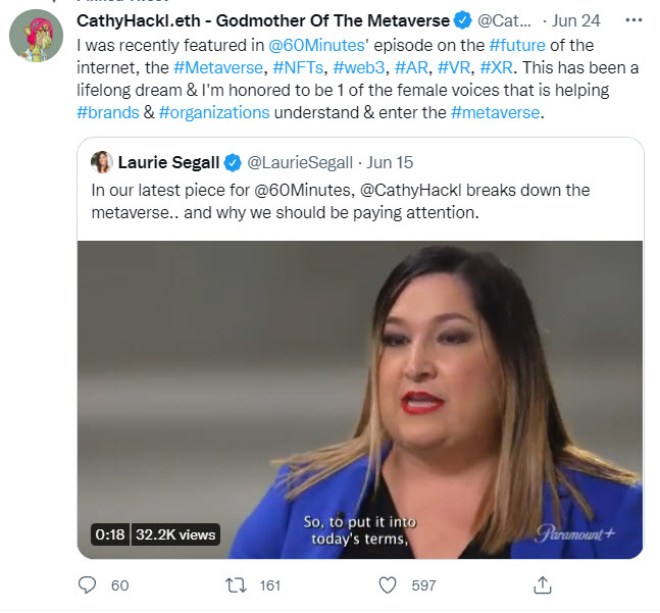
Godmother of the metaverse? Philip Rosedale and Adam Frisby would like a word 😉 but I must admit that this is a bold, nervy, and frankly savvy move. Go get that consulting coin, Cathy!


But what I do have a serious problem with, and what I want to focus on today, is the hothouse atmosphere created by the collision of the existing crypto/NFT/blockchain hype with the newer-but-no-less-hyperbolic metaverse hype triggered by Facebook’s recent rebranding.

This is getting completely out of hand, people

I have been writing this blog for four and half years now, and I have seen a lot of sketchy stuff during that time, but I have never witnessed as much absolute, unadulterated, utter bullshit out there as I am seeing and hearing right now. The number of schemes, scams, and outright cons out there, seeking to profit off of gullible investors who have not done their due diligence, is frightening. The grifters are out in full force!

I am a member of various Discord servers relating to blockchain-based virtual world projects, such as Decentraland, Cryptovoxels, and Somnium Space (all of which, I hasten to add, I have little to no issue with, since they are all actual, working products which you can visit today). Because of that, I am inundated with DMs from people wanting to sell me on the latest and greatest get-rich-quick NFT scheme. Here are examples of two messages which I deleted (and reported as spam) just this morning:

Last night, I went and visited a couple of metaverse communities on Reddit (namely, r/metaverse and r/Metaverse_Blockchain), and I was staggered by all the johnny-come-latelies who are piling on, shilling for this or that pet project. Almost all of them involved cryptocurrency, NFTs, or the blockchain in some way or another. Here’s a couple of sample videos to give you a flavour of the overall feeding frenzy:

You get all that jargon? There will be a quiz later… 😉 Here’s another example:

My eyes rolled so far back in my head that I could see myself think! What’s worse to me, though, is the number of cryptonewbies who are asking questions and seeking advice on where to invest in these Reddit communities. Lambs to the slaughter!

These past few days, I have also spent many hours hanging out in several metaverse-related discussion rooms on the social audio app Clubhouse (or, to put it another way, rooms with “metaverse” in their title), where various people were actively shilling for any number of sketchy, dubious, and frankly harebrained schemes, seeking to part the unwary and the ignorant from their hard-earned money. No, I am not naming the names of any guilty parties in this particular blogpost, but I listen, I worry at the amount of misinformation and disinformation circulating out there, and I shake my head.**

I fear that we are going to see a LOT of people lose a LOT of money on these projects. Just because a project name-drops terms like “blockchain” and “crypto” and “NFTs” and now the latest buzzword in the mix, “metaverse”; and/or the project has an active Discord or Telegram or Clubhouse rooms full of true believers and yes-men; and/or the project has a slick-looking website all ready to accept your crypto wallet credentials—NONE OF THESE THINGS ARE ANY SUBSTITUTE FOR YOU TO CAREFULLY DO YOUR OWN RESEARCH, AND YOUR OWN DUE DILIGENCE, BEFORE YOU INVEST A PENNY.

Do your research before you invest a penny (Photo by UX Indonesia on Unsplash)

And if you can’t do your own homework because you don’t know enough, then take the time to learn what you are doing before you spend any money on any scheme—no matter how wonderful it sounds. Ask someone you trust for their opinion. And then ask again, and again, and again, until you feel you know enough to make an informed decision. If you have any doubts, pull out! Steer clear of anyone who is using the Fear Of Missing Out (FOMO) to try and sell a project, or who appeals to your greed with rash promises of lofty returns on your investment.

For example, there are now about 600 people on the RyanSchultz.com Discord, with actual experience in dozens of social VR platforms and virtual worlds, who are my personal team of metaverse bullshit detectors! We learn from each other, we help each other, and we rely on each other to spot and avoid precarious schemes and outright scams.

I shouldn’t have to say any of this, people, but as I said earlier, I have NEVER seen so much bullshit out there as I do right now about the metaverse. So forewarned is forearmed.

Photo by Goh Rhy Yan on Unsplash

*I will make an exception ONLY for those crypto/blockchain projects which already have an actual social VR/virtual world platform which you can currently visit, namely: NeosVR, Decentraland, Cryptovoxels, and Somnium Space.

**Note: I am not talking about the MetaWhat? The Metaverse Show rooms on Clubhouse, which I am often a part of, enjoy participating in, and which are not devoted to selling you on any particular projects.

Step by Step, Roblox Is Moving from a Game Platform to a Full-Blown Metaverse: A Look at Some Recent and Upcoming Features

As I mentioned in a previous blogpost, Roblox has received a lot of attention when its market valuation hit US$41.9 billion when the company went public in March 2021. I’ve only written about Roblox a couple of times in the past on my blog (here and here), but I thought it was time to take a closer look at the popular platform, and some of the moves that the company is making to branch out from simply being a place to play games created by other users, into a more open-ended metaverse platform.

But first, some statistics: the core demographic of Roblox is children and teenagers, ages 9 to 15; adults over the age of 25 make up only 14% of users. In order to keep Roblox a family-friendly place, the company has deployed a team of 400 human moderators (assisted by AI algorithms), and has instituted policies such as a ban on romance and politics:

The company’s community standards were revised this week and detail many policies that weren’t in the version that was updated in July.

• An old ban on using Roblox for dating has been expanded to “prohibit content that seeks or portrays romantic relationships,” including weddings, honeymoons and romantic animations of kissing or hand-holding.
• A new section bars “discussion or depiction” of political parties, sitting elected officials, “previously-elected officials in their official capacity” and slogans tied to any current political races.
• The new policies also explicitly ban recruitment into and fundraising for terrorist or extremist groups.

The platform saw a surge in use due to the global COVID-19 pandemic, when millions of children were in lockdown, and currently has over 202 million monthly active users (i.e., those who sign on at least once in the past 30 days). VentureBeat reported:

The platform has 1.3 million developers and creators earning Robux [Roblox’s in-world currency], and this year, they are on track to earn $500 million from their creations.

Most metaverse platforms for kill for that level of popularity, but Roblox is far from an overnight success. Launched in September 2006, it has had a 15-year head start on competitors, building slowly but surely to become a dominant player in the marketplace.

At this year’s Roblox Developers Conference (RDC), the company did a show-and-tell of what new features they were working on. An October 19th, 2021 article in Vogue Business, titled Shaping online avatars: Why our digital identities differ, included the following picture from Roblox, showing a key future feature: dressable avatars!

At last week’s Roblox Developer Conference, the company announced an upcoming “Layered Clothing Studio” beta launch that allows a “combinatorial explosion of possibilities in customising your avatar”, according to a spokesperson, as any body can be outfitted with layered clothing items and will adjust to the avatar’s shape. This release “represents an important stepping stone in a long line of innovations to improve the expressiveness and combinatorics in the metaverse,” the spokesperson said.

This Layered Clothing Studio feature will be launching in beta sometime soon, and it would appear that, as in Sansar, Sinespace, and Second Life, there will be a new, emerging market for avatar fashion designers!

Another upcoming feature is Dynamic Heads, as mentioned in this Oct. 14th, 2021 tweet; this is a feature in private beta test, for avatar heads that support facial animations (more information here):

If you want to jump in and get started with these new avatar features, here’s a video by KreekCraft explaining how to test it out:

In addition, Roblox is hard at work on other features, including:

Finally, Roblox has launched a new feature called Party Place, where users can create a private server to host their own parties and events with friends. Last year, The Verge reported:

Party Place is currently in beta testing and free to access; it was previously used by the developers to host their own in-game events, including the One World: Together At Home Virtual Concert in April. 

As far as I can tell, the Party Place is still in beta as of this writing (November, 2021).

Step by step, Roblox appears to be adding new features that are expanding the platform to be more than just a collection of user-generated games, into a more fully-featured metaverse product where you can customize and animate your avatar in new ways, and socialize with your friends! I will be keeping an eye on Roblox and writing more about the platform in future, so I have created a new blogpost category, Roblox, and adding this and all my previous blogposts about Roblox under that new tag.

Facebook/Meta’s New Metaverse Commercials: Is There a Method to Meta’s Madness in Their Current Advertising Campaign?

I first heard about Facebook (now Meta)’s new metaverse commercials via the following tweet by Andrew Woodberry:

This Meta ad ran during tonight’s Notre Dame vs. UVA football game. I’m not even sure Meta knows what “the metaverse” is.

If you happen to have missed this commercial, as I did, and in case you’re curious, here’s the advertisement in full, via the official Meta channel on YouTube:

What is notable about this commercial is that it is not promoting a specific Meta hardware product or platform; it is promoting the idea of the metaverse (and using some surprisingly acid-trip visuals!).

As I predicted, Facebook (sorry, Meta!) is spending a small portion of its billions of dollars in earnings to do a little public relations: to try and implant the idea among the general public that Meta now a metaverse company; and to attempt to distance itself from the now-tarnished Facebook brand.

Here’s another ad in the current campaign (at least this one is for an actual product, the newly-rechristened Meta Quest 2 (formerly known as the Oculus Quest 2):

Jason Aten, a tech columnist with Inc., writes about Meta’s recent round of advertisements in general, and this last video in particular, in a recent editorial titled Facebook’s Ridiculous New Ad Reveals Its Vision of the Metaverse. It’s Everything Wrong with the Company:

If you want people to buy headsets, and Facebook definitely does, you do what companies do and you make an ad. That’s exactly what Facebook did, designed to highlight the Oculus Quest 2. 

In it, two men are playing video games in virtual reality using their Oculus Quest headsets. The two men are apparently neighbors, but have no idea. In fact, they don’t even like each other in real life, demonstrated by the closing scene where they yell at each other for making too much noise through the wall.

In the game, however, they are both teammates and friends. They even complain about their bad neighbors, again not realizing they are referring to each other. The ad is meant to be humorous, of course. It’s not, but that’s not even the biggest problem.

The real problem is that Facebook–which now calls itself Meta but is still the same company, with all the same issues–thinks this is a good representation of why you’d want to put on a VR headset and jump in the metaverse. If that’s the case, it’s a brilliant example of everything wrong with the company.

Jason goes on to write:

…the people who are friends don’t even realize they can’t actually stand in each other in real life. They live next door to each other, never interact in real life other than to ignore each other’s small talk in the elevator, or to yell at each other through the wall. 

Except, that’s everything that’s wrong with the way people connect online. And Facebook is largely the reason. Over the last decade, Facebook has worked hard to make us think that scrolling through a feed of images and posts from people we are loosely connected to is a substitute for actually engaging with real people. 

Not all connections are equal. Following someone on Twitter, or sending a friend request on Facebook doesn’t mean you have a relationship. It doesn’t even mean you know the person in real life. The problem is that we think that we know people because we scroll through an endless feed of carefully curated photos and moments they share. 

Part of the problem of eliminating the friction in making those connections online is that it makes it easier to connect with people you don’t actually know. Real relationships–the kind that add actual value to our lives–require proximity, conversations, and physical interaction. 

If the metaverse is going to be an amplified version of the kind of relationships people have been building online for years, I’m not sure we’re better off. 

In discussing the (in)effectiveness of this advertising campaign on the RyanSchultz.com Discord server, somebody made the following insightful observation:

They don’t need the ad to tell anybody anything- everyone is talking about it. The commercial did what it was supposed to do, get people’s attention and put Meta in the public consciousness.

Say the family is gathered together for the game—the less computer savvy family members go “what the heck was that”, then the techies in the family explain it to them, and have the time to get them to understand it better than a 1 minute ad could hope to do. The tactic was to get people to ask the question.

Hmmm, perhaps there is some method to Meta’s madness after all. The commercials are intended to be some sort of a conversation starter. From an experienced metaverse user perspective it’s bonkers, but then, WE (i.e. the hardcore virtual reality and virtual world crowd) are not the target audience here; the broader general public, who knows little to nothing about social VR, virtual worlds, and the metaverse, is the target.

And, again I say something I repeat often on this blog, the adage that “a rising tide lifts all boats”. Meta’s continued pouring of profits into this sort of advertising means that many more new people will be introduced to the concepts of the metaverse. In the long run, this is a good thing for all metaverse world builders and content creators, whether or not they are on board with Horizon Workrooms and Horizon Worlds, or use Meta-branded VR hardware like the Quest 2.

In other words, Meta’s recent promotional push is good for everybody—provided that we (the people and companies who are passionate about social VR and virtual worlds) seize and pursue the opportunities which will arise due to this greater metaverse awareness by the general, non-computer-geek public. Everybody wins.


P.S. I wanted to leave you with something which I found extremely clever and amusing. The government of Iceland has brilliantly parodied Mark Zuckerberg’s recent Connect keynote address in the following funny three-minute video: come to the Icelandverse!

Now THAT is the kind of advertising which Meta should aspire to! 😉

“I like to dream with my eyes”: The BBC Reports on Lessons the Metaverse Can Learn from Second Life

Have you joined the RyanSchultz.com Discord yet? You’re invited to be a part of the first ever cross-worlds discussion group, with over 600 people participating from every social VR platform and virtual world! We discuss, debate and argue about the ever-evolving metaverse and all the companies building it. You’re welcome to come join us! More details here.


Premium Second Life members can get a lovely Linden Home (image source: Linden Lab, via BBC)

I often say that 18-year-old Second Life has many lessons which newer metaverse platforms would be wise to learn from, and it would appear that the BBC agrees! Yesterday, in an article titled Zuckerberg’s metaverse: Lessons from Second Life, reporter Joe Tidy wrote:

It has been about 10 years since I first entered the virtual world of Second Life, arguably the internet’s first attempt at what every tech giant is now racing to build: the so-called metaverse.

The term metaverse was coined in the 1990s in a science-fiction novel, Snow Crash, where it served as a virtual-reality successor to the internet, where people live large portions of their lives in virtual environments.

Second Life peaked in the late 2000s with millions of users and hundreds of excitable headlines about people devoting hours of their daily lives to live digitally.

Since then, I assumed it had died a slow and quiet death. But how wrong I was.

One of the people he met in-world was Rei:

Our avatars bumped into each other after teleporting to a seaside world modelled on a strange rundown 1960s Scottish fishing village. He told me he had been spending time in Second Life for about four months after “getting curious about all this metaverse stuff”.

Rei is not a fan of Zuckerberg’s vision of the metaverse. “They’ll want to control everything. But I think the people should be in charge and it should be fully open,” he told me.

The entire article is well worth a read, especially if you are not familiar with Second Life and its history. SL’s massive marketplace where avatars can buy and sell user-generated content are just one of the reasons why Second Life is still so popular (in fact, many newer social VR platforms such as VRChat and Rec Room are hard at work at building their own in-world marketplaces!).

There are indeed many lessons which the newer social VR platforms (such as Meta’s Horizon Worlds, still in closed beta testing two years after it was first announced) can learn from the both the successes and the scandals of Second Life’s 18-year history. Joe ends his article:

Back in Second Life, I asked Rei one last question before I logged off: why does he keep coming back?

He answered: “I like to dream with my eyes”.

So, I’d like to take this opportunity to invite you—if you have never done so, or even if you haven’t been in SL for a long time—to come pay us a visit! You might be surprised by what you find. Second Life still is a vibrant place, 18 years after its founding, with tens of thousands of concurrent users in the virtual world at any time of the day or night.

The Second Life website (just click on “Sign Up” in the upper right-hand corner to get started)

Thanks to Neobela for the heads up!