Second Life Steals, Deals, and Freebies: The Crystal Heart Festival and the World of Mahou Shoujo

Did you know that I run a Second Life group telling you about the best steals, deals, and freebies on the grid, including many finds which I don’t write about on the blog? Here’s how you can join the group.


Second Life is home to any number of regular shopping events, but The Crystal Heart Festival is unique, with a strong emphasis on mahou shoujo, Japanese magical girls, (also kawaii, the Japanese culture of cuteness). You can pick up dozens of free gifts at each vendor booth at the shopping festival (no group needed).

The festival creator writes:

Welcome to the Crystal Heart! We are bringing the magic back to Second Life annually as a fantasy-themed fair. Magical Girls and the Witches who loom in the darkness form the focus of our event, but in the spirit of our magical guardians our doors are open to mermaids, fairies and more!

The Crystal Heart is a passion born from a lifelong influence of mahou shoujo (magical girl anime) that is a tribute to the innocent wonder it instilled in my childhood.  My love stems from anime like Card Captor Sakura and Pretty Cure to Western-themed media like Winx Club, and of course Sailor Moon. That passion has allowed me to bring the Crystal Heart back time and again to celebrate our 6th year! In that time we have worked with over 150 stores, designers, and creative minds who have all collaborated to bring the beauty and charm of this mystical event to life.

Thank you for your endless support since the beginning.

—Elliean

Now, I am not what you would call a kawaii guy 😉 but every so often I find a freebie that brings me joy, and gives the perfect finishing touch to an outfit! And the gift from Jinx is this delightful animated seahorse, which levitates in the palm of your hand!

You can pick up this delightful animated seahorse for free from the Jinx booth at the Crystal Heart Festival (styling credits for my mermaid avatar can be found here)

My mermaid alt is now complete! It’s ridiculous how much creative satisfaction pulling together a head-to-toe avatar makeover brings me (you can find all those blogposts here, if you’re interested in perusing the whole series).

Cat Pink has released another one of her YouTube videos, showing off all the gifts you can pick up at the Crystal Heart Festival:

So why not set aside your worldly cares for a little while, and be a magical girl? Hey, even the official webpage for Second Life is embracing it!
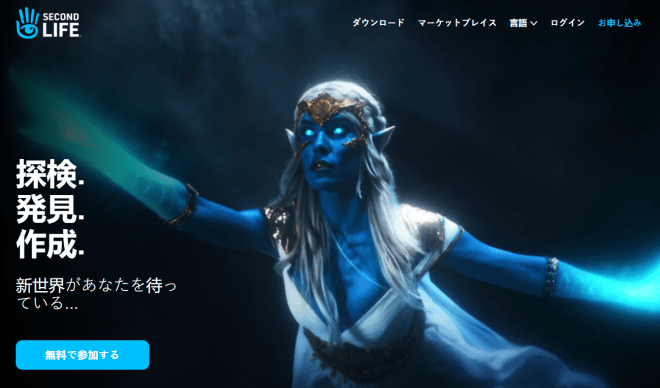
The new Second Life homepage in Japanese also features a magical girl!

Happy freebie shopping!

Savvy Promotion of Social VR and Virtual Worlds: Learning Valuable Marketing Lessons from Second Life

Meela Vanderbuilt’s YouTube page

I believe that Second Life, at the ripe old age of 18, is the perfect model of a mature, fully-evolved virtual world, which many newer entrants into the metaverse market would be very wise to study. And one of the things which those newer platforms would be smart to emulate, is the cultivation of a fervent and creative fanbase, who make and post content on all kinds of social media on the internet.

Second Life has a vibrant and thriving community of thousands and thousands of bloggers, vloggers, photographers, and machinima makers. Combine that with a flourishing ecosystem of programs and tools, such as the Black Dragon viewer, and you get a creative frenzy of activity which is, as yet, unmatched by any other social VR platform or virtual world (although VRChat comes close!). It’s essentially a self-sustaining marketing machine at this point, selling SL to a wide outside audience.

Second Life has even evolved its own particular brand of celebrity, such as those vloggers whose content attracts thousands of views on YouTube. You might call them virtual influencers! While I have been in (semi-) lockdown during the past year-and-a-half of the coronavirus pandemic, I have spent many an hour curled up on the sofa with my trusty iPad, watching some of these videos!

Some, like Cat Pink and Naria Panthar, tend to focus on Second Life shopping events and hunts. Others, like Meela Vanderbuilt and Carmen King, offer entertaining commentary as they go about their daily Second Lives. Here’s a recent example of a Carmen King video:

Now, Carmen King might not agree with your taste or sensibilities (I personally think she’s hilarious). But Carmen also vlogs regularly about her adventures in IMVU, the Sims 4, and games like Grand Theft Auto V, and I can tell you that this is exactly the sort of thing which intrigues her cross-over video audience, and tends to bring them into Second Life, to try it out for themselves. (I’m quite sure that any number of Sims players have ventured into SL because of Carmen’s videos.)

See the lesson here? If the newer social VR platforms were wise, they would create incentives (monetary or otherwise) to cultivate the users who create this sort of content. It’s the best and most natural form of advertising, that’s inspired by the fanbase of the platform, and driven by the enthusiasm of the creators themselves.

So my message. to all those companies which are toiling away, hoping to inherit the mantle of Second Life and become the next massive metaverse platform, is this: pay attention to your community, and encourage their creative pursuits! You might be pleasantly surprised at the spin-off benefits of cultivating and leveraging your fanbases. So go, get out there, and find your own Carmen King! 😉

UPDATED! Studying Supernova Explosions Using Collaborative Virtual Reality at Purdue University

Dr. Danny Milisavljevic has been using VR headsets to immerse his Purdue University students in the study of supernovas. (image source)

The only experience better than the act of discovery, is the experience of sharing that experience with someone.

— Danny Milisavljevic (source)

Danny Milisavljevic, a Purdue University astrophysics professor, is using an innovative, collaborative VR platform to help students explore models of star explosions in 3D. In a May 3rd, 2021 article published on the Edscoop website, titled Purdue students are using VR to explore the cosmos, remotely:

Over the last year, Milisavljevic — an astrophysicist at Purdue University who was formerly a postdoctoral fellow at Harvard University — has taught the study of exploding stars with the aid of virtual reality. Exploding stars leave trails of fragments and other clues around them, much like the debris patterns of explosives. But rather than looking at photos or through a telescope, students in his class can walk around a virtual classroom and examine 3D models of supernovas from every direction by strapping on a VR headset. Milisavljevic said his students act like an astronomy-focused “bomb squad,” reviewing how different stars exploded and citing their previous astronomical classifications.

The 3D models and the VR simulations were a perfect match, and Milisavljevic quickly realized there are two primary benefits of examining the models using virtual reality. One is the ability to study them with another researcher or student in the same room, who was also wearing a headset. The second is that a VR environment can host multiple models on the same program. Because students can walk back and forth between models, he said, it prompted more insightful questions and a more effective understanding of the complex detective work he was asking his students to perform.

According to a recent press release from Purdue about the project:

The first technology of its kind to allow connection by students in different locations — rather than on the same Wi-Fi network — the headsets are also based on lightweight, relatively inexpensive and commercially available hardware. The technology was used for the first time last month in his Intermediate Astronomy II class.

The virtual reality environment allows students to fly through and around astronomical objects including stars and supernovae, and manipulate them to observe how they have changed over time, something that is possible thanks to enormous quantities of rich 3D modeling information and analyses. The system emphasizes scientific fidelity, giving a clear and accurate depiction of datasets. 

A photo collage showing the students interacting with each other while exploring various 3D models of supernovae (a screen capture from the above YouTube video)

It took a significant amount of work to build this platform, according to the professor teaching the course, but it was judged to be worth the labour. Edscoop reports:

Danny Milisavljevic, an assistant professor of physics and astronomy at Purdue University, told EdScoop that creating content in virtual reality can take years, but that it’s often worth the effort.

“I see this as a vital, complimentary way to teach,” Milisavljevic said. “There’s just some topics that cannot be conveyed properly with the traditional lecture format, and this platform provides a way to be able to share those experiences.”

Milisavljevic used VR over the past year to teach his students about supernovas, working with Purdue’s Envision Center, a simulation and computer graphics-focused lab on campus, to create a platform to display his 3D models of exploded stars. It took two years, even with graduate students assisting, he said.

A shot of the avatars (shown wearing different coloured astronaut helmets and hands) standing in front of several supernova models (a screen capture from the above YouTube video)

As the Purdue press release notes, “Similar systems eventually could allow students to study other topics including looking at microscopic or cellular data, anatomy, geospatial terrains, historical locations or even complex animated machinery.”

UPDATE August 11th, 2021: I exchanged emails with Danny, and he told me a bit more about his platform:

Yes, I plan to continue using our Collaborative Astronomy VR platform in future classes. Presently we are developing a new version that can eventually scale up to ~100 users. One of the limitations of the current version is that we can only support approximately 10-12 users simultaneously before hitting performance issues.


We built our own infrastructure because existing VR infrastructures are either 1) too focused on social interaction for large audiences and lack options to appropriately visualize and explore scientific data in a scalable format, or 2) lack multiuser connectivity and instead focus on specialized individual experiences for use on high-end devices.

Thanks, Danny!

UPDATED! Sensorium Galaxy Update: The Now and the Not Yet

I have been monitoring the progress of the ambitious social VR platform Sensorium Galaxy ever since I first wrote about it on my blog in October of 2020. There have been a couple of very slickly-produced videos recently released by the company, teasing a forthcoming performance by superstar deejay David Guetta on the platform:

In a second video, David is shown being scanned in high resolution in order to create his avatar:

A recent tweet makes it sound like David Guetta’s performance in Sensorium Galaxy is imminent:

David Guetta – The #1 DJ in the World – is the next of ’The Chosen Ones’ to set off for Sensorium Galaxy’s PRISM World – the epicenter of entertainment in the digital metaverse. Don’t miss his upcoming epic shows. Register now to get early access.

Unfortunately, when you do register, all you are presented with is a downloadable technical demo, which requires a high-end gaming PC with either an Oculus Rift or HTC Vive tethered VR headset (alas, no Valve Index support yet):

The Sensorium Galaxy tech demo has some fairly steep hardware requirements

This is NOT a platform for the Oculus Quest crowd! While the social VR platform has not yet launched, the company is already selling full-body avatars in its online store for you to wear while attending future shows:

The company is also demoing its AI bots, including releasing a couple of “interview” videos, where they respond to a reporter’s questions:

I must confess that these chat bots, while certainly able to string together English sentences in response to questions, leave me a bit cold. Why you would want to engage in chitchat with an AI-enabled NPC, other than for novelty’s sake, to test it out for a few minutes? I’m not 100% convinced that a social VR platform really needs a feature like this, especially one where the obvious focus is on music performances.

With its provision of a ready-to-accept-your-cryptocurrency store before the actual product launch, its high-resolution scanning of celebrities, and its audacious, selling-the-sizzle-instead-of-the-steak promotion, Sensorium Galaxy reminds me of nothing so much as the ill-fated MATERIA ONE (formerly called Staramba Spaces; you can follow that sad saga here). MATERIA ONE, while embracing celebrity endorsers such as Paris Hilton and Hulk Hogan, foundered for any number of reasons: misplaced priorities, overweening ambition, and a limited target audience given its requirement for high-end PCVR.

Frankly, I’m not quite sure what to make of Sensorium Galaxy so far. I do know that, with my current hardware setup, that I cannot participate in it. The company is definitely trying to generate some serious buzz for the product, and I wish them every success in what is becoming a rather competitive marketplace for virtual events.

But as far as I can tell, and based on what I have seen and read so far, there’s a bit of a gap between the now and the not yet. I will continue to monitor Sensorium Galaxy as its develops!

UPDATE August 11th, 2021: I came across this April 2nd, 2021 press release which says:

Sensorium Corporation today announced the closed beta launch of Sensorium Galaxy — a social metaverse uniting people through high-quality virtual experiences. Selected users have gained access to the platform to explore worlds PRISM and MOTION.

The main goal of this closed beta test is to collect valuable insights to enhance the experiences at Sensorium Galaxy ahead of its public launch in Q2 2021.

“Sensorium Galaxy is revolutionizing how the arts are created, distributed, and enjoyed. From music festivals to dance shows, we’re creating the world’s first social metaverse where everyone can get together, experience high-quality virtual content, and find new opportunities for self-expression,” says Vladimir Kedrinsky, CEO at Sensorium Corporation.

“The SG beta test helps us streamline the in-platform user mechanics, and get actionable insights before the metaverse goes public in the upcoming months. Participants of this invite-only beta test are able to experience some of the sophisticated user-level mechanics that Sensorium Galaxy has to offer,” explains Ivan Nikitin, Head of Product at Sensorium Corporation.

So it sounds as though a lot of work is going on behind the scenes.