NOTE: Have you read part one of this two-part series? I review two other 2008 books about Second Life here, and talk about how well they’ve held up since publication:
PART ONE OF TWO: I Review Two 2008 Books About Second Life—What’s Changed in 18 Years? What’s Stayed the Same?

Boellstorff, T. (2008). Coming of age in Second Life : an anthropologist explores the virtually human. Princeton University Press.
As I mentioned in my previous blogpost, Tom Boellstorff, a cultural anthropologist at the University of California, Irvine, wrote this academic book in 2008, after conducting an anthropological study of Second Life and its residents. The time period of Tom’s anthropological fieldwork, which forms the basis of this book, ran from June 3rd, 2004 to January 20th, 2007 (p. 7), a period he refers to as the “coming of age” of Second Life as a virtual world, when it grew from 5,000 to ten million resident accounts (p. 83).
Boellstorff stated his goals for this academic monograph as follows (p. 24):
One goal of this book is substantive: to provide an ethnographic portrait of Second Life. Another is methodological: to demonstrate the potential of ethnography for studying virtual worlds. A third goal is theoretical: to contribute toward a better understanding of virtual worlds in all their constantly transforming complexity.
While I do seem to remember that I had, some time in the past, dipped my nose here and there into sections of Tom’s book, I had not really had an opportunity to read through the entire work until this week (thank you to my university for approving my research and study leave!). So here is my review of Tom’s book, along with some quotes which I quite liked.
This is a structured, nine-chapter academic work, which Tom recommends you read in order as he builds his arguments. The book includes a glossary, a notes section, an extensive bibliography, and a professionally-compiled index—all features which were greatly appreciated by this librarian!
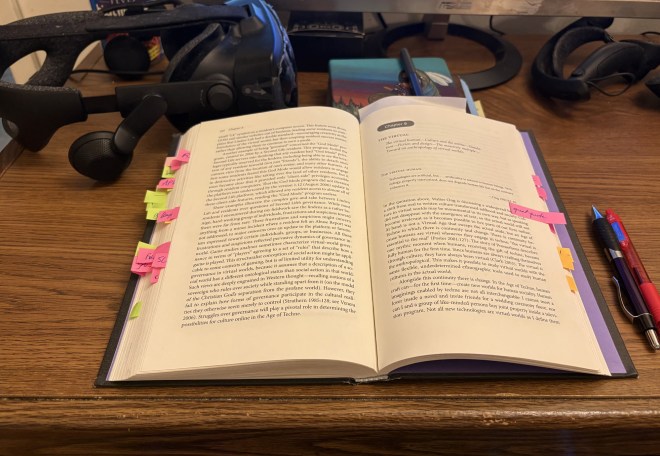
There’s so many great insights that I sticky-noted, but I’m going to start off with a quote from his final chapter, The Virtual (p. 217):
Culture in virtual worlds may be monumental in its own way, but as speaking did not disappear with the emergence of text, so the actual world will not become irrelevant as it becomes possible to live parts of our lives online. At hand is not a Virtual Age that sweeps the actual aside, but an Age of Techne in which there is continuity and change. There is continuity because humans are virtual whenever they engage in techne: “the virtual is essential to the real” (Poster 2001:127). The story of Prometheus describes one mythic moment when humans, receiving the gift of techne, became fully human for the first time. Since humans are always crafting themselves through culture, they have always been virtual (Clark 2003). The virtual is the anthropological [emphasis Boellstorff’s]. This makes it possible to study virtual worlds with the same flexible, underdetermined ethnographic tools used to study human cultures in the actual world.
The Age of Techne is a theme throughout this book, the term Boellstorff uses to describe the technology of the current information age is which we live (p. 21). Later, on p. 38, he states:
In this discussion and throughout this book, I might be seen to be trying to have it both ways; I claim that notions of the virtual and of techne are in one sense as old as humanity, and in another sense I claim that something very new is happening in virtual worlds. This is intentional. It is crucial to keep in mind the history shaping the present moment, while also identifying how that present moment is not reducible to its history. What makes virtual worlds different from all hitherto existing forms of virtuality is that techne can take place inside them [emphasis Boellstorff’s], rather than solely in the actual world to produce them: “where most tools produce effects on a wider world of which they are only a part, the computer contains its own [virtual] worlds in miniature” (Edwards 1990:109). Techne makes wood and ideas into a newspaper, but techne not only makes silicon and ideas into a virtual world; techne can take place within that created world itself. In virtual worlds, techne produces a gap between actual and virtual in the realm of the virtual [emphasis Boellstorff’s]. Swallowing their own ontological tails, virtual worlds for the first time allow techne to become recursive, providing humans with radically new ways to understand their lives as beings of culture as well as physical embodiment.
As you can see from these two excerpts, Boellstorff is writing for an academic audience, so it might be a tough slog for those of you who are more used to reading mass-market works written for the general public, but it’s well worth unpacking his ideas! Virtual worlds created by techne (i.e, the act of software programming), can in themselves become arenas for techne (i.e creating a house in Second Life)! Indeed,this has been one of the primary reasons for the initial and continued success of Second Life: its ability to be a blank, three-dimensional canvas for people to be creative, and build anything they can imagine.
On page 25, Tom writes:
Drawing upon the work of a range of scholars of technology and society, I will develop a theory of this virtual worldview as techne, and of the person who engages in techne not just as homo faber (“man the maker”) or homo ludens (“man the player”), but above all as homo cyber. The human online, the virtual human. In using the term “techne,” I will draw upon a philosophical distinction between knowledge (episteme) and technology or art (techne), examining how virtual selfhood is becoming predicated on the idea that people can craft their lifeworlds through intentional creativity.
On page 29, he makes a clear distinction is his defnition of homo cyber, arguing that virtual worlds make us more human rather than post-human:
While some see virtual worlds as marking the emergence of the posthuman, through terms like homo cyber I argue that the forms of selfhood and sociality characterizing virtual worlds are profoundly human. But while the emergence of virtual worlds “does not necessarily mean the end of the human . . . we need to see the human as re-configured and organized differently” (Nayar 2004:21). This is one meaning of the phrase “virtually human”—in virtual worlds, we are not quite human. The relationship between the virtual and the human is not a “post” relationship where one term displaces another; it is a relationship of coconstitution. Far from it being the case that virtual worlds herald the emergence of the posthuman, in this book I argue that it is in being virtual that we are human [emphasis Boellstorff’s].
Another theme that runs throughout the book is that of creationist capitalism, described by Boellstorff as “a mode of capitalism in which labour is understood in terms of creativity, so that production is understood as creation.” (p. 206). He goes on to write (pp. 207-208):
Creationist capitalism draws structuring principles from the individualistic ethos of contemporary capitalism—specifically its Silicon Valley variant, which can be termed the “Californian Ideology” (Barbrook and Cameron 2001; see also Turner 2006). Given that Linden Lab was based in California 20 Chapter and its CEO, Philip Rosedale, grew up in San Diego, it is not surprising that Second Life was particularly shaped by assumptions of this ideology, which “has emerged from a bizarre fusion of the cultural bohemianism of San Francisco with the high-tech industries of Silicon Valley. . . . [T]he Californian ideology promiscuously combines the free-wheeling spirit of the hippies and the entrepreneurial zeal of the yuppies. This amalgamation of opposites has been achieved through a profound faith in the emancipatory potential of the new information technologies” (Barbrook and Cameron 2001:364).
This ideology, by no means limited to California, is an economic model of “prosumption” where capitalist subjects produce what they consume, turning consumption into a form of production (Toffler 1980).
And again, another reason for Second Life’s longevity (and profitability!) is its ability to allow residents (who are themselves consumers) to create and sell goods and services to other residents. For example, an SL user can purchase textures from an in-world store, apply them to furniture she creates, and then vend that chair or table to another user. Linden Lab’s November 2003 decision to give creators the intellectual property rights to their creations (p. 214) was a key decision to enable the explosion of creationist capitalism across the grid. (I particularly loved Tom’s phrasing of “the free-wheeling spirit of the hippies and the entrepreneurial zeal of the yuppies;” to me, it perfectly encapsulates Second Life’s ethos!)
Now, I am going to jump around a bit within the book, talking about other sections I enjoyed. For example, on page 102 I was amused when Tom compared SL residents complaining about lag being equivalent to real-life people complaining about the weather. Accurate! In a further discussion of the concept of lag, I came across the following, highly interesting fact (p. 103):
In the context of Second Life, lag originated in the truly immense amount of information represented by its land, the objects on that land, and the avatars inhabiting that land. By early 2007 there was by one estimate about one petabyte (a million gigabytes) of data in Second Life. At that point, were all of the books in the Library of Congress digitized (about 30 million volumes), it would have been equivalent to only about 2 percent of the data stored inside Second Life.
I would dearly love to see this assertion updated with current statistics for both Second Life and the Library of Congress, to see how it has changed over time! Alas, I do not have the time to do this research myself (I have my hands full as it is!).
There’s also a lengthy discussion of the AFK (Away From Keyboard) phenomenon in Second Life and its various meanings (pp. 106-112), ending with the following section:
Residents sometimes explicitly scheduled mundane actual-world activities like laundry to coincide with events in Second Life, so that they could run back and forth to the washing machine: as one resident emphasized, “AFK works so well because people do not know what we are doing [in the actual world].” Residents sometimes said they wished they could “go AFK” in the actual world to escape uncomfortable situations, but knew this was not possible: “no one ever says ‘AFK’ in real life.” Such conscious uses of AFK reflect the consequentiality and durability of the virtual/actual binarism: the boundary between virtual and actual is constituted and reinforced by movements between them. Like lag, AFK reveals how virtual worlds are places in their own right, temporally linked to the actual world but constantly at risk of falling out of synch. Indeed what I term the “AFK test” provides one of the clearest means for identifying virtual worlds: if you can go “AFK” from something, that something is a virtual world. [Emphasis mine].
I also appreciated Tom’s discussion of the use of the word avatar to describe Second Life users, as well as his discussion of alts (alternate avatars) on pp. 128-134. Here’s a sample quote from page 128:
Throughout this book I have been referring to the virtual embodiments of persons as avatars, a term used in many online worlds. This Sanskrit word originally referred to the incarnation of a Hindu god (particularly Vishnu). With reference to cybersociality, the term was probably first used in the virtual worlds Habitat and Ultima IV in the mid-1980s, as well as in Neal Stephenson’s 1993 science fiction novel Snow Crash (Morningstar and Farmer 1991; Stephenson 1993:470).7 While “avatar” (“avie” or “av” for short) historically referred to incarnation—a movement from virtual to actual—with respect to online worlds it connotes the opposite movement from actual to virtual, a decarnation or invirtualization.
Among other topics, Boellstorff discusses the popularity of Second Life among various communities, such as the furries, queer people, and those with autistim and/or ADHD. I’m not going to quote the sections, because this blogpost is already reaching War and Peace length; I would advise you to obtain your own copy of Tom Boellstorff’s book, and read it yourself!
Even as a almost-nineteen year resident of Second Life (in one avatar or another), I gained some excellent insights from reading this book, and I can recommend it highly. It provides a valuable snapshot of a crucial time period in SL’s history, and Tom Boellstorff’s commentary on Second Life, and its cultures and idiosyncrasies, has stood up very well in the 18 years since this academic monograph was published.
P.S. To my surprise and delight, Tom Boellstorff was kind enough to comment on my first blog post of this two-part series, offering to meet up in Second Life and answer any questions I had. So you might soon see a follow-up blogpost, with a Q&A session with the author himself! It’s great to hear Tom is still active in Second Life.
P.P.S. I also did write up a blogpost about another of Boellstorff’s research projects here, as well as another blogpost about moving his Digital Cultures course into Second Life during the pandemic.