UPDATED JAN. 20th, 2026 WITH EXTRA COMMENTARY: Metaverse Bombshell: NETFLIX Acquires Ready Player Me—What Does This Mean for Metaverse Platforms Using Ready Player Me Avatars?

I somehow missed a major piece of news that dropped last Friday, which will definitely impact a lot of existing metaverse platforms (including big names like VRChat). On Dec. 19th, 2025, Sarah Perez wrote, in an article on the tech news website TechCrunch:

After shifting its gaming strategy to focus more on games played on the TV, Netflix announced it’s acquiring Ready Player Me, an avatar-creation platform based in Estonia. The streamer said Friday it plans to use the startup’s development tools and infrastructure to build avatars that will allow Netflix subscribers to carry their personas and fandom across different games.

Terms of the deal were not disclosed. Ready Player Me had raised $72 million in venture backing from investors, including a16z, Endeavor, Konvoy Ventures, Plural, and various angels, including the co-founders of companies like Roblox, Twitch, and King Games.

Netflix told TechCrunch the startup’s team of around 20 people will be joining the company. Of the four founders Rainer Selvet, Haver Järveoja, Kaspar Tiri, and Timmu Tõke, only CTO Rainer Selvet is moving to Netflix. It doesn’t have an estimate of how long it will be until avatars launch. Nor does it detail which games or types of games will be first to get avatars.

Following the acquisition, Ready Player Me will be winding down its services on January 31, 2026, including its online avatar creation tool, PlayerZero.

Scott Hayden, in an article written for The Road to VR website, adds:

“Our vision has always been to enable avatars and identities to travel across many games and virtual worlds,” Ready Player Me CEO Timmu Tõke said. “We’ve been on an independent path to make that vision a reality for a long time. I’m now very excited for the Ready Player Me team to join Netflix to scale our tech and expertise to a global audience and contribute to the exciting vision Netflix has for gaming.”

Avatar creation using Ready Player Me in the metaverse platform Spatial

Additionally, Ready Player Me announced its taking avatar creation services offline starting January 31st, 2026.

And, indeed, when I head over to the Ready Player Me website, the banner across the top of my screen declares:

Thank you for the chance to build together with you. Our services will become unavailable starting January 31, 2026. Please reach out to devs@readyplayer.me for any questions.

I pity the poor person on the receiving end of all those emails, because there are countless metaverse platforms which have relied on Ready Player Me as their avatar creation component, rather than try to build their own avatar design system in-house. All of these platforms now have a little over a month to come up with a replacement for the services provided up until now by Ready Player Me, which is shutting down on January 31st, 2026!

Ready Player Me’s avatar creation tools, which have been used by many virtual worlds and social VR platforms, will be shutting down on January 30th, 2026.
Among the tools affected by the NETFLIX acquisition of Ready Player Me are the Avatar Creator SDK, and the newer PlayerZero SDK, which allowed for users to create and sell avatar modifications and updates.

Ready Player Me has been the go-to solution for both gaming and metaverse companies for outsourcing much of its avatar creation process. Among those companies is VRChat. Scott Hayden opines:

Netflix hasn’t intimated it’s getting into XR gaming yet, so it’s pretty safe to say the Ready Player Me acquisition and subsequent shutdown is more or less a blow to one specific group of people: namely, VRChat users.

VRChat beginners looking to make their own avatars over the years were almost always pointed to Ready Player Me, with the platform even allowing users to upload a personal photo and generate a cartoony persona that was easy to mix-and-match with a variety of parts.

And while they weren’t always the most original avatars out there, it’s difficult to argue with the platform’s ease of use, as the web-based tool basically got you a (mostly) unique avatar that was not only cross-platform, but also already rigged for VRChat.

I’m not too worried on the impact to VRChat; as Scott goes on to write in his article, there are alternatives, albeit ones requiring a bit more technical know-how on the part of the user. VRChat also has a thriving third-party avatar creation and sale ecosystem, including a very popular series of Virtual Market avatar shopping events). VRChat will be fine. But it’s the smaller metaverse platforms like Spatial.io, which wholly rely on Ready Player Me’s services, that are now going to have to scramble to find and implement a replacement in very little time.

NETFLIX’s acquisition of Ready Player Me reminds me, at first glance, of when the fledgling metaverse platform Cloud Party (which I have written about on my blog before) was acquired by Yahoo! back in early 2014, over a decade ago. The entire small company (only 3-4 people) was “acquihired” by Yahoo!, and they shut down the Cloud party platform (with a truly memorable sendoff, as they shut down the servers, that made me emotional; this link is from a former Blogger.com blog I used to write about Cloud Party, which is still up!). The staff were absorbed into Yahoo! to work on Yahoo! projects, and God only knows what happened to them, or the projects they were hired to work on. (And, of course, Yahoo! is a shadow of its former self; does anybody still use it?)

It is very clear from this news that NETFLIX has big plans for its gaming service, and they “acquihired” the staff (and assets) of Ready Player Me, in order to use them for some future project. Their gain (for whatever project they are working on) is the loss of the hundreds of virtual worlds, games, and social VR/AR platforms which relied on Ready Player Me.

The fallout from all this is going to be fascinating to watch.

UPDATE Dec. 23rd, 2025: Another thing that came to mind after I posted this blogpost is this: metaverse-building companies who choose to outsource aspects of their services to other companies like Ready Player Me, have to be prepared for the possibility that that other company could be bought out, change the terms of their service, or even shut down. While it might be more time and money consuming to build something like an avatar system in-house, at least it’s under your control, and you don’t run the risk of having the rug pulled from under you.


Thank you to my metaverse friend Carlos Austin for the heads-up on this news.

UPDATE Jan. 20th, 2026: Today I came across an article on LinkedIn by Terry Proto for the group with the lengthy title, Reality Innovators Network for Spatial Computing, Metaverse, AI & XR – Virtual, Augmented Reality (whew, that’s a mouthful!):

8,000 developers. 6 weeks. One lesson. Netflix bought Ready Player Me, and January 31st is the deadline to replace avatar infrastructure for a lot of companies.

This isn’t the first time we’ve seen this. Altspace. 8th Wall. The pattern repeats.

The lesson? Interoperable ≠ open.

RPM worked everywhere. But it was still owned by one company. One acquisition later, and thousands of production systems are scrambling.

That’s the difference between building on convenience vs. building on ownership.

I just wrote a new article on why the spatial internet can’t be built on rented land. Have a look here: https://lnkd.in/etu3xpiF

(Note: I don’t know if you actually have to have a LinkedIn account to read this article.)

In the linked article from the above quote, Terry goes to give a very good summary of why relying on a third-party solution (even one that is interoperable), is still not as good as having open standards.

He writes:

Netflix acquired Ready Player Me on Dec 19 and 8,000 developers have until January 31st to rip out and replace their avatar infrastructure.

That’s six weeks.

Six weeks to rebuild identity systems that many teams integrated as foundational layers, not optional features. For some developers, RPM wasn’t just powering avatars. It was powering user accounts, social presence, cross-platform persistence, and the entire notion that their users could carry an identity across virtual worlds.

As Jose Antonio Tejedor Garcia of Virtway put it: “Trust built over years is breaking in weeks.”

As I write this, that six-week window has narrowed to (checks calendar) just twelve days. And, as Terry has stated, many of the 6,000 developers who used Ready Player Me, used it for a lot more than just avatar appearance. He goes on to add what I was trying to get at in my original blogpost, but does it much more concisely:

ack in June 2023, I wrote about “life after Altspace”, exploring which platforms could fill the void when Microsoft shut down one of the oldest social VR spaces. Altspace launched in 2015, got acquired by Microsoft in 2017 and closed in March 2023. The community scrambled to find new homes.

Sound familiar?

But back then, I was asking the wrong question. Finding alternative platforms doesn’t solve the underlying problem. It just kicks the can down the road until the next acquisition, the next pivot, the next “strategic realignment.”

The real question is: why do we keep building critical infrastructure on top of proprietary platforms?

I am not going to quote it all, but I do strongly recommend you read the entire article here (even if I very strongly disagree with any potential solution which requires blockchain, cryptocurrencies or NFTs, all of which by now are tainted beyond redemption by numerous scandals, scams, and rugpulls). And I will watch with keen interest as the deadline of January 31st, 2026 comes and goes.

A Report from the IMMERSIVE X Conference, Nov. 12th and 13th, 2025

Because of my workload, I was only able to attend one session of the IMMERSIVE X metaverse conference on Wednesday, November 12th:

  • Conversational AI in Healthcare (held in Foretell Reality, which was a new-to-me platform).

However, I more than made up for it on Thursday, November 13th, attending the following five conference sessions:

  • Private, Present & Fully Heard: How Virtual Reality is Reclaiming the Power of Anonymous Peer Support (held in Foretell Reality)
  • Healing Beyond Walls: VR Social Support For Patients At SickKids (held in Foretell Reality)
  • Immersive Learning Beyond the Classroom (held in ENGAGE)
  • AI, WebXR and the Future of the Immersive Web (held in Hubs)
  • Will AR Be The Big Immersive Breakthrough? (held in VRChat)

So I will briefly report on each of these six sessions, one by one.

I accessed the three sessions held in Foretell Reality using the Meta Quest 3 wireless headset at my workplace, and I entered the sessions in ENGAGE and VRChat using my PCVR setup at work, a Vive Pro 2 VR headset tethered to a Windows desktop PC with a fairly decent NVidia gaphics card.

The final session, held in Hubs (formerly Mozilla Hubs), I could have entered via virtual reality, but instead I opted to pay a visit via the flatscreen monitor on my trusty MacBook Pro! By the end of the day, my neck and shoulders were aching, but I did make it through.

Conversational AI in Healthcare

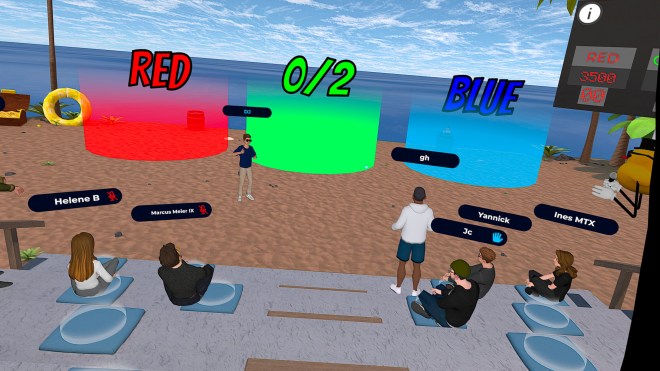
This was not the first time that I had seen artificial intelligence combined with social VR (the first time was a memorable conversation I had with an AI-enhanced toaster in the now-shuttered platform called Tivoli Cloud VR, back in January of 2021), this one had a more practical purpose: to use generative AI to power a diabetes counselor (played by an NPC avatar) who could hold a conversation with a real-life person who has questions after being newly-diagnosed with type II diabetes.

An initial discussion held in an open-air auditorium was followed by a group teleport to a lecture theatre where the embodied AI chatbot (a woman dressed in light blue, centre) held a conversation with a demonstrator (the woman named Ines MTX):

When I asked what generative AI system was being used to drive this demo, I was informed that Foretell Reality actually can use any of Google’s Gemini, OpenAI’s ChatGPT, or Anthropic’s Claude AI to generate responses. As somebody who was actually diagnosed with Type II diabetes during the recent pandemic, and who never had an opportunity to meet with a real-life diabetic coach, I would really have appreciated having something like this available!

Unfortunately, the conference session description was frustratingly short on concrete details: who the speakers were, what company (or companies) they represented (other than Foretell Reality), and who the actual client was. It was also not clear to me if this just a tech demo or an actual system used by real people. And, because I was in my Meta Quest 3 headset, I could not take any written notes as people were speaking. There was a company called MTX involved, as far as I can remember. This is an example of where an inadequate session description hampers my ability to report on the event itself, as impressive as the technology demo was.

Private, Present & Fully Heard: How Virtual Reality is Reclaiming the Power of Anonymous Peer Support

We started off in this open-air amphitheatre at dusk (I think they said it was based on Red Rocks in Colorado)

Unlike the previous day’s session, both sessions I attended in Foretell Reality were sterling examples of how social VR could be used as an effective solution to address real-world problems and issues, and provide tangible benefits.

First up, here’s the conference blurb about the NorthStar project:

In traditional Alcohol & Substance Use Disorder treatment spaces, anonymity is often promised but rarely provided. NorthStar’s groundbreaking VR platform redefines what true
anonymity can look like—and how it unlocks unparalleled honesty, vulnerability, and connection. This session explores how immersive, avatar-based peer support transforms treatment outcomes by allowing patients to show up fully without being seen, while feeling surrounded by a community. We’ll discuss how VR group therapy makes treatment more accessible, more private, and more powerful—meeting people where they are – literally – while protecting who they are.

Unfortunately, the representative from NorthStar was unable to be present at this session, but DJ from Foretell Reality still had plenty to show us, taking us on a sort of field trip through the various settings built by the company to facilitate NorthSatr’s virtual group meetings (based on Alcoholics Anonymous principles), such as an urban park where you could toss a stick and have one of several virtual dogs fetch it back to you:

Foretell Reality’s dog park, where virtual AA meetings are sometimes held

Other locations included a chilly space station, where you could see your breath in front of you in the frosty air, and gravity could be turned off and on at will:

Foretell Reality’s space station

And finally, a newer addition, a competitive shooting game where you were part of team trying to shoot down rubber ducks of various colours! (I’m not sure if this last one was actually used by NorthStar clients, though).

Duck hunting in Foretell Reality

Overall, and especially when combined with the following conference session I describe below, I came away with a very favourable impression of Foretell Reality. You can check out their website here.

Healing Beyond Walls: VR Social Support For Patients At SickKids

Shaindy the avatar presents a video of the real-life Shaindy, explaining the SickKids project

Another Foretell Reality client is Toronto, Ontario’s famous SickKids Hospital,where the conference blurb states:

Join us for a special fireside chat with Shaindy, Clinical Manager [of the] Child Life Program at SickKids Hospital in Canada and DJ Smith, Co-Founder and Chief Creative Officer of Foretell Reality. Together, they will share how virtual reality is transforming the way children facing serious illnesses connect, play, and support one another. Shaindy will discuss her groundbreaking program that allows kids to log in once a week to a virtual world for group sessions. DJ will highlight how Foretell Reality’s platform has powered successful clinical pilots and is now scaling to reach even more children. This conversation will explore the impact on patients and families, the power of hospital collaboration, and the future of immersive technology in pediatric care.  

By “kids,” Shaindy explained that these were actually teenagers (aged 13 to 19) who were in hospital or a hospice, fighting various health-threatening conditions such as cancer. Because of their illnesses, these teenagers often found it difficult to socialize, which is where social VR afforded them an opportunity to interact and have fun virtually. Shaindy explained that they would get groups of six or so patients together, and they would keep it open and freeform so the “kids” could join or leave as they felt able to do so.

Among the many stories told were the delight by one patient who discovered a rubber ducky hiding in one of the virtual environment, which led to a quest to hide ducks (and pigs!) in as many environments as possible, for others to find. DJ helpfully rezzed one such duck for show-and-tell (also a pig, but I didn’t take a picture of that!). I apologize for the lopsided aspect of some of these screenshots; determining the right balance of your head in a VR headset when taking screenshots is a bit of a black art, at which I usually fail miserably!!

Behold, a rubber duck! (Apologies for the awkward angle of this shot.)

The presentation ended with a group teleport to a meditation centre, where Saindy led us through a box breathing exercise, helped along by the in-world painting tools installed by Foretell Reality!

We ended with a box breathing exercise in a meditation temple, assisted by a little art therapy. (Again, apologies for the sideways tilt!)

This was one of the most heartwarming conference sessions I have ever attended, and I wish this project every success as they hope to expand this service to more hospitals in future!

Immersive Learning Beyond the Classroom

This session had a capacity crowd of avatars present, and was held in ENGAGE (in fact, there were so many avatars that my experience began to degrade to the point where I eventually had to bail out of my Vive Pro 2 VR headset or risk nausea!). Because of that, I missed about the final third of the talk. Here’s the blurb:

How can immersive environments transform teaching, learning, and cross-cultural connection? This panel brings together diverse perspectives from the fields of education and innovation.
Chris Madsen empowers organizations worldwide through the ENGAGE XR platform. Wolf Arne Storm and his team at the Goethe-Institut created GoetheVRsum, which explores new formats in culture, language, and creativity. Marlene May researches and teaches in 3D virtual spaces at Karlshochschule International University and Birgit Giering is pioneering the large-scale adoption of XR in schools of North Rhine-Westphalia. Moderated by Prof. Dr. Dr. Björn Bohnenkamp, this session will explore the future of learning beyond traditional classrooms.

However, this time I was able to take some chicken scratch handwritten notes! So here goes…Wolf-Arne spoke about the Goethe Institut, Marlene spoke about the Karlshochschule International University (in fact, the space where we met in ENGAGE was one of their creations), and Birgit spoke her work in the schools of North Rhine-Westphalia.

The Goethe Institut is Germany’s premier cultural institute, with locations around the world teaching German language and culture. The organization chose ENGAGE as their metaverse platform, creating a virtual space called the Goethevrsum. The Goethevrsum uses the works of various Bauhaus artists as inspiration for its design.

It was a shame that technical glitches kinda marred the overall experience for me, but I am glad that I was able to be able to make it in, and make it through most of it!

AI, WebXR and the Future of the Immersive Web

This session was held in (formerly Mozilla) Hubs, and much like all Hubs experiences I have ever had, it tended towards the spontaneous, the off-the-cuff and the chaotic! Like the ENGAGE session, it was unfortunately plagued by technical issues and problems. The presenter, Adam Filandr, talked about how he used open-source WebXR code and generative AI tools to create something called NeoFables, which delivered personalized worlds, characters, and storytelling (currently limited to 2D images, although he hopes to be able to expand it over time to create 3D content).

Screenshot

He discussed the advantages and disadvantages of using WebXR to create VR content, and gave a couple of examples of bigger-name projects which were based on WebXR (Wol, made by Google to provide information about the U.S. national parks system, and Raw Emotion Unites Us, about Paralympian athletes). It was interesting to hear a developer’s perspective of using WebXR to create content, mixed in with generative AI tools, however.

Will AR Be The Big Immersive Breakthrough (Heather Dunaway Smith and Lien Tran)

My final session on Thursday, Nov. 13th was not what I expected. It was a panel discussion with two musicians and artists, Lien and Heather, who have worked extensively with augmented reality and mixed reality. They shared samples of their work, and the panel (moderated by Christopher Morrison) held a wide-ranging discussion on how AR/MR/XR (or, as Chris said it, “XR-poly”) is impacting and transforming creative expression. I’m not sure if there will be a livestream of this talk (I did not see Carlos and his video camera while I was there), so I will leave it at that, since (again), I did not take written notes.

UPDATED! A Report from the IMMERSIVE X Conference, Nov. 11th, 2025

If anything, I urge everyone in our industry to build our digital spaces the way we design cities: with flow, gathering spots, heart and soul. Places that invite people to linger, not just scroll. It’s not just about what people see—it’s about where they feel seen.

—Andy Fidel, State of the Metaverse in 2026 keynote presentation, IMMERSIVE X Conference, November 11th, 2025 (in ENGAGE).

Julian Reyes delivering his talk titled Preserving the Legacy of Digital Culture: The Virtual Worlds Museum Living Archive, which took place yesterday evening my time in a virtual world in Spatial (I’m the blonde in the green T-shirt, sitting in the front row, near the centre bottom of this screen capture).

Yesterday, November 11th, 2025, I had the opportunity to attend three sessions of the IMMERSIVE X conference, held on three different platforms:

  • IMMERSIVE X 2025 Warm-Up: Curator’s Remarks (held in VRChat)
  • Andy Fidel’s keynote, The State of the Metaverse in 2026 (held in ENGAGE)
  • Julian Reyes’ presentation, Preserving the Legacy of Digital Culture: The Virtual Worlds Museum™ Living Archive (held in Spatial)

Warm-Up: Curator’s Remarks (Thomas Zorbach)

Set in a custom-built theatre surrounded by lush rainforest. Thomas Zorbach set the tone and agenda for the conference sessions to follow over the hree days of the conference. My friend Carlos Austin was the videographer for the event (as he no doubt will be for many of the conference sessions!), and he produced the following video of Thomas’ speech, which was posted to the IMMERSIVE X YouTube streams channel (I also took some photos using VRChat’s built-in camera, but I first have to figure out how to transfer them from VRChat to my blog!).

UPDATE Nov. 13th, 2025: I was finally able to add some photos I shot while in VRChat to this section of my blog post (please see the pictures above).

The State of the Metaverse in 2026 (Andy Fidel)

Andy’s keynote was prefaced by a half-hour red carpet awards session where various people were introduced, and several awards were given out (I arrived late for this part, but here’s the 35-minute video from IMMERSIVE X’s YouTube channel). Here’s the blurb from the conference program:

What an entrance! Dress your avatar to impress and flash your most dazzling smile for the photo. Once again, the path to the Opening Keynote leads across the legendary red carpet of the Polys Theater, home of the annual Polys Awards. Thanks to Ben Erwin and his incredible Polys team, this festive event marks the official start of IMMERSIVE X 2025. Don’t miss this prestigious social event in the Metaverse — you might just be in for a surprise or two.

After the red carpet, we all moved over to the main stage where Andy Fidel, the founder and creative lead at Spatial Networks, shared her insights on where the metaverse stands today and where it might be heading.

Andy Fidel on the virtual stage, giving her keynote address in ENGAGE (it was giving TED Talk!)
I took a selfie of my avatar in ENGAGE at the red carpet event prior to Andy’s keynote!

Because I attended the event in my Vive Pro 2 VR headset, I did not take written notes of her talk, but it was excellent! Also, Andy has asked that her talk not be streamed to YouTube, a decision which I can totally understand and respect. However, Andy was happy to share her speech notes with me, so I did not have to rely on my notoriously faulty 61-year-old memory to share a few quotes which especially resonated with me!

Andy started her presentation off with a sigh, stating:

I’m tired of the [metaverse] hype cycle. I don’t know what we’re all waiting for. Because I’ve seen us create real, human digital experiences—moments of presence—every day for the past ten years. This isn’t a sci-fi episode. The metaverse is already here. It’s in your browser tab. It’s not just a concept, a game, or a place. It’s how we’re choosing to show up online.

And my favourite [metaverse] misconception? We’re not escaping reality—we’re extending it.

There were more of Andy’s quotes which I really appreciated. In talking about the shift away from massive metaverse platforms to micro-communities, she said:

We’ve got to find new ways of measuring success when we talk about connection. Every social metric measures visibility, impressions, clicks, followers…that’s activity, not authenticity. And I don’t know about you—but I’m done chasing mass engagement and empty distribution. Because connection isn’t content. It’s presence.

And she talked about how, perhaps, we are a little too narrowly focused on what the “metaverse” is:

Let’s be honest—the metaverse didn’t start with VR. We’ve been building shared digital worlds for decades: Second Life, World of Warcraft, Minecraft…The only difference now? The new emerging tech finally lets us feel presence. VR, AR, digital—these are just new layers on something deeply human. “Metaverse” is just a new name for something we’ve always done: to gather. And to gather, we need space to do so. What’s different now? We have the technology to do it remotely, and feel like we’re right there. With embodiment, body language, haptics, even phantom touch—we’re tapping into all the little things that make our digital space feel more immersive and real.

And:

Virtual presence has become its own form of togetherness. We show up not just in person, but in-world. Because let’s be honest—why show up at all? Because you can feel it.

The metaverse isn’t here to replace the real world. It’s here to layer it with new forms of meaning. It’s not just a playground, [and] not just a marketplace. It’s a new layer of human communication.

And look—if you say, “the metaverse isn’t for me,” that a bit like saying “the internet isn’t for me” in the 1990s. You don’t have to love every corner of it. You just have to find the part that resonates. Because this isn’t about tech for tech’s sake. It’s about connecting—more intimately, across space, time and medium.

UPDATE Nov. 13th, 2025: I was finally able to add some photos I shot while in ENGAGE to this section of my blog post (please see above).

I want to thank Thomas Zorbach for shoehorning me into this avatar-packed session, after I personally begged him to let me in, even though the event was fully booked and no longer accepting signups. I did not want to miss Andy’s speech, and I was not disappointed!

Preserving the Legacy of Digital Culture: The Virtual Worlds Museum™ Living Archive (Julian Reyes)

I was not sure if I was going to be able to attend this session (I was having all kinds of trouble getting Spatial to work for me, and I eventually threw my hands up, gave up on attending in virtual reality, and instead visited via my flatscreen monitor on my Windows home computer instead). However, I am so, so glad that I did! A video stream of the 45-minute presentation has already been posted to the IMMERSIVE X YouTube channel, but I will also add some of my own remarks (since I was on desktop, I took written notes).

This blogpost will be updated as I add pictures and more of my impressions, so check back later today for those updates! I enjoyed all three sessions, and I am very much looking forward to the sessions I will be attending today and tomorrow!


With the deepest thanks to Andy Fidel for sharing her speaking notes with me. Thanks, Andy!

The IMMERSIVE X Metaverse Conference, November 11-13, 2025

I’m laid up with severe neck and shoulder pain, off sick from work today again, lying on the sofa and blogging via iPad, my neck propped up on a good pillow. In addition to visits to my family doctor and my physiotherapist (who also does acupuncture), I’ve started seeing a massage therapist. I had a one-hour massage session Friday morning, and felt wonderful afterward—only to have rebound neck and shoulder aches and pains which scuppered my Friday night plans and put me in a foul, cranky mood all weekend.

This is all coming at a time when I need to be well enough to attend a metaverse conference coming up this week! It’s the IMMERSIVE X Conference, organized and run from Berlin, Germany, but with events taking place in various social VR platforms and flatscreen virtual worlds. Instead of getting on a plane to go to a physical conference in meatspace, I just put on a VR headset and attend in cyberspace!

However, my physical pain today does not bode well for my metaverse excursions on Tuesday (Remembrance Day here in Canada, if not in Germany), Wednesday, and Thursday. Wish me well! I’m probably going to have to take breaks between sessions to pop painkillers, apply cold and heat packs, and do my prescribed physiotherapy exercises to get through this. But come hell or high water, I am going!!

I started preparing for the conference last week, revisiting some social VR platforms that I had not visited in many months, and making sure that I could still remember how to log in and move around in my Vive Pro 2 PCVR setup in my office (sadly neglected since I began my well-documented love affair with my Apple Vision Pro).

I must admit that I was surprised when I signed into my VRChat account on their website, to discover that I first joined VRChat 8 years ago! (You can find all my blogposts about VRChat here.)

And likewise, I had first joined ENGAGE in July of 2018, which means I have been using the metaverse platform for over seven years at this point! (You can find all my blogposts about ENGAGE here.) I am especially excited that the organizers were able to squeeze me into Andy Fidel’s keynote State of the Metaverse presentation in ENGAGE (a big thank you Thomas Zorbach and his team!).

In addition to VRChat and ENGAGE, I signed up for sessions being held on three other metaverse platforms: Spatial, Foretell Reality, and Hubs. I’ve been in Spatial and (formerly Mozilla) Hubs before, but Foretell Reality is new to me.

So I hope to be able to post my session notes to the blog, starting tomorrow. And, in the meantime, I will rest, take painkillers, do my physiotherapy exercises, and pray my body holds up. Stay tuned!