UPDATED! Comparing Clubhouse with Twitter Spaces: A Chart Comparing the Features of the Two Leading Drop-In Audio Chat Social Apps for Mobile Devices

Clubhouse (photo by Erin Kwon on Unsplash)
Twitter Spaces (source)

I don’t know what lucky star I was born under, but as of very early this morning, Thursday, March 4th, 2021, I am now part of not one but two beta tests of competing drop-in audio chat apps: Clubhouse (which I have been on for a little over a week), and the newer Twitter Spaces, which I was invited to join today, after participating in my first-ever Twitter Spaces group chat that lasted into the wee hours of this morning!

This morning, I tried out my new abilities, setting up Twitter Spaces chatrooms to talk with various people one-on-one, like Michael Zhang, Kent Bye, Will Burns and Andy Fidel. With those chats, and last night’s group chat, under my belt, I now feel confident enough to compile a comparison chart between the two platforms.

Please note that the situation is evolving rapidly (for example, the press have reported that Twitter Spaces works for Android, but in trying to connect with an Android user, she reported that she received a message that it’s not available yet for Android). So this chart will age rapidly, and I will NOT be keeping it up to date; consider it just a current snapshot of the race between the two social audio companies! (And yes, you can bet your bottom dollar that Facebook is feverishly working on a competing drop-in audio chat app to dominate the nascent marketplace*.)

(I apologize for the somewhat messy dimensions of this table; I was unable to find an easy way to make the columns all the same size! I need to brush up on my HTML/CSS.)

Features/DetailsCLUBHOUSETWITTER SPACES
CompanyAlpha Exploration Company, founded in April 2020 by Rohan Seth and Paul Davison, funded by venture capitalist Andreessen HorowitzTwitter, founded by by Jack Dorsey, Noah Glass, Biz Stone, and Evan Williams in March 2006
Current Number of Users10 million users (and growing quickly!)Unknown number of users since its private beta launch in late December 2020, mostly iOS (Twitter itself has 330 million users)
Supported Mobile DevicesiOS onlyiOS only; the press has already reported that Android support has just launched, but I have had a least one report of an Android user who could not get in, and one report of someone who could, so…
Current Growth ModelInvite only (You have to have someone text you an invitation)Invite only (Twitter seems to be selecting the longest-standing accounts first)
Number of Rooms You Can CreateAs many as you like (three kinds: open, public/followers only, or closed/invite only)It appears to be just one, reusable room linked to your Twitter profile (you can retitle the room every time you spin it up, though)
Number of Clubs (Recurring Rooms) You Can CreateYou need to ask Clubhouse to set up a club for you, but soon they plan to launch the ability for you to create your own clubs There does not appear to be a regularly-scheduled room or club feature yet (but it’s early days!)
Number of People You Can Invite into a RoomSeems to have no upper limit (the Elon Musk interview room had over 6,000 people)UPDATE: It would appear you can invite as many Twitter users and lists of users as you like (thanks, Navah!). You can also send out a general invitation tweet to your Twitter feed, or generate a special link to post to places like Discord (I tested both and they do indeed work).
EmojisEncouraged in user profiles and searchable, but when you are in a room, and not speaking, you are limited to clicking your microphone button repeatedly (similar to clapping), or changing your user icon and PTR (Pull To Refresh) the screen.Yes (but the selection is limited to only 5 emojis). Of course, you can also use emojis in your Twitter profiles and tweets!
Direct MessagingNo (you must use Instagram or Twitter to send direct messages, although you could create a private room for just the two of you to chat)Yes, built-in from the start
CostThe platform is free to all users and doesn’t yet offer any kind of premium plan or method of charging users, nor is it ad-supported. They plan to monetize by adding ways for users to pay other users, which will provide an opportunity for Clubhouse to take a cut for its services.Free (Twitter makes its money through advertising and data licensing)

And if you want to ping me on either Clubhouse or Twitter, my handle on both is the same: @quiplash. Quiplash is short for “quipster whiplash”, because I am very well known for my snappy comebacks 😉 (and no, I am not named after the Quiplash game). Hit me up if you want to experience Twitter Spaces and perhaps we can schedule a group discussion, and I’d like to extend the same invitation for Clubhouse (if you can get an invite; I might be able to you out there, too, if you join my Patreon).

Feel free to give me a shout! (photo by Jason Rosewell on Unsplash)

UPDATE 4:13 p.m.: Well, I have been testing out Twitter Spaces with small groups of three to five people; thanks to Navah Berg and my European social VR blogger counterpart Niclas Johansson, and to Thomas for helping me test! (I’m sorry but given the problems I report below, I was unable to add Thomas as a friend, and I didn’t catch his last name.)

Unfortunately, this afternoon, the Twitter Spaces app performed horribly, muting my microphone at one point and forcing me to use the very limited set of 5 emojis to express myself (like some sad mime!), and at another point, slowing down to the point that it took me several painful minutes to search for a username, waiting 5-10 seconds for each and every key press to register, and then, not once but twice in a row, actually crashing me out of the app and causing my iPhone to lock up completely! I haven’t had that happen in a while… So, after four tries, I gave up.

So I would very strongly recommend that you wait a day or two before trying Twitter Spaces, even if you have been invited to participate as a host today. It seems to be buckling under the load, and in my opinion, it’s just not ready for prime time. Very buggy, very beta. (Sorry, Twitter!)

Navah, who says she had been on Spaces for a couple of weeks now and that she prefers Twitter Spaces to Clubhouse, told us that her pervious days’ performance was much better, and she suggested that all these serious problems are happening to us today because Twitter launched Spaces for Android users today, and they are getting hammered with Android device traffic (which makes sense to me).

UPDATE 8:31 p.m.: Well, things are looking up! Navah is hosting a Twitter Space this evening with approximately 55 people present, with only occasional audio issues. One of the features I do quite like about Twitter Spaces is the ability for someone either (host or speaker) to share a tweet with everybody in the room. Somebody posted a copy of my tweet of this blogpost to tonight’s meeting!

UPDATE 8:43 p.m.: Aaaand the room crashed again! Back to the drawing board, Twitter…

*UPDATE March 6th, 2021: Well, surprise, surprise… word has leaked out that Facebook is working on adding audio chat rooms to Instagram:

Here’s a link to the tweet and resulting comment thread if you’re interested.

My Projects for November

Have you joined the RyanSchultz.com Discord yet? You’re invited to be a part of the first ever cross-worlds discussion group, with over 460 people participating from every single social VR platform and virtual world! More details here


I tried.

I mean, I really, really tried, people.

My vow today was to spend the entire day (a vacation day) cleaning up both my spectacularly messy apartment and Vanity Fair’s overstuffed inventory, and assiduously avoiding any social media and any news media for any snippet of U.S. election news, good or bad.

My resolve lasted an hour. First, I peeked at my Twitter, just to see what hashtags were trending. Then, I opened up Google News, just to check the coronavirus headlines. After that, the floodgates were wide open. It looks like I, like so many other people, are going to be glued to their news media today and tomorrow, just to find out what happens.

*sigh* Oh well.

Image by Lena Helfinger from Pixabay

You should know that I do have two projects to work on over my holidays.

First, it is time—far past time—for me to reorganize and categorize my popular Comprehensive List of Social VR Platforms and Virtual Worlds. It’s waaay overdue. (And I’m curious to see what projects and platforms have thrived or folded.)

It’s also time for my annual November update of my Comparison Chart of Popular Social VR Platforms (and yes, I know, “Popular” is subjective). I do plan to draw on the readers of my blog and the 460-plus members of the RyanSchultz.com Discord server to crowdsource a lot of the information contained in the updated comparison chart. (Expect a separate, more detailed blogpost on this topic later this week.)

I will also have to rely on others to help me fill in all the details in the updated comparison chart for Facebook Horizon, as I intend to continue my personal boycott of all Facebook/Oculus products and services (as protest against the company forcing Oculus VR device users to set up accounts on the Facebook social network).

I am not naïve; I full well realize that the Oculus Quest 2 is gonna sell like hotcakes anyway, and no doubt I will continue to feel pressure (both from myself and from my readers) to cave in and buy one, just so I can report directly on the social VR platforms that will inevitably find fertile ground on the headset. I have zero doubt that, much like vibrant communities like Bray’s Place which have sprung up in Second Life over the seventeen years of its existence, healthy communities will spring up within Facebook Horizon (in face, Facebook is counting on that fact).

UPDATED: Version 4.0 of the Kalhene Anya and Alexa Bodies: A Great Second Life Bakes-on-Mesh Bento Head and Body Package Gets Even Better!

I have been following the progress of the Kalhene Bento, Bakes on Mesh bodies (the Anya female body and the Alexa transgender body) for some time now, and I am mightily impressed with how often the creator issues updates. We are now at version 4.0 of the Anya body, which I have found to be nearly 100% compatible with apparel and footwear designed for Maitreya Lara mesh bodies!

Pay a visit to the Kalhene store (located opposite the N-Core shoe store), and for only L$1,795, you get not only a Maitreya-Lara-compatible Bento mesh body, with a top-notch HUD, but you also get a Bento mesh head, plus pretty much everything else you need to get started—skins, eyes, hair, a starter wardrobe, even an AO to control the eyes, head, and hands! All you need to add is a body AO and you’re all set!

Let’s draw up a side-by-side comparison chart, showing you what you get for your money: column A is the Kalhene Anya version 4.0 head and body, and Column B is the Maitreya Lara version 5.3 mesh body with a Catwa brand of Bento mesh head (the most popular combination):

Kalhene Anya 4.0Maitreya Lara 5.3
Base Cost of Mesh BodyL$1,795L$2,750
Petite Breast OptionIncluded (all clothing in the package works with it) L$599 extra
Flat Chest OptionIncluded (all clothing in the package works with it) L$499 extra
Implant (Large) Breast OptionIncluded (all clothing in the package works with it)Not included (not sure what the extra cost would be!)
Bento Hands and Nails Included; Fingernails come in 36 colours and patterns, and 5 styles Included; Fingernails come in 19 colours and 5 styles
Mesh Feet 3 feet heights controlled by HUD (flat, medium, and high) 5 feet heights controlled by HUD (flat, kitten, medium, high, and point)
Bento Mesh HeadIncludedNot Included (Catwa heads cost L$5,000)
Starter SkinIncluded (5 skin tones in regular and flat-chested versions)Included (22 skin tones)
Starter WardrobeBikini (12 colours), dress (8 colours), shirt (4 colours), leggings (4 colours), flat shoes (5 colours, 2 styles), high-heeled shoes (5 colours, 3 styles), plus black and white pantyhose/stockings and finger rings. All apparel fits flat. petite, regular, and implant breast versions of the Anya body.Bra and Panties by Erratic (9 colours) and Zaara (black)
TOTAL COSTL$1,795L$8,848 (not including the cost of a starter wardrobe)
Comparison Chart: Kalhene Anya versus Maitreya Lara with a Catwa head

Also, because the included skin tones that come the Maitreya Lara body and your choice of Catwa head will not match, you will also have to shell out for skin appliers from your favourite skin store (or a Bakes on Mesh skin, since both Maitreya and Catwa now support BoM). You could easily spend well over L$10,000 before you’re done with the Maitreya/Catwa combination, whereas you could take that extra money and put it towards apparel, footwear, hairstyles, and Bakes on Mesh skins, cosmetics and tattoos if you opt for the Kalhene Anya mesh body.

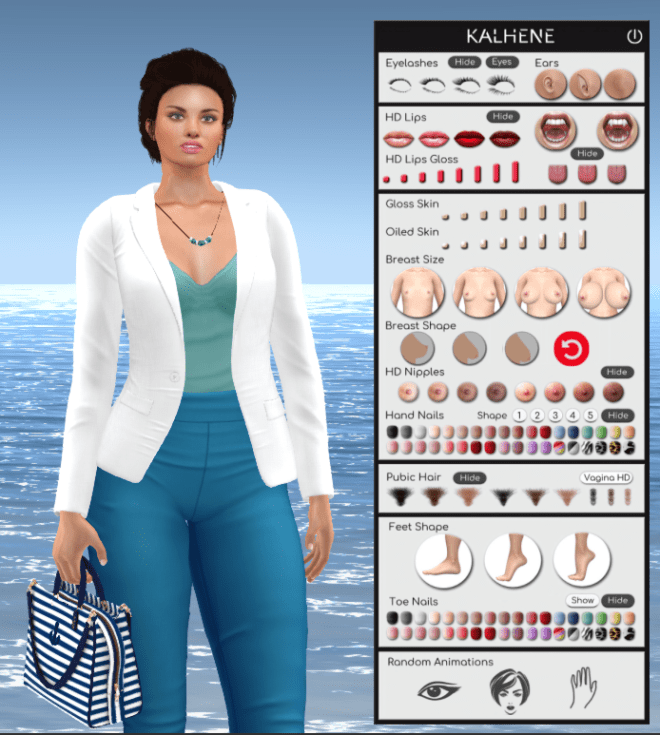
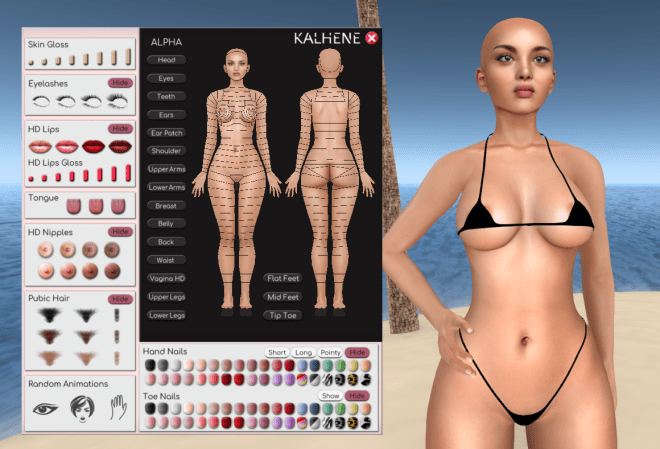
Here’s a look at the HUD that comes with version 3.0 of the Anya body. Note that unlike earlier versions, there are now three feet heights, controllable by the HUD (instead of separate mesh bodies): flat feet, mid-height feet, and high heel feet.

There’s a pretty complete set of alpha selections on the HUD, which compares quite favourably with those of the major mesh body brands, and of course you can also use the alphas that come with the clothing you buy. If you do need a set of alphas to use with clothing that does not come with them, you can pick up a free set from Little Black Dress at this SLURL (just click on the bag on the floor).

The separate clothing HUD allows you to change the colour and style of the included hairstyle (bangs/no bangs), as well as all of the included starter wardrobe items, including the metals and gemstones on the included set of rings, the ability to show or hide the rings on each finger, and the colour and style of two kinds of shoes, flat and high (including the flats shown here; other options include sandals and pumps). Black and white pantyhose and tights (in all three feet heights and four different transparency levels) are included in the package, too.

Here’s a look at a completely styled version of the Anya mesh avatar, showing you where on the body and clothing HUDs I made selections:

As you can see, you can create and style a complete avatar look using only the elements in the Anya package! However, I also wanted to show you how this body would look with a different head and skin (the Anya head and body are separate attachments, and of course you can mix and match them with other BoM-compatible heads and bodies as you wish).

This avatar is wearing:

  • Mesh Head: Strong Face gift Bento mesh head from The Genus Project (free group gift)
  • Mesh Body: Anya version 3.0 from Kalhene (L$1,695; Kalhene has a a small store located opposite the N-Core Design footwear store (here’s the SLURL)
  • Skin: Brielle by Amara Beauty (a former free group gift; group is free to join)
  • Hair: Beyoncé hair by enVOGUE (a L$1 gift from a previous year’s Hair Fair)
  • Gown: Azahara ballgown in red by Scandalize (which I picked up using the recent group gift of L$400 store credit; the Scandalize group costs L$100 to join, but if you hurry, you can join for free and pick up a second L$400 store credit offer! I believe today is the final day you can join the Scandalize group for free.)
  • Jewelry: I pulled this old set from my inventory; they came from a store that has long since left the grid!

TOTAL COST OF THIS AVATAR LOOK: L$1,696 (L$1,695 for the Kalhene Anya mesh body when I purchased it, and L$1 for the hair; the rest was free!)


UPDATE March 31st, 2021: I wanted to report that Kalhene has now released version 4.0 of the Anya mesh body! If you bought an earlier version of the Anya body, you can get a redelivery at their in-world store here; just click the large REDELIVERY sign on the wall as shown here:

Among the new features in this latest release are:

  • a new mesh head (version 2), with a stronger jawline, more arched eyebrows and some soft changes on the nose and lips;
  • three new different breast positions via deformer animations in the HUD (which works for all breast sizes: petite, regular, and implants), to give a more natural look to the breasts;
  • a neck fix for LeLutka mesh heads; and
  • new body oil materials (for the mesh body Bakes on Mesh only).

I have now been using the Anya mesh body with dozens and dozens of outfits that were designed for the Maitreya Lara body, without any issues, except for two minor ones:

  1. sometimes, on only a few very long-sleeved shirts, there is a problem with the wrist and hand area, where the hand pokes through the sleeve; and
  2. with a few pairs of jeans or pants, the waist of the pants is a bit wider than the waist of the body (see image, right), a problem which does not occur on the Maitrey Lara mesh body.

However, these problems are so uncommon (I have encountered them only 4 or 5 times in well over a year of testing!), that I can recommend the Anya 3.0 mesh body without hesitation if you want a Maitreya Lara-compatible mesh body at a bargain price!

Here is the version 4.0 the Anya body paired with the recent dollarbie group gift of the Catwa HFPRO Queen Bento mesh head, along with a look at the new HUD:

A look at the version 4.0 Anya body HUD (the alpha HUD is separate)

Note that the alpha sections HUD seen in the version 3.0 pictures earlier in this blogpost is still available; it’s in the box marked “BOXED -Kalhene- ANYA Mesh Body V4.0 (BoM + Alpha HUD)” in the version 4.0 package, which must be unpacked separately (the alpha sections HUD looks identical to the one pictured above). Please also note that you must use the bodies in that particular unpacked folder with the alpha sections HUD! For some strange reason, the alpha HUD didn’t work with the bodies from the main folder.

So, wait are you waiting for? Get shopping! 😉

An Updated Comparison Chart of Social VR Platforms

Have you joined the RyanSchultz.com Discord yet? You’re invited to be a part of the first ever cross-worlds discussion group, with over 300 people participating from every social VR platform and virtual world! More details here


IMPORTANT NOTE, PLEASE READ! This version of the comparison chart is very out-of-date!! You can find the updated version here.

UPDATE Feb. 6th, 2023: Thank you to Dr. Fran Babcock, who made some updates to this spreadsheet in 2021. I am currently working on a complete update to this spreadsheet for 2024. Thank you for your patience.

I haven’t published an update to my popular November 2018 comparison chart of twelve social VR platforms for quite some time. There never seems to be a perfect time to update. At first, I wanted to wait until the Oculus Quest was released. And then, I was wondering whether or not I should wait until Facebook releases the Oculus Link update to the Oculus Quest (which means, theoretically, that Oculus Quest users can use a custom cable connected to their VR-ready Windows computer to view content originally intended for the Oculus Rift).

In the end, I decided to go ahead and publish a first draft of the updated comparison chart now, get feedback from my readers, and update the chart as necessary. So here is that first draft.

I removed two of the 12 platforms in last year’s comparison chart: both Facebook Spaces and Oculus Rooms were shut down by Facebook on October 25th, 2019, in preparation for the launch of Facebook Horizon sometime in 2020. I have not added Facebook Horizon to this chart (yet) because we still know so little about this new social VR platform. And I decided to add six more social VR platforms to the chart: Anyland, Cryptovoxels, Engage, JanusVR, Mozilla Hubs, and NeosVR.

Rather than publish the chart as an image to Flickr, as I did last year, I decided to create a spreadsheet using Google Drive, and publish it to the web here:

Comparison Chart of 16 Social VR Platforms (Updated and Expanded Draft © Ryan Schultz, November 13th, 2019).

Please leave me a comment with any suggestions, corrections or edits, and I will update this new comparison chart accordingly. You can also reach me on the RyanSchultz.com Discord server, or any other virtual world Discord that I might belong to (my handle is always the same, RyanSchultz). You can also use the contact form on my blog.

UPDATE 3:48 p.m.: I’ve had a request to add userbase figures to this chart, but I am not going to do that for a very good reason: there’s absolutely no way I can get accurate figures from the various companies, many of whom want to keep that information private. And even ranking them using a scale like low, medium, and high would just be guesses on my part, misleading to a lot of people, and liable to lead to a lot of arguments. Sorry! I will leave it up to you to check Steam statistics for those platforms which are on Steam (which, again, may or may not be an accurate measure of the actual level of usage of any platform).

UPDATE Nov. 13th: I’d like to thank Frooxius (of NeosVR), Artur Sychov (of Somnium Space) and Jin for their corrections and suggestions. Any updates to this table are shown in real-time, which is a unexpected bonus to publishing a spreadsheet directly to the web from Google Drive! I should have thought of doing it this way last year.

And it would appear that there is a great deal of disagreement of what constitutes “in-world building tools”. I am referring to the ability to create complex objects entirely within the platform itself, and not using external tools such as Blender or Unity and then importing the externally-created objects into the platform. For example, High Fidelity has very rudimentary “prim-building” tools in-world, which are not often used by creators, who prefer to import mesh objects created in tools like Blender, Maya, or 3ds Max instead. To give another example, Somnium Space now offers a completely in-world tool for constructing buildings on your purchased virtual land. Sansar has no such tools for in-world building, although you can assemble premade, externally-created objects into a world by using their Scene Editor (which is something completely different from what I am talking about here).

One reader had suggested adding in a few more columns to this chart to include various technical aspects of these social VR platforms: game engine used, open/closed source, support for scripting, etc. Using the table provided to me by Enrico Speranza (a.k.a. Vytek), I have now added three more columns to the original comparison table: architecture/game engine, open/closed source, and scripting. Thank you for the suggestion, Vytek!

Please keep your suggestions, corrections and edits coming, thanks!