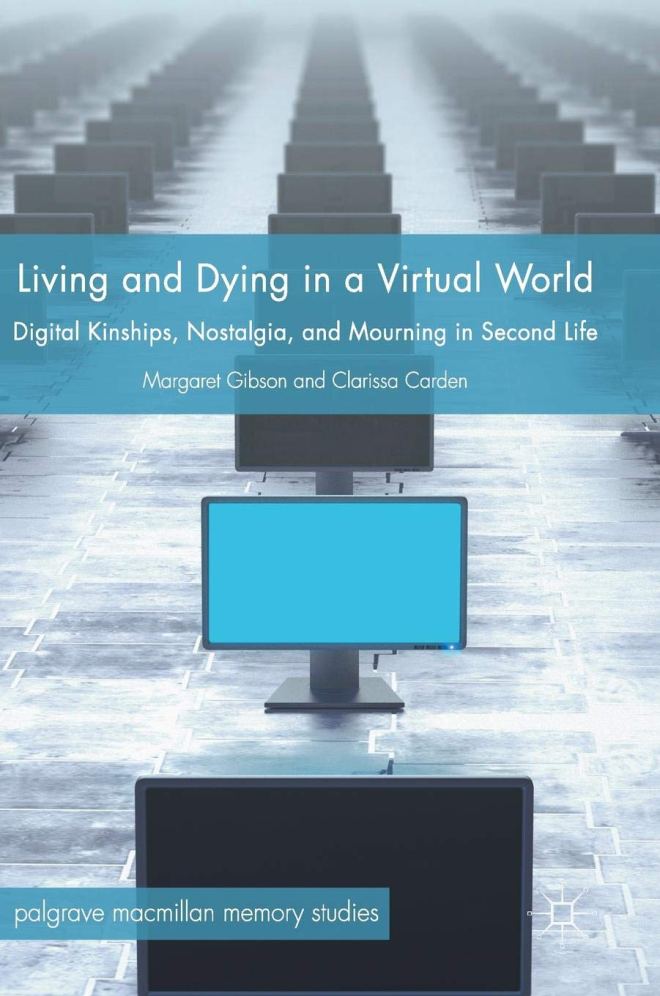
New Book on Second Life: Living and Dying in a Virtual World

Living and Dying in a Virtual World.jpg

Last October, Dr. Margaret Gibson of Griffith University posted to the official Second Life forums:

Hi everyone, my name is Dr Margaret Gibson and I am writing a book with Clarissa Carden titled Living and Dying in a Virtual World: Digital Kinships, Commemoration and Nostalgia, to be published by Palgrave Macmillan. See link:  https://sociologicalexplorations.com/second-life-living-and-dying-in-a-virtual-world/  We are writing a chapter on sentimental objects in SL and we would love to hear any of your stories. These could be things in your inventory that matter to you because someone died or they remind you of an important part of your SL or RL.   If you are interested in participating in the book more fully and being interviewed via chat in SL we would love to hear from you. As you can see from book title we are interested in death, grief, family relationships in SL, nostalgia…

Any responses will be anonymous and if you do not wish for your response on this forum to be included in the book please say so. Thanks!

Well, the results of that research have now been published by Palgrave MacMillan. Titled Living and Dying in a Virtual World: Digital Kinships, Nostalgia, and Mourning in Second Life, the book is described as follows:

This book takes readers into stories of love, loss, grief and mourning and reveals the emotional attachments and digital kinships of the virtual 3D social world of Second Life. At fourteen years old, Second Life can no longer be perceived as the young, cutting-edge environment it once was, and yet it endures as a place of belonging, fun, role-play and social experimentation.  In this volume, the authors argue that far from facing an impending death, Second Life has undergone a transition to maturity and holds a new type of significance. As people increasingly explore and co-create a sense of self and ways of belonging through avatars and computer screens, the question of where and how people live and die becomes increasingly more important to understand. This book shows how a virtual world can change lives and create forms of memory, nostalgia and mourning for both real and avatar based lives.

The book is rather expensive (Amazon.ca lists it at CDN$93.54), so see if you can get it through your library (I was able to access the electronic version via my university library’s SpringerLink ebook service). Thank God for libraries!

I am looking forward to reading this, and I may write a book review afterwards. Here’s a brief excerpt from the introduction:

Now that it is 14 years old, SL attracts less news attention. Where a reporter is assigned to cover a story relating to SL, their copy carries a faint air of astonishment, as though the author believes that this world ought, surely, to have disappeared by now. The fact that it persists goes against the grain of consumer media logic of upgrading, replacing, and letting go of the old for the new. It also speaks to an implicit recognition that the demographics of SL are not “young people” even though the image culture of avatars valorises the appearance of youth.

Despite this disconnection with media logics, SL has in no sense disappeared. Instead, it has been transformed. We argue in this book that SL is now a mature virtual world. It is a world in which residents have lived and lost. It is a world which has seen significant social changes. This is a typeof virtual world that has never existed—and which could not exist—at any previous moment in history. This is a book about the maturity that has come with age. Inevitably, as an extension of that, it addresses the memory, loss, and grief that have marked the lives of SL residents. It is also a book about the care and compassion residents show towards one another and about the strength of the attachments that are formed online.

Also, an older blogpost on a topic related to this: Why I want to leave my Second Life avatars to other people when I die.
Linden Lab Issues the Shop, Gift and Spend Release of Sansar

The latest update to the Sansar client software, dubbed the Shop, Gift and Spend Release, came out on Sept. 10th. Among the new features is the ability to pay another avatar in-world, a long-awaited feature that will encourage music performers and other types of jobs in Sansar.

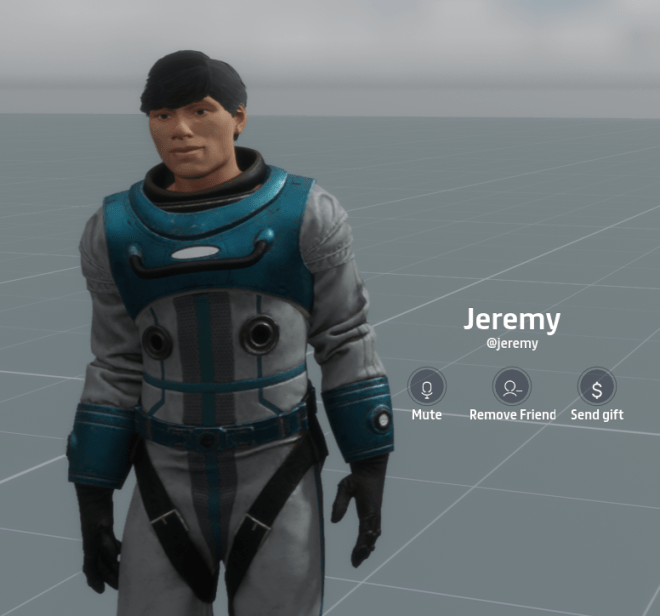
Click avatar to send.png

With today’s update, we are now adding the ability for you to gift Sansar Dollars to another user. You will find the option to to this in the same menu where you can add someone as a friend, or mute someone. It is also available on a user’s profile through the People tool, which can be opened from Chat.

Sansar Dollar Gifting will start a default value of 100 and can be increased or decreased in increments of 10 and 1. There will also be a transaction fee of 15% for any amount of Sansar Dollars gifted (to a minimum of S$1). This is in preparation of (eventually) being able to gift objects, to prevent users from circumventing the Store.

For more information, please see the Gifting Sansar Dollars document.

In addition, you can now browse the Sansar Store from within the client. However, you will still be taken to the Sansar Store website to actually make a purchase.

Also, users in VR headsets will no longer have to take them off to style their avatar in Lookbook!

VR users will no longer have to edit their Avatar in desktop mode. You can now edit your Avatar in VR and you can enjoy adjusting Marvelous Designer clothes by simply reaching out and grabbing them.

And (in an answer to builders’ prayers), Linden Lab has finally added a Folders feature to Edit Mode. You can find this option in the Scene Objects windows. I’m sure I’m not the only builder whose inventory was getting rather unwieldy!

You can see the full list of new features and bug fixes here.

Unfortunately, as Inara Pey reported on last Friday’s Product Meetup, the eagerly-awaited permissions and licensing system in Sansar was not part of this release. due to some last-minute problems that still need to be addressed. Maybe next release.

Five Thoughts as Google Turns 20

google_1998-316x95
The original Google logo from 1998

Google was incorporated on Sept. 4th, 1998 in the garage of Susan Wojcicki (who is now the CEO of Google subsidiary YouTube), with an initial US$100,000 investment by Sun Microsystems co-founder Andy Bechtolsheim.

It’s hard to believe that this happened only twenty years ago. In those 20 years, Google (now known as Alphabet) has transformed society. The way we look for information. The way we ask for directions. The way we consume the news.

What lessons can we learn from the astonishing growth of Google?

First, those things which might seem unimportant at the time can have great impact. Larry Page’s PageRank algorithm, which relied on the links between web pages to determine the ranking of search results, was a simple idea that became very, very powerful. In fact, it spawned the whole industry of Search Engine Optimization (SEO), which is basically figuring out ways to improve your Google search ranking!

Second, never underestimate the power of networks. As the World Wide Web grew (and I remember a time when it was still called that!), the Google search engine only became more accurate and useful over time. The power of networks acts as an amplifier (you need no further proof of that than Donald Trump’s Twitter account).

Third, that being an early entry into a marketplace positions you for growth (call it “the Microsoft effect”). It’s not always true, but often enough, being first is better than being best when it comes to the Internet. As some entrepreneurs like to say: “ready, fire, aim”—it’s better to launch something early, then make constant adjustments to your course as you go along and learn from your mistakes. The fatal mistake is to wait until everything is perfect before taking action. Larry Page and Sergey Brin didn’t wait.

Fourth, that a lot can happen in a short period of time. We tend to underestimate just how quickly things can change in today’s society. The pace of technology is accelerating. Think ahead to 20 years from today—Sept. 8th, 2038. It might seem far away. But every day, it comes a step closer. Who will you be in that world, on that day? If I am still alive, I will be 74 years old and retired, perhaps feeling insecure and afraid in my old age as civilization charges ahead without me. What will I have seen in those twenty years? What will I regret doing? What will I regret not doing? What should I have been paying attention to, while I was busy doing something else? What will I have learned?

Finally, remember that the actions of individual people do make a difference in this world. Sergey Brin and Larry Page had an idea, and that idea changed the world. Philip Rosedale had a dream, and his dream became a daily reality for millions of people on dozens of metaverse platforms. Never doubt for one second that you are not capable of that same miraculous feat, in countless different ways, every single day.

googlelogo_color_272x92dp
The Google logo today

High Fidelity Sets a New Avatar Capacity Record: 356 Avatars in a Single Domain!

High Fidelity logo

I have to say this: I am really quite impressed with the level of innovation recently coming out of Philip Rosedale’s metaverse company High Fidelity. (It might be the result of all that new venture capital money they are spending!) Yesterday they had their third in a series of monthly stress tests of the virtual world platform, and they officially beat their old record by quite a margin: 356 avatars in a single HiFi domain!

They started off with a half-hour trivia game, where you had to stand on one of four coloured squares (A, B< C, or D) corresponding to what you thought was the correct answer to a posted trivia question. Each wrong answer teleported the losers automatically off the playing field (to watch from a raised platform on the sidelines) until there was only one winner left standing! There were a few glitches to the system, but overall it worked fairly well, and it was a fun way to start off the event!

The following picture of me standing in front of the main stage at The Spot with the official avatar counter in the background was taken by Andrew, who is the very hard-working producer and video editor of my upcoming pre-taped show, Metaverse Newscast. (High Fidelity hired him to be the official photographer at yesterday’s event!)

HiFI Stress Test 7 Sept 2018.jpg

We already have two taped segments of the first episode of Metaverse Newscast, and we hope to add a third segment and release the program to viewers sometime this fall. We’ll be interviewing the personalities behind social VR, virtual worlds, and the metaverse on various platforms, including High Fidelity in the future!