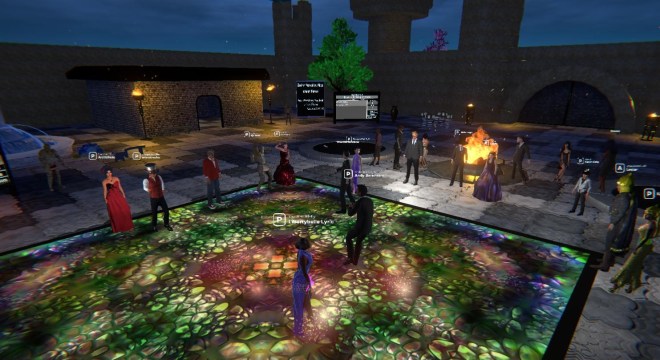
Heads up on a Sinespace event taking place this evening, Sunday April 18th, 2021 in the virtual world of Sinespace: a Formal Royal Music Event starting at 8:00 p.m. EST/7:00 p.m. CST/5:00 p.m. PST.
Second Life (which I still consider to be the perfect model of the mature, fully-evolved virtual world that the companies creating the newer social VR platforms would be wise to study) has two levels of membership: Basic (free), and Premium. How Premium membership in Second Life works: for US$99 a year (or $32.97 quarterly, or $11.99 monthly), you get a set of benefits and perks over free, Basic user accounts:
VRChat is another platform that decided to offer a comparably-priced paid premium membership level last December, called VRChat Plus (which I first wrote about here). Now, upon first reading of the perks such a membership would offer me (see below), I was less than impressed (probably because I have been spoiled by all the goodies Second Life Premium memberships offer me in comparison).
Among the (relatively) small number of features for VRChat Plus users is the ability to set a user icon to display in a circle next to your user name:
But in conversation with Voices of VR podcaster Kent Bye last night via Zoom, he raised a point that I had hitherto failed to consider, Given my well-documented, one-man, scorched-earth campaign against Facebook and Oculus for, among other things, forcing Oculus headset users to get Facebook accounts and their toxic advertising-based business model which scrapes and strip-mines users’ personal data, why would I not support an alternative way for VRChat to earn a profit?
I stopped to think of what VRChat would be like with Facebook-like advertising, and I positively shuddered in revulsion. So this evening, I pulled out my credit card and ponied up for a VRChat Plus membership (US$99.99), so I now have the familiar “red Ryan” logo displayed next to my username in world (which has sort of become an icon for my brand, as I use it everywhere else, too). If it helps other users in VRChat recognize who I am, then I think it’s worthwhile.
My familiar “red Ryan” user icon
So, I have decided to do a quick survey of the major social VR and virtual world platforms, and find out whether or not they offer a paid premium service, and if so, what you get for your money.
Second Life
My alt Moesha Heartsong, sitting on the porch of her lovely Victorian Linden Home on the continent of Bellisseria (one of the many nice perks you get with your Second Life Premium membership)
Second Life Premium membership (currently priced at US$99 a year) offers you the following benefits:
A weekly L$300 stipend (basically enough to buy a nice outfit or pair of shoes for your avatar every week)
A L$1,000 sign-up bonus for first-time Premium users (can only be used once)
Priority entry when regions/sims are full of avatars (in other words, if a Basic user and a Premium user both try to get into a packed sim at the same time, the Premium user gets priority; this comes in handy at crowded shopping events, and I have made use of this perk often!)
A 1024m² virtual land allotment for use towards a nice starter Linden Home or a parcel on the Second Life mainland; this is another benefit I do take advantage of!
Expanded live-chat customer support (which I have used on occasion!)
Premium virtual gifts (frankly, kinda useless to me)
Exclusive access to Premium areas and experiences (such as building sandboxes)
Increased cap on missed IMs (which I never use)
Increased group membership limits (I make use of my groups ALL THE TIME! A freebie fashionista can NEVER have too many free group slots for store groups, freebie groups, etc. Basic accounts have 42 group slots, but Premium has 70;)
Voice morphing (never used it, myself; most SL users never use voice, anyways)
UPDATE 11:36 p.m.: Animesh (animated mesh) creator Medhue tells me that SL Premium members can attach two animesh items (e.g. pets such as Medhue’s delightful animesh cihuahua), while Basic members can only attach one.
Basically, I have three Premium accounts, with two lovely Linden Homes between them (which I think is the major benefit of a Premium membership). More group space and priority access to overcrowded sims are also perks I tend to use a lot.
A 45-day free trial of the Marvelous Designer software (used to create avatar clothing in Sansar)
Purchase discounts on Marvelous Designer for when you do decide to buy it
An increase in the number of Sansar worlds you can create (frankly, I’m not sure most people bother beyond the free Basic account, which lets you create up to 25 worlds)
Premium users can create larger regions/worlds, have a larger number of regions active at one time, and get priority support and user-created content processing and approval, among other benefits.
AltspaceVR
Surprisingly, Microsoft-owned AltspaceVR doesn’t seem to offer any premium accounts (that may change in the future, though).
VRChat
VRChat Plus offers you the following perks (with more promised soon):
A nameplate icon: With VRChat+, you can personalize your nameplate with an icon you create! Snap a pic in VRChat or upload your own image on our website.
You can send a picture with an invitation to a friend to join you at your location
Free slots for up to 100 favourite avatars (as opposed to 25 for basic users)
“A limited edition VRCat Badge to display on your profile” (Really? Really?!??)
As I said up top, this list is a bit sparse, especially compared to what Second Life offers (and yes, you can be an anime girl in SL, just as easily as you can in VRChat!), but of course, there’s zero VR support in Second Life.
Rec Room
Rec Room offers something called Rec Room Plus at US$7.99 a month, which includes the following benefits:
You get 6000 tokens (r6000) monthly, delivered in installments of r1500 per week
One four-star gift box per week
A 10% discount in Rec Room stores that accept tokens
Exclusive access to the RR+ section of the item store
100 saved outfit slots
The ability to sell premium inventions/keys for tokens
NeosVR
NeosVR uses Patreon levels to hand out perks to various levels of paying users (more info). For example, at my current “Blade Runner” level ($6 per month), I get:
Access to private channels on the official Discord Server
Patreon supporter badge in Neos
Early access to Linux builds
Early Access to Patreon only content (exclusive experiences, work in progress experiences before they’re public)
A Neos Mini account with 25 GB of storage
Your name in the stars! (your name will appear in the sky in the Neos hub)
The ENGAGE educational/corporate/conference social VR platform offers a free, “lite” version, and a premium, “plus” version for €4.99 a month, which gives you space to save your presentations, among other benefits. (They also offer enterprise and educational rates on request.)
Blockchain-Based Virtual Worlds (Cryptovoxels, Decentraland, and Somnium Space)
Of course, the various blockchain-based virtual worlds sell everything using whatever cryptocurrencies they support (for example, a custom, non-randomly-generated avatar username in Decentraland will set you back 100 MANA, Decentraland’s in-world cryptocurrency (which is about US$36 at current exchange rates). It’s just a completely different model than the “freemium” ones offered above.
Thanks to Kent Bye for giving me the idea for this blogpost!
Do you have a question about the ever-evolving metaverse of social VR platforms and virtual worlds? Ask Ryan!
Maribeth asks:
Hi Ryan! My name is Maribeth. I am trying to use virtual worlds to help diabetes patients and others with chronic disease/chronic stress. My colleague and I are thinking about jumping ship from Second Life and it’s really confusing to know which way to turn. Your blog is so amazing! I’d love to pick your brain. I really respect your deep and vast knowledge on the topic. If you’re at all open to chatting, please let me know. Thanks!
—Maribeth.
Ooh boy, did you ever come to the right place to ask this great question! 😉
But, instead of charging you $25.00, Maribeth, I’ll let you pick my brains for free this time, provided we do it publicly on the RyanSchultz.com blog…after all, I am the Freebie Queen of Second Life, plus quite a few other platforms, to boot! 😉
And, in this case, I have an easy answer for you. If you are getting tired of Second Life and are looking for something similar to replace it with, but with all the latest bells and whistles (like a webcam-based avatar facial animator), may I recommend Sinespace?
Sinespace is based on Unity, which is a cross-platform game engine used to develop both three-dimensional and two-dimensional video games and simulations. This is a different approach from Linden Lab’s Second Life, which built and maintains its own engine from scratch (which means, at the ripe old age of 17, it is getting a bit long in the teeth). This also allows Sinespace to take advantage of the work that is done by countless other Unity developers on other Unity-based apps and games, such as the extremely cool Archimatix tool, which allows you to automagically resize highly complex mesh items in-world (which puts the rather simple move, rotate and stretch in-world building tools in Second Life to shame!).
Even better, male and female avatar fashions are designed to fit EVERY male and female avatar body, respectively. You don’t have to check to see if apparel or footwear are designed for a specific brand of mesh body, like you have to do in Second Life (e.g. Maitreya Lara, Belleza Freya, Slink Physique, Belleza Jake, Signature GIanni, etc.). Also, you don’t have to fuss with a HUD to make parts of your avatar body invisible under apparel; the clothing fits perfectly, and it adjusts if you make any changes to the body sliders! Another advantage of basing Sinespace on Unity.
Oh, and did I mention that Sinespace has workingin-world cloth physics on skirts and dresses? Check out the videos to see it in action here and here! And Sinespace supports both desktop users, and users in virtual reality headsets! There’s also a web browser-based client. You can even run Sinespace on your mobile device!
Oh, and also, while Second Life struggles with lag when over 50 avatars are in a single sim, Sinespace has already demonstrated that its worlds can handle up to ten times as many avatars (the latest record achieved in testing, Adam tells me, is 499 avatars in a single region). And those regions can be mind-bogglingly large, too, not just restricted to 512 square metres. In fact, Adam tells me that the largest Sinespace region to date is a staggering 8 km by 8 km in size, with an 8 km vertical space! Think of what you could do with all that virtual real estate!
Unfortunately, the pandemic has also delayed Sine Wave Entertainment’s plans for an splashy official launch of Sinespace, complete with a advertising blitz, until 2021. Trust me when I say this: Sinespace is going to attract a lot more attention from SL folks (and other quarters) next year. And if Second Life should ever stumble in future, Sinespace is perfectly positioned to welcome the refugees. In fact, many SL content creators have already set up shop in Sinespace, such as Abramelin Wolfe of Abranimations.
However, if you are loath to work your way up a new learning curve, may I suggest you investigate the incredible myriad of OpenSim-based virtual worlds? (Ironically, Adam Frisby of Sine Wave Entertainment was one of the founding developers for OpenSim, before he started his new company and focused on Sinespace and Breakroom.) Much of what you already know about Second Life can be directly transferable to OpenSim, and the prices for things such as land rentals are often significantlycheaper.
Another advantage of Hypergrid-enabled OpenSim worlds is that you can even take your avatar from one grid to another! However, one disadvantage of OpenSim is that platforms tend to rise and fall with alarming regularity, so stability is an issue (witness the sad saga of InWorldz/Islandz for an example of what can happen). Also, the network effect means that no single OpenSim grid will ever rival Second Life for its sheer reach and (relatively) massive audience.
So, the executive summary of my answer is: if you don’t want to work your way up a new learning curve, go with OpenSim; otherwise, go with Sinespace.
It’s been a little over a year since I first wrote about Arthur, one of the social VR products that I like to lump togather under the acronym YARTVRA, which stands for Yet Another Remote Teamwork Virtual Reality Application (and which I am still trying, and still failing rather spectacularly, to popularize). *sigh* Work with me, people!
The new rallying cry of the remote online workplace: YARTVRA!
The press briefing was one of a few ever to occur in VR*, a spokesperson for this new app claimed. It’s called Arthur, and part of the pitch is that it’s going to catapult VR for work into the mainstream, that meetings and collaboration sessions and deskside briefings will become… headset briefings.
The app launched on December 8, but it’s been in development for four years. The company behind it, also named Arthur, is headquartered in San Mateo, California, with employees scattered around the globe. It has secured seed funding from VC firm Draper Associates, and it lists the United Nations, Societé General, and a large automaker as its beta testers.
Taking a meeting in Arthur requires a literal suspension of reality. You exist only from the waist up (hey, just like Zoom!), and your shirtsleeves taper off to reveal blue computer arms, which move according to how you move the Oculus Quest controllers in your hands. Your digital eyes are obscured by Matrix-style glasses, and a headset microphone covers your virtual mouth. This is because the technology can’t yet mimic facial expressions in VR, and “it’s better than looking at dead eyes,” says Arthur founder Christoph Fleischmann. My avatar looked nothing like me except that it had dark brown hair.
Lauren was kind enough to share a picture of what her avatar in Arthur looks like:
Reporter Lauren Goode’s avatar in Arthur (image source: WIRED)
Holy Toledo! I’m sorry, but if you expect me and my coworkers to shell out for VR headsets in order to feel more immersive at our virtual business meetings, you’re going to have to do better than this. These are among the butt-ugliest avatars I have seen in any social VR platform or virtual world—and trust me, I have seen them all in the three years I have been writing this blog. (As a matter of fact, there are a few I wish I could unsee. Is there such a thing as YARTVRA PTSD?)
Frankly, Arthur’s avatars leave a lot to be desired. To avoid having to rig eye movements, the avatars all wear black sunglasses like Corey Hart (“I wear my sunglasses at night…”). To avoid having to rig the mouth, they all wear wraparound black microphones that cover the avatars’ mouths so closely, they look as if they are being gagged! And the avatars’ arms fade out to controllers instead of hands. The avatars look extremely off-putting, and it’s a definite strike against Arthur.
Now, to be fair, there have been a few developments since then. Arthur now supports the Oculus Quest 2 wireless headset according to the article (although a keyword search for “Arthur” pulls nothing up in the Oculus Store). The WIRED article says that Arthur launched on December 8th, 2020, but the Arthur website only talks about joining a waiting list for the product.
There’s the usual YARTVRA jabber on the Arthur website about enhanced productivity:
Virtual Real(i)ty
Arthur is a virtual office space that enables you and your team to meet, collaborate and manage your work. It empowers you to maximize your level of remote productivity and free yourself from geographic and physical constraints…
Arthur is intuitive to use and its functionalities aim at maximizing productivity for you and your team. Thanks to automated onboarding guides, it takes only very little time to be productive with Arthur – by which time you can enjoy a vast array of features, including:
• Presentations • Whiteboards • File Management • 3D Objects
I particularly rolled my eyes at what appears to be an animated GIF in the bottom right hand corner of this image (although I cannot copy and paste it here to show you on the blog; you’ll have to go over to the Arthur website to view it). Resizing and rotating what look like 2003-era Second Life prims in social VR!!?! Oh yeah, businesses are really going to use that feature to get that vital point across to a potential sales client, aren’t they?
Sorry, it’s 4:00 a.m., I have insomnia, and I am feeling particularly cranky (Ryan, sweetheart, step away from the keyboard…).
But this looks absolutely dreadful, especially compared with much more fully-featured platforms, with far better-looking avatars. Avatars with eyes. Avatars with actual hands. Avatars whose mouths move. Platforms which actually already have working solutions, instead of their founder saying inane things like “the technology can’t yet mimic facial expressions in VR, and it’s better than looking at dead eyes“.
Give me some so-called “dead eyes” instead of these Men in Black sunglasses! Frankly, I’d rather have myself seen in Zoom, Cisco Webex, or Microsoft Teams with a severe case of “COVID-19 hair” and a ketchup stain on my shirt, than represent myself with these creepy-looking, budget-basement, cookie-cutter avatars.
Arthur is already on my listing of social VR/virtual worlds, which I am still in the process of reorganizing and categorizing (it’s taking me a lot longer than I expected).